Home
Hintergrund
Aktuelles / Artikel
Online Events
Petitionen
Download/Materialien
Radio Beiträge
Radio
Termine
Demonstration
3 + 12
Bündnisse weltweit
Bücher,Filme +
Musik von/
über Mumia
Hörbuch
Kontakt
Links
Archiv
•Bündnis
•Mumiaartikel Deutsch
•Mumiaartikel Englisch
•Stopp Todesstrafe
•Anti-Repressions-
Nachrichten
Impressum
Datenschutzerklärung

ARCHIV
Mumia Artikel Englisch
2020
- (Counter Punch) Mumia Gets a New Chance to Challenge His Murder Conviction (Dec 25, 2020)
- (YT Mitschnitt einer Veranstaltung in den USA) Freedom & Abolition: A Critical Moment in the Fight to Free Mumia Abu-Jama
- (truthout) You Cannot Decarcerate by Using the Tools of Incarceration, Says Mumia Abu-Jamal (October 25, 2020)
- Mumia Abu-Jamal - From One Struggle to Another: Lessons From the First Abolition Movement
- (Philadelphia campaign) Mumia Abu-Jamal Way
- "Murder Incorporated"
- (The Pledge) The movement against police violence in the United States resonates with the release of Mumia
- (Democracy Now) Philadelphia DA Larry Krasner on Mumia Abu-Jamal, Police Corruption & Reexamining Old Cases
- Rise up and resist - Celebrate Mumia's 66th birthday
2019
- (Prison Radio) Freedom is Now in Sight (September 17, 2019)
- PRESS RELEASE - New Evidence of Innocence Spurs 2 Court Filings for Mumia
- (PennLive) Protestors come to central Pa. to demand medical care for inmate convicted of killing police officer (Jul 24, 2019)
- Brief Medical Update on Mumia Abu Jamal
- Richter Tucker kritisiert Bezirksstaatsanwalt für Berufung gegen Mumia
- Labor Action Committee to free Mumia Abu-Jamal
- Under Pressure, Yale Reblaw Conf Rescinds Keynote Ofer To Philly D.A. Larry Krasner
- DO YOUR PART TO FREE MUMIA
- On-line petition to Pressure Krasner not to appeal re Mumia Abu-Jamal
- JAN4 Twitter Storm for Mumia: #KrasnerDoRightByMumia
- Philadelphia: You can lock up prisoners but you can't silence them
2018
- Open Letter to Mumia by Zaklin Nastic (German MP and Human Rights Committee)
- (The Guardian) ‘Intoxicating freedom, gripping fear'
- Report from Mumia's Day in Court by Dave Lindorff
- Mumia's Day in Court!
- Mumias heutiger Gerichtstag: Mumia Abu-Jamal's appeals hearing continued until August
- New articles on Mumia Abu-Jamal
- Mumia Update - Here's What Happened in Court
2017
- Press Release - Dec 8, 2017 - Philadelphia (Presseerklärung)
- Freedom for Mumia - Freedom for All!
- Free Mumia Now! Stop the DA Office's Cover-up!
- Urgent Press Release on Mumia Abu-Jamal (inkl. deutscher Übersetzung)
2016
- (Democracy Now) Philadelphia Activists Demand Life-Saving Drugs for Mumia Abu-Jamal (December 12, 2016)
- (Mexico City) Fotos: ¡Afuera de la embajada, por la libertad y salud de Mumia
- (Courthouse News Service) Abu-Jamal Says Bad Medical Care May Kill Him (October 11, 2016)
- Chris Hedges: Mumia Abu-Jamal's Fourth of July
- Protest walk-in at Philadelphia's City Council
- Radio-Podcast - Law and Disorder: Mumia Abu-Jamal Health Lawsuit Update by Lawyer Bob Boyle
2015
- (Video) December 18th: Demand Medical Treatment for Mumia Abu-Jamal and 10,000 Prisoners with Hepatitis C
- Press Release - Mumia Abu-Jamal: Years of Wrongful Incarceration & Current Health Crisis
- (Workers World) Mumia supporters highlight HVC epidemic (November 19, 2015)
- (The Black Agenda Report) The People Demand Treatment for Mumia and 10,000 PA Inmates Suffering from Hepatitis C (November 17, 2015)
- (WBAI - Radio, New York City) Building Bridges: Mumia Must Live (October 28, 2015)
- (Workers World) Pam and Ramona Africa tour Bay Area for Mumia (October 22, 2015)
- (Workers World) Health care providers call for hep C treatment for Mumia Abu-Jamal and other PA prisoners (October 7, 2015)
- Offener Brief an Tom Wolf: Health care providers call for hep C treatment for Mumia Abu-Jamal and other PA prisoners
- (Buchbesprechung) Mumia Abu-Jamal's Eighth Book: Writing On The Wall
- Stellungnahme der Autor*innen Gewerkschaft der USA - Resolution to Save the Life of Mumia Abu Jamal from "Medical Neglect"
- Lehrerin Marylin Zuniga aus New Jersey endgültig gekündigt
- Free Mumia - Free Them All! - english version
2014
2013
- Mexico Report on April 24 Activity
- Rebel Diaz: Free Mumia - Free Them All!
- Life in Prison Is Not an Option
2012
- The Unsilenced Voice of a "Long-Distance Revolutionary"
- New Documentary Tells Untold Story of Mumia Abu-Jamal's Life Journey
- Interview über den Film "Long Distance Revolutionary - A Journey with Mumia Abu-Jamal"
- FREE MUMIA - Now! OCCUPY FOR JUSTICE: OCCUPY THE JUSTICE DEPARTMENT -- April 24, 11AM
- Mumia Abu-Jamal death sentence dropped
2011
- Update on Mumia: Call Philly DA: Demand Mumia Be Released to Gen. Population!
- Report from Wien
- Press Release: Response To Da Seth Williams' Decicion On The Mumia Abu-Jamal Case
- Free Mumia Abu-Jamal Now: 30 Unconstitutional Years on Death Row are Enough! (October 23, 2011)
2010
- Video Link with Judith Ritter (frz/engl)
- Mumia Abu-Jamal's 1982 Death Sentence is Again Declared Unconstitutional
- An evening with Mumia's new legal team
- Video: Call the Justice Department for Mumia
- Nov 9 legal procedures + the meaning for Mumia
- The Death Penalty, Mumia Abu-Jamal and the European Parliament
- Demonstration: From Mexico City: We're with Mumia all the way!
- (Video) Test Shows Missing Evidence and Falsified Testimony from Key Witnesses in Abu-Jamal Trial
- Report Blows Holes in Mumia Abu-Jamal's conviction
- Media Justice On Trial In Philadelphia - The duel of two films about Mumia Abu-Jamal
- Mumia Is In Great Danger - Interview with Robert R. Bryan
- Gucci Mane Release Celebrated, Mumia Abu Jamal Still Forgotten (13.05.2010)
- Video of Cornel West and Mumia (March 3, 2010)
- Mumia Honored on His 56th Birthday on Pacifica Radio
- US TV: "Mumia Abu Jamal placed on death row 28 years ago"
- FBI File on Mumia
- New York 24.04.2010: Writers for Mumia - Readings and Testimonials
- Call the Department of Justice every Thursday
- Call the Department of Justice on Thursday, February 25
- The 'Mumia Exception' - Explaining Injustice (by Linn Washington Jr.)
- Mumia Abu-Jamal Case is Stuck in Hellish Limbo
- Harlem Supporters Protest Supreme Court Ruling On Mumia!
- Supreme Court opens door to Mumia's execution
2009
- Rally for the freedom of Mumia Abu-Jamal outside the most hated embassy in México
- Free Mumia: events on Dec 9 in Philadelphia
- Press Release: Delivery of Mumia Petition to US Department of Justice
- SF Bay Area Expressing Solidarity With Mumia Abu-Jamal
- Counterpunch: Glen Beck's Mumia Obsession / Fox Finds a New Black Boogeyman
- Mumia Abu-Jamal faces new execution threat
- Get Ready for the Emergency Protests!
- The Fantasies of Joe McGill
- From the National Writers Union, United Auto Workers Local
- J. Patrick O'Connor: Civil Rights Investigation for Mumia Abu-Jamal
- campaign resources
- Citing Withheld Evidence, Supporters Of Mumia Abu-Jamal Call For Civil Rights Investigation
- Philadelphia Tribune Columnist Linn Washington Jr. speaks about Mumia Abu-Jamal (Videos)
- Mumia and the D.A. candidates
- Happy Birthday to Mumia Abu-Jamal: We are all prisoners
- Angela Y. Davis Speaks in Support of Mumia Abu-Jamal
- Interview with Angela Davis by JR Valrey on Mumia Abu-Jamal
- Amy Goodman / Democracy Now - Interview mit Mumia Abu-Jamal
- New Book: Kiilu Nyasha - Mumia's Jailhouse Lawyers
- NAACP Legal Defense Fund Files Brief in Supreme Court in Mumia Abu-Jamal Case
2008
- Fight for Mumia Abu-Jamal at Brandenburg Gate
- Philadelphia Officials Again Seek Mumia's Execution
- Video from Philly
- Geo.Clan Interview with Hand Bettet (Video)
- Robert R. Bryan at the Humboldt Uni 3th nov. 2008 (film)
- Interview with Robert R. Bryan (film)
- DA wants to Execute Mumia Abu-Jamal
- FREE MUMIA: global week of action, December 6th until 13th, 2008
- Letter from Mumia's lead atourney on Supreme Court
- Mumia Abu-Jamal Faces US Supreme Court as New Book and Film Expose Injustice
- New review of "the Framing Of Mumia Abu-Jamal"
- The Suppression of Dissent in America, by Linn Washington
- An interview with Livia Giuggioli Firth, co-producer of "In Prison My Whole Life"
- RIGHTS-US: Death Row Activist Prepares New Appeal
- International Day of Solidarity With Mumia
- The criminal "justice" system and the case of Mumia Abu-Jamal
- Abu-Jamal loses latest appeal for new trial (from Philaldephia Inquirer)
- Paris: News from the worldwide Movement to free Mumia Abu-Jamal
- Write to Mumia Abu-Jamal
- Free Mumia rally in Philadelphia on July 4, 2008
- Book Asserts Black Reporter Didn't Kill White Officer in '81 (NY Times)
- The Framing of Mumia Abu-Jamal: An interview with author J. Patrick O'Connor By Hans Bennett
- The New York City Coalition to free Mumia Abu-Jamal
- Mumia press conference at the Federal Courthouse in Philadelphia
- Mumia Exception's' ugly head again by Dave Lindorff
- Abu-Jamal supporters protest ruling, Philadelphia Inquirer, April 1, 2008
- Robert R.Bryan on Democrcy Now Radio - Transkription
- Observations and analysis of Linn Washington
- Justice Denied: A Political Decision that Cannot Be Allowed to Stand by Michael Schiffmann
- Amnesty's statement
- Mumia Film "In Prison My Whole Life"
- 21 frequently asked questions about the Polakoff photos
- Mumia Abu-Jamal - NBC\'s "Today Show"; pending decision - from from Robert R. Bryan
2007
- U.S. executions at a 13-year low (L.A. Times, Dec, 19, 2007)
- TAKE ACTION! Big Media Must Not Ignore New Mumia Abu-Jamal Crime Scene Photos
- The Guardian on Mumia Abu-Jamal, oct. 2007
- Interview with Mumia's daughter Goldii, May 2007
- There is a brand new Film about Mumia Abu-Jamal
- In Prison my whole live. Interview mit William Francome
- Amnesty Internationals on the launch of the new Mumia Abu-Jamal film at the London Film Festival
- "We're Fighting for a New Trial" - July 2007 Mumia Abu-Jamal Interview with Margaret Prescod for Her KPFK Program "Sojourner Truth"
- From the International Concerned Family and Friends of Mumia and the NYC Coalition - DAY AFTER DEMONSTRATIONS
- Two Audio of the Court Hearings on the Case of Mumia Abu-Jamal in Philadelphia, May 17, 2007
- Hans Bennet berichtet über Solidarität mit politischen Gefangennen in den USA
- COURTROOM AUDIO: Mumia Abu-Jamal's May 17 Oral Arguments
- Leserbrief von Dave Lindorff aus dem "Philadelphia Inquirer" beleuchtet die in der Anhörung zur Sprache gekommene Frage des Jury-Pools in den 80ern
- Artikel von Dave Lindorff zur Anhörung
- Artikel aus Workers World
- Abu-Jamal News
- Interview with Linn Washington
- Interview with Piers Bannister
- What Happened on December 9, 1981: A Timeline
(Counter Punch) Mumia Gets a New Chance to Challenge His Murder Conviction (Dec 25, 2020)
by Dave Lindorff - December 25, 2020
State Supreme Court rejects Faulkner Widow's 'Evidence-Free' Effort to Block Mumia Appeal
Mumia Abu-Jamal, the prison journalist long known as the "voice of the voiceless" for his compelling writings and short audio tapes about life behind bars, moved a step closer to getting a chance for a reconsideration of his earliest appeal of his conviction - an allegedly flawed Post-Conviction Relief Act hearing in 1995, as well as three other later PCRA appeals of aspects his case, all ignored and their findings rejected by Pennsylvania's appellate courts under spurious conditions.

(YT Mitschnitt einer Veranstaltung in den USA) Freedom & Abolition: A Critical Moment in the Fight to Free Mumia Abu-Jamal
(Mumia Campaign, YT Video) FREEDOM & ABOLITION: A Critical Moment in the Fight to Free Mumia Abu-Jamal(November 16, 2020)
Mit Statements und Beiträgen von Angela Davis, Colin Kaepernick, Linn Washington Jr., Jamal - einem Enkel von Mumia, Dwayne Betts, Johanna Fernandez, Greg Gonzales, Pam Africa, Santiago u.a.
(truthout) You Cannot Decarcerate by Using the Tools of Incarceration, Says Mumia Abu-Jamal (October 25, 2020)
Mumia Abu-Jamal - From One Struggle to Another: Lessons From the First Abolition Movement
In der Reihe "Abolition for the People" lud der Profisportler Colin Kaepernick im Oktober den gefangenen Journalisten Mumia Abu-Jamal zu einem Beitrag über die Abschaffung der (historischen und gegenwärtigen) Sklaverei in den USA ein:
From One Struggle to Another: Lessons From the First Abolition Movement (by Mumia Abu-Jamal)...
(Philadelphia campaign) Mumia Abu-Jamal Way
In a campaign which began in early summer, activists are working with residents of Council District 5 in Philadelphia to petition City Council to change the name of a block of North Wallace St., where he grew up, to "Mumia Abu-Jamal Way."
In 2006 the Paris suburb of St. Denis named a street in honor of Mumia Abu-Jamal.
read more from Workers World Philadelphia bureau posted on October 12, 2020
"Murder Incorporated"
 500 Years of Colonialism, Mass Murder, and White Supremacy
Book Series by Mumia Abu-Jamal and Stephen Vittoria Reading with Stephen Summers
The United States after the presidential elections – where does its violent "white supremacy" come from? And why does this go far beyond Trump?
A search for the history of the Americas from below – reading (and following conversation) from the first two volumes of Murder Incorporated: Colonialism, Mass Murder, and White Supremacy from the perspective of the victims from the beginning of the European land grab to the crisis-ridden present by the two authors Mumia Abu-Jamal (journalist imprisoned since 1981) and Stephen Vittoria (filmmaker from New Jersey).
The book excerpts will be read by Stephen Summers – Vietnam veteran, contemporary witness of the Black Power movement in the U.S. and anti-war activist.
The event is in English, with German translation. Because of the Corona situation, there will be only an internet livestream.
For more info, see here... & or here...
Date: December 9., 2020 - 1:00 PM (EST) / 10:00 Am (PST) / 7:00 PM (CET)
(39th anniversary of the arrest of Mumia Abu-Jamal)
Place: Internet
Organized by: Buchladen Schwarze Risse & Free Mumia Berlin
 geförder durch
(The Pledge) The movement against police violence in the United States resonates with the release of Mumia
(Democracy Now) Philadelphia DA Larry Krasner on Mumia Abu-Jamal, Police Corruption & Reexamining Old Cases
Rise up and resist - Celebrate Mumia's 66th birthday
(Prison Radio) Freedom is Now in Sight (September 17, 2019)
PRESS RELEASE - New Evidence of Innocence Spurs 2 Court Filings for Mumia
>From Mobilization4Mumia
Contact: Pam Africa 001 - 267-760-7344
Joe Piette 001 - 610-931-2615
PRESS RELEASE
NEW EVIDENCE OF INNOCENCE SPURS TWO COURT FILINGS FOR MUMIA ABU-JAMAL
September 9, Philadelphia - The struggle to free unfairly-convicted Mumia Abu-Jamal took a significant step forward on Sep. 3 when his attorneys submitted two documents to PA Superior Court .
Judith L Ritter, Widener University-Delaware Law School, and Samuel Spital, NAACP Legal Defense & Educational Fund, Inc. released this statement: "This week, Mumia Abu-Jamal filed a brief in PA Superior Court to support his claim that his 1982 trial was fundamentally unfair in violation of the Constitution. For example, he argues that the prosecution failed to disclose evidence as required and discriminated against African Americans when selecting the jury. And, his lawyer did not adequately challenge the State's witnesses.
Mr. Abu-Jamal also filed a motion containing new evidence of constitutional violations such as promises by the prosecutor to pay or give leniency to two witnesses. There is also new evidence of racial discrimination in jury selection."
Abu-Jamal has always said he is innocent and the new documents go a long way in supporting his case, undermining police and prosecution claims of how Philadelphia police officer Danny Faulkner was killed.
The filings are in response to the Dec 27, 2018 decision by Court of Common Pleas Judge Leon Tucker reinstating Post Conviction Relief Act (PCRA) petitions for the defendant. Tucker ruled Justice Ronald Castille unconstitutionally participated in deciding the appeals in the Pennsylvania Supreme Court after denying Mr. Abu-Jamal's motions asking for his recusal, creating an appearance of judicial bias.
The "BRIEF FOR APPELLANT" in support of his struggle to gain his freedom after 37 years in PA prisons re-opens the PCRA petitions as ordered by Tucker.. The "APPELLANT'S MOTION FOR REMAND TO THE COURT OF COMMON PLEAS TO CONSIDER NEWLY DISCOVERED EVIDENCE" ask the Superior Court that the case be sent back to the Court of Common Pleas "so that he may present newly discovered evidence."
Among the arguments resubmitted in the "BRIEF FOR APPELLANT":
Ineffective Assistance of Counsel -- Failure to make right argument because counsel did not know the law.
Brady Violation -- DA Withheld Evidence. Namely that Prosecutor said that he would look into reinstating the driver's license of key witness, Robert Chobert;
Rights Violation of 5th, 6th, and 14th Amendments -- DA manipulated key witness to falsely identify Abu-Jamal as the shooter.
Ineffective Assistance of Counsel -- Failure to retain ballistics expert when the trial counsel knew Officer Faulkner was killed by a .44 caliber bullet even though it was known Abu-Jamal's firearm was not a .44 weapon.
Batson -- Discrimination in jury selection that kept Black jurors from being sworn in.
Juror Misconduct - Several jurors violated court rules by conducting premature discussions, creating potential for prejudgment of evidence.
Basym Hassan, Philadelphia political activist, said: "The district attorney clearly violated Mumia's constitutional rights by withholding clear evidence that should have been exposed from the beginning. Throughout the entire process of Mumia's approaching the scene up until today's current developments, the law has not been applied as it was created - to get to the truth of a matter. Hopefully, Mumia will get a re-trial and the truth will finally get told. We await his release from hell."
Cindy Miller, Food Not Bombs - Solidarity and Mobilization for Mumia reminds us: "Does everybody remember on December 28, when current Philadelphia District Attorney Larry Krasner and his staff happened to find six boxes of evidence that had not beforehand been shown? That evidence is partly the reason for this new motion."
The "APPELLANT'S MOTION FOR REMAND TO THE COURT OF COMMON PLEAS TO CONSIDER NEWLY DISCOVERED EVIDENCE"
Miller refers to includes the suppression of evidence of improper prosecutorial interactions with the state's main two witnesses that were instrumental in ensuring Abu-Jamal's conviction. The motion charges that "Abu-Jamal's capital trial was fundamentally unfair and tainted by serious constitutional violations. Mr. Abu-Jamal respectfully requests that this Court remand the case to the Court of Common Pleas so that Mr. Abu-Jamal may litigate the claims arising from this new evidence."
Pam Africa: "Here's another example of why Mumia shoulda been home - an example of police and prosecutorial misconduct. That evidence has been there for years. It shoulda been in trial records but it was hidden. What else is hidden besides the few things that we have right here."
MOVE 9 member Eddie Africa said: "If they deal with this issue honestly, they'll have to release him because they know what they did was wrong."
Mumia, 65 years old, remains in SCI Mahanoy in poor health, suffering from severe itching and cirrhosis of the liver. He recently had cataract surgery in his left eye and is awaiting surgery in his right eye. He also has glaucoma.
Janine Africa, from the MOVE 9, said: "I just got released from prison after 41 years in May. I want to say everyone work hard to bring Mumia home so he can be taken care of and get proper medical care, and he don't deserve to be in jail from the beginning."
Mike Africa Jr added: "The pressure of the people, and of the power of the people is squeezing the evidence of Mumia's innocence out. We shall win."
(PennLive) Protestors come to central Pa. to demand medical care for inmate convicted of killing police officer (Jul 24, 2019)
Brief Medical Update on Mumia Abu Jamal
Artikel auf Deutsch (Übersetzung)...
"Like a Cheesecloth over both my eyes"
Mumia's visual impairment has rapidly progressed.
I reviewed Mumia's chart and saw the patient for a regular monthly f/u on Memorial Day 5/27/19
Mumia's suffers from multiple medical conditions including Glaucoma, (Open Angle) as well as Vitreous Detachment and Cataracts. This in addition to Cirrhosis, Hypertension, NIDDM, (Type 2 diabetes), Hepatitis C.
The patient reports being unable to read or write anything for over 5 weeks in March and April and although reporting improvement over the last 3-4 weeks given the over all clinical context:
- Several Severe risk factors-positive family history, NIDDM, poorly controlled hypertension, Hx of Cirrhosis, as well as the demands of his profession as a journalist (incessant reading under conditons of poor lighting) and the increased stress typical of the correctional envirionment, it is nearly certain that Mumia Abu-Jamal will progressto near- total if not total Blindness within 2-4 years.
- Immediate release on a Medical and Compassionate basis to his community and family would be the standard of care in this situation. The has indicated an extensive social network that would assist him in th of his release.
- If a question of Public Safety is posed home confinement would be an acceptable alternative.
Full report to follow.
The patient Mumia Abu-Jamal gave permission to discuss his medical case publicly.
I will seek to personally visit District Attorney this week to discuss this medical need.
Best,
Peace,
Joseph Harris MD
Richter Tucker kritisiert Bezirksstaatsanwalt für Berufung gegen Mumia
- (Workers World) Philly judge challenges "liberal" DA over Mumia's appeal (April 9, 2019)
- (Global Research) Mumia Abu-Jamal's Next Stop: Freedom (April 2, 2019)
- (Philadelphia Tribune) Judge in Mumia Abu-Jamal's case blasts Krasner for trying to block latest appeal (April 1, 2019)
Under Pressure, Yale Reblaw Conf Rescinds Keynote Ofer To Philly D.A. Larry Krasner
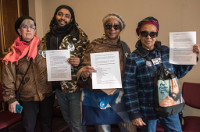
Instead Invites Political Prisoner Mumia Abu-Jamal
Signator attorney Anneke Dunbar-Gronke noted, "Krasner will go down in history as the well-meaning, "progressive" DA who opposed justice in the case of the Nelson Mandela of our time."
Contact: Felipe Hernández - Anneke Dunbar-Gronke - Nyle Fort
felipe.dhernandez@gmail.com - onnieg@gmail.com - nylefort@gmail.com
562-298-6712 314-255-4327 - 973-985-9038
FOR IMMEDIATE RELEASE - Feb.1, 2019
Under Pressure, Yale Reblaw Conf Rescinds Keynote Ofer To Philly D.A. Larry Krasner
Instead Invites Political Prisoner Mumia Abu-Jamal
Cambridge. Organizers of the Rebellious Lawyering (RebLaw) conference at Yale Law School rescinded a speaking invitation to Philadelphia DA Larry Krasner (see RebLaw letter below). The celebrated "progressive" DA was scheduled to be one of the keynote speakers at the 25-year-old conference on the weekend of Feb. 15-16, 2019. But earlier this week, a coalition of Harvard law students and lawyers wrote to conference organizers saying that Philadelphia prosecutors could not be counted in the tradition of rebellious lawyers. Their impassioned letter condemned DA Krasner's decision to appeal a recent court order that granted Mumia Abu-Jamal the right to re-appeal his conviction. The letter also challenged the notion that a prosecutor could hold that title.
In their letter to RebLaw, they said, "The so-called progressive Larry Krasner is hell-bent on keeping [Mumia's case] out of the appellate process. Larry Krasner was voted into office by the Black, working-class people of Philadelphia, but in the hour of truth, he has upheld the rulings of racist judges (in this case) and is doing the bidding of one of the country's most corrupt and homicidal police forces."
The signers added: "Prosecutors, those managers of the oppressive state, regardless of the rhetoric they may espouse during a campaign, should not be invited to speak at a conference for Rebellious Lawyering."
Signator attorney Anneke Dunbar-Gronke noted, "Krasner will go down in history as the well-meaning, "progressive" DA who opposed justice in the case of the Nelson Mandela of our time."
Harvard Law Student Felipe Hernández concluded, "The lesson here is that in the mind of a progressive DA, justice is doled out selectively and only when there is no real political risk involved. Thankfully the conference participants will hear from Mumia, an actual jailhouse lawyer-and pinnacle of rebellious lawyering."
Dear RebLaw attendees and comrades,
RebLaw 25 centers on a question: how can rebellious lawyers engage with our existing institutions and government? In other words, are there just and effective ways that grassroots movements can wield power through electoral politics?
In this spirit, we invited Larry Krasner, the District Attorney for Philadelphia, to serve as one of our keynote speakers. We invited a prosecutor to a Rebellious Lawyering conference hoping to foster a critical conversation about what place, if any, prosecutors should have in rebellious lawyering. Larry Krasner has spent the majority of his career as a defense attorney and civil rights lawyer, building solidarity with communities he has served. He has consistently challenged the power and credibility of law enforcement. Inevitably, prosecutors are implicated in the deep injustices of the system they serve. But as a DA, Larry Krasner has largely shown an admirable, if imperfect, new approach by using his office to challenge the morality and logic of incarceration and to divert police resources away from the project of controlling communities of color.
Given this record, we were disturbed to hear that DA Krasner will challenge the court decision giving Mumia Abu-Jamal the right to re-appeal his conviction of the 1981 death of a white Philadelphia police officer. Mumia, a longtime political activist and writer who has always maintained his innocence, spent decades on death row and is now serving a life sentence without parole. Mumia's case is marred by injustices, including clear evidence of systematic racial bias, political targeting, conflicts of interest, and police corruption. In short, Mumia's case illustrates many of the pervasive injustices that Krasner campaigned against.
Like many of you, we were immediately troubled by DA Krasner's decision when it was announced. Because this issue is so important-and because as RebLaw directors we strive to make decisions together, incorporating the voices of our communities-we waited to release this letter until we has a chance to reflect, discuss, and determine how to best advance the goals and values that RebLaw embodies.
We cannot understand how DA Krasner's decision in this case serves justice or the transformative vision that he ran on. We also hear and deeply appreciate the voices of the law students and activists calling on us to take action in response.
We have rescinded Larry Krasner's invitation to serve as a keynote speaker at RebLaw, and we strongly urged him to drop his appeal. We asked the DA, instead, to join activists in a conversation about the promise and perils of "progressive prosecution," including directly discussing his decision to appeal Mumia's court decision. The DA declined to take part in such a conversation.
It was communities of color who lifted up Larry Krasner to a position of power. He is obligated to respond to those same movements as he wields the power the community has vested in him. We are working with activists to craft programming that examines both Mumia's case and the successes and limitations of DA Krasner's regime.
We look forward to coming together with all of you at RebLaw.
In solidarity,
RebLaw 25 Directors
Here you can listen to it "Rebel Lawyers Speech by Mumia Abu-Jamal" (10:05)
Labor Action Committee to free Mumia Abu-Jamal
P.O. Box 16222
Oakland, CA 94610
February 11, 2019
The Labor Action Committee to Free Mumia Abu-Jamal congratulates the Rebellious Lawyering ("RebLaw") Conference on making the principled decision to disinvite Philadelphia District Attorney Larry Krasner from making the 2019 RebLaw keynote address.
The Labor Action Committee to Free Mumia Abu-Jamal (LAC) was founded in 1998. We have defended Mumia for twenty years since Mumia was represented by his second appellate team (Eliot Grossman, Marlene Kamish and Nick Brown), and a number of our founding members have defended Mumia from the very beginnings of his case. We base ourselves on the principle that Mumia was framed by a racist, capitalist legal system, and that militant class struggle action, through the labor unions and the mass mobilization of the working class, is necessary to win Mumia's freedom.
Examples of such class struggle action include the Oakland Education Association's (OEA's) city-wide teach-in for Mumia in 1999, which two LAC members initiated and coordinated against the opposition of the OEA leadership and the local NAACP. We also helped to organize the West Coast port shutdown for Mumia on April 24, 1999. The resolution for that action, which included a march of 25,000 through the streets of San Francisco, was introduced by LAC member and then-ILWU (International Longshore and Warehouse Union) Local 10 Executive Board member, Jack Heyman.
In 2016, as part of the successful international campaign to save Mumia's life when he was diagnosed with Hepatitis C, we worked with the OASIS Clinic here in Oakland to organize demonstrations at J.P. Morgan's annual biotech conference at the St. Francis Hotel, as well as at Gilead Sciences in Union City. As NUMSA (National Union of Metalworkers of South Africa) General Secretary Irvin Jim noted in a solidarity statement, on behalf of a membership of 340,000:
"The refusal of health-care [to Mumia] reminds us of the conditions we were put in under Apartheid prisons where sick detainees were allowed to die in very deplorable lonely conditions in solitary as part of the punishment for their role in the struggle."
We commend the students from Harvard University for their initiative and courage in calling to disinvite Krasner. However, given the critical importance of this present moment to Mumia's freedom, we have some additional remarks to add to theirs.
While we stand with all organizations who defend Mumia - including RebLaw - the LAC defends Mumia on the only position which is consistent with the evidence: that Mumia Abu-Jamal, just like Angela Davis and Huey Newton, was factually innocent of the murder of Daniel Faulkner, and was, in fact, framed. We do not say that Mumia deserves a new trial because he was denied "due process", or because of any procedural problems in his original trial. Instead, we say "Free Mumia!"
The argument that Mumia deserves freedom only because of procedural violations (whether committed by Judge Sabo, Justice Castille, or others) has existed in the Mumia movement for a long time. It has sometimes allowed organizations to softpedal criticism of the police, as well as prosecutors like Krasner. It has also resulted in excluding or sidelining Mumia from so-called "progressive" events and spaces.
The Fourth World Congress Against the Death Penalty, in 2010, comes to mind. At that conference, a memo was circulated calling for the exclusion of Mumia from the event, which was signed by representatives from, among others, Death Penalty Focus and the National Association of Criminal Defense Lawyers. That memo read, in part:
"The Abu-Jamal case, regardless of its merits, acts as a lightning rod that galvanizes opponents of abolition and neutralizes key constituencies in the cause of abolition. Continuing to give Abu-Jamal focused attention unnecessarily attracts our strongest opponents and alienates coalition partners at a time when we need to build alliances, not foster hatred and enmity."
The authors of that memo specifically wrote that the "alliances" and "key constituencies" they had in mind were "police, prosecutors and law enforcement experts".
Why is Mumia, then, a "lightning rod"? It is not just because he is accused of shooting a cop. Rather, it is because he is a self-proclaimed revolutionary.
Mumia first came around the Black Panther Party in Philadelphia in 1967, at the age of 13, and joined two years later. He says that he was "beaten into the Black Panther Party" by the police, because of their repression of black youth at events such as the student-led mobilization to rename Benjamin Franklin High School in Philadelphia for Malcolm X. Mumia also attended, in 1968, a demonstration in South Philadelphia to protest George Wallace, at which all the protesters were severely beaten by the Philadelphia police. Later, after the Panthers, he joined the MOVE organization.
Mumia's politics are not confined to the struggle for black liberation, though that is obviously important to him. A casual examination of his commentaries on fascism, the internal divisions in the British Labour Party, monopoly capital, or his seminal history of the Black Panther Party, "We Want Freedom," reveals a powerful, explicitly class-centered critique of international capitalism. Mumia is a thinker in the tradition of W.E.B. Du Bois or C.L.R. James - one who also has the power to move the masses.
The power of Mumia's voice, as a representative of a strata of the working class segregated at the bottom rungs of American society, is undeniable. And it is precisely because of that voice that those layers of society whose interests are represented by the police - and the prosecutors - will never permit his freedom. The only road to Mumia's freedom - and, in point of fact, the only reason he is even alive today - is mass organization.
In this particular moment in American history, there is a pronounced political polarization, with growth on both the Left and the Right. This has been expressed, on "our" side, in movements such as Occupy, Black Lives Matter and the emergence of "socialist" electoral candidates. This is a positive development, and it has resulted in progressives such as Krasner being propelled into positions of power with a mandate to "reform" the criminal justice system.
We criticize politics, not personalities. It is important to assess what role Krasner plays structurally. In the 1970s, in the heyday of the New Left, there were also "progressive" prosecutors and even "progressive" police chiefs. Such efforts, as we are already beginning to see, always eventually run afoul of the fundamental contradiction that a "progressive" prosecutor or police chief presides over that arm of the state apparatus which is tasked with social and political repression.
The same police who framed Mumia also clear homeless encampments, break strikes, disperse rallies and demonstrations and destroy social movements. Such institutions cannot, in the final analysis, be reformed.
We look forward to working alongside you and all groups and individuals who are struggling for Mumia's freedom.
In solidarity,
Jack Heyman, International Longshore and Warehouse Union, Local 10 (ret.)
Bob Mandel, Oakland Teachers for Mumia
Gerald Smith, former Black Panther
for the Labor Action Committee to Free Mumia Abu-Jamal
Here you can listen to it "Rebel Lawyers Speech by Mumia Abu-Jamal" (10:05)
DO YOUR PART TO FREE MUMIA
EVERY TUESDAY, CALL 001-215-686-8000 BETWEEN 12-2PM
AND TELL PHILLY DA KRASNER:
(Choose the one you prefer)
"Many people who worked tirelessly for your election feel betrayed. We
knocked on doors, held fundraisers and gave our own money to support a
"Just DA". We disagree strongly with your decision to appeal the Mumia
ruling, in fact we condemn it. Retract the appeal! Release Mumia now!"
Or
"Your appeal of Black Judge Leon Tucker's ruling in favor of Mumia defends racist Judge Albert Sabo, who said: 'I'm going to help them fry the N-word'. He also put more Black and Brown men on death row than anyone else in the US. Retract the appeal! Release Mumia now!"
Or
"Mumia Abu-Jamal was convicted because the police tampered with and 'lost' key pieces of evidence; the prosecution manufactured evidence of guilt, suppressed proof of innocence and selected a Jim Crow jury, among other due-process violations. Krasner, your appeal of Judge Tucker's ruling defends those unjust practices. That's not what you were elected to do. Retract the appeal! Release Mumia now!"
Or
"Krasner, Black Lives Matter! Stop siding with the FOP and racist corrupt judges like Sabo & Castille and against a Black Judge, Leon Tucker. When you appealed Tucker's decision, you betrayed us and your own rhetoric about ending mass incarceration and wrongful incarceration. Retract the appeal! Release Mumia now!"
You can also flood the DAs office by Email: justice@phila.gov and Tweets: @philaDAO
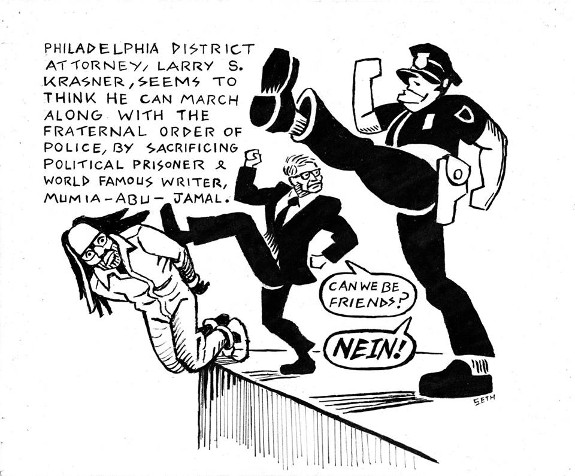
On-line petition to Pressure Krasner not to appeal re Mumia Abu-Jamal
Here's an online petition to sign and share widely.
Don't Stand in the Way of Justice for Mumia Abu-Jamal! Don't AppealJudge Tucker's Decision!
Mumia Abu-Jamal has always maintained his innocence in the 1981 fatal shooting of Philadelphia police officer Daniel Faulkner. His prosecution was politically-motivated because of his Black Panther Party membership, his support of the MOVE organization and as a radical journalist. His 1982 trial and subsequent 1995 PCRA appeals were racially biased: the prosecution excluded African Americans from the jury; and PCRA trial Judge Albert Sabo, the same judge in Abu-Jamal's initial trial, declared, "I'm gonna help them fry the n----r."
On Dec. 27, Mumia Abu-Jamal won a significant case before Judge Leon Tucker in a decision granting him new rights of appeal.
Philadelphia District Attorney Larry Krasner: We call on you to do the right thing. Do not stand in the way of justice. Do not appeal Judge Tucker's decision.
As a progressive attorney you ran for Philadelphia District Attorney on a platform that included standing "for justice, not just for convictions." You promoted reviewing past convictions and freeing the wrongfully convicted. In Philadelphia, Abu-Jamal's frame-up stands out as the city's most notorious wrongful conviction.
We call on you to cease defending former Philadelphia DA and later PA Supreme Court Judge Ron Castille's now-discredited claim of impartiality. It was a people's movement that paved the way for your election – not the financial backing of the FOP or the establishment including judges like Castille.
Show your supporters that your campaign promises meant something. That your concern for justice extends to controversial cases your predecessors held untouchable. Allow Abu-Jamal to go forward with re-arguing his appeals, which Judge Tucker states "would best serve the appearance of justice."
JAN4 Twitter Storm for Mumia: #KrasnerDoRightByMumia
Join in to pressure so-called "progressive" Philadelphia DA Larry Krasner not to appeal a judicial decision just won by Mumia Abu-Jamal, so that he can finally proceed with his appeals.
Anyone with a twitter account just has to click on these links and it will take you to your own Twitter account with the wording already there, all you have to do is click Tweet. Both of these linked Tweets have a picture linked to them as well. The first has a pic of Mumia, the 2nd has a pic of a flyer for a rally to pressure Krasner in Philly on the 5th.
Please do this on Friday, January 4th. We need the numbers all on the same day to create the Twitter storm. These links can also be posted on your Facebook pages, web sites, etc. Just headline it "Twitter Storm for Mumia on Friday, January 4 - Click To Tweet"
Click to Tweet link #1: https://ctt.ac/cY4TC
#KrasnerDoRightByMumia @philaDAO Don't stand in the way of justice. Don't appeal Judge's decision allowing ex Panther Abu-Jamal to re-appeal! Judge says re-arguing Mumia's appeals “would best serve the appearance of justice”
Click to Tweet link #2: https://ctt.ac/cY4TC
#KrasnerDoRightByMumia @philaDAO Don't appeal Judge's decision allowing ex Panther Abu-Jamal to re-appeal. You campaigned on freeing the wrongfully convicted. Mumia's case Is Philly's most notorious Wrongful Conviction!
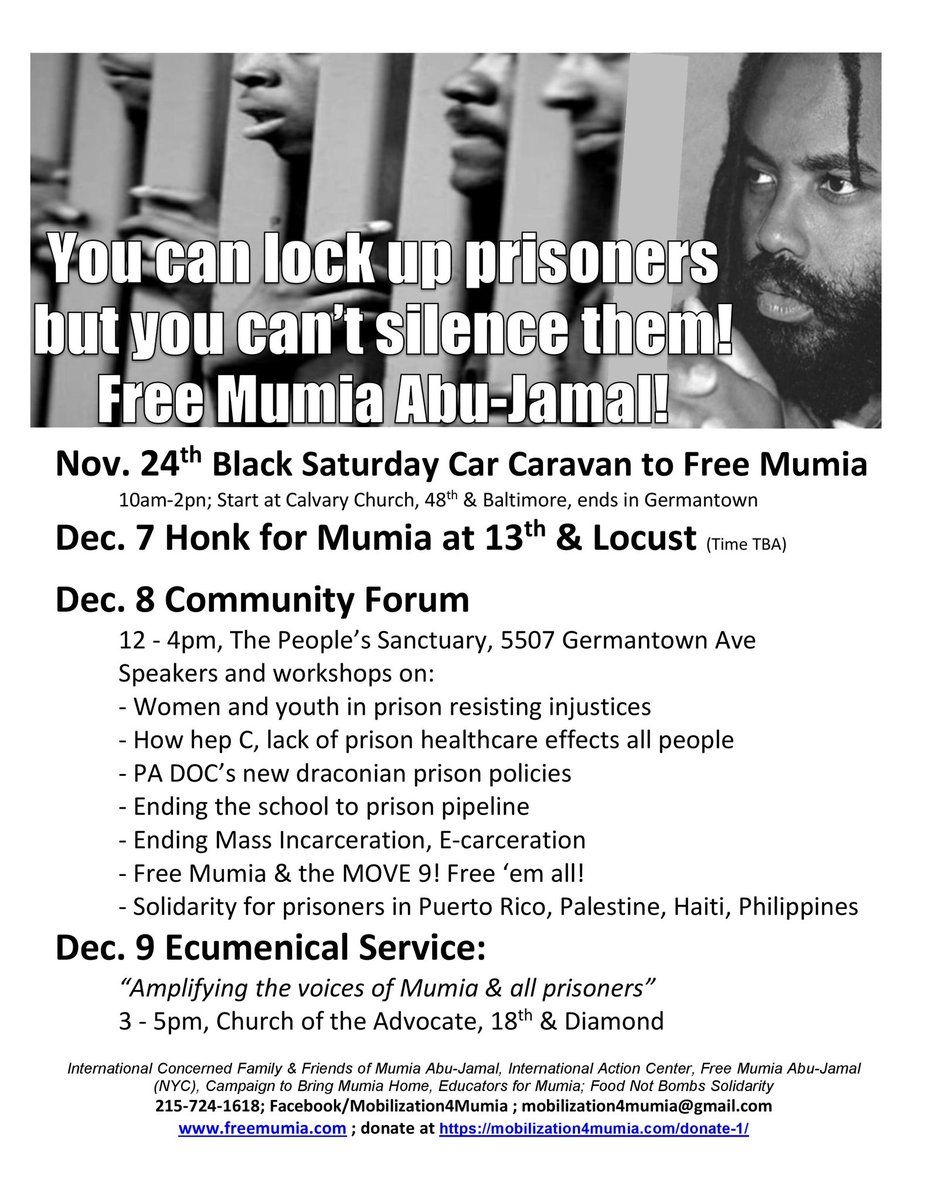
Philadelphia: You can lock up prisoners but you can't silence them
Open Letter to Mumia by Zaklin Nastic (German MP and Human Rights Committee)
Die deutsche Version ist hier zu finden..
Zaklin Nastic is a Member of the German Parliament. She works in the Human Rights Committee and is a member of the LEFT Party (Partei Die LINKE). On August 16, 2018 she wrote an open letter to Mumia with regard to his upcoming court date on August 30, 2018:
Dear Mumia,
For years I have been observing your fight, your activities from inside prison, your courage. In view of the events of 30 April 2018, I feel absolutely compelled to become part of a critical public and to step up observation at international level. The international community must raise its voice in protest at the human rights violations taking place in the USA. Your battle for freedom and the rule of law is also attracting attention here in Germany.
My political work is people-centered. Freedom and justice in solidarity, and individual and social human rights must be the cornerstones for the actions of politics and society.
Yet human dignity is being violated; your dignity and the dignity of people across the world, every day and in diverse ways. The time has now come to invest all our strength, all our insight and all our optimism in fighting at national and international level to safeguard human rights, despite claims that this cannot be achieved. Human rights include the right to rise up against injustice and oppression. You have proved this very clearly.
Together, we fight for an end to racist reality – not just within the prison industry – and for the abolition of the death penalty. “International solidarity” is not merely a hollow phrase; it is practical, empathic and is brought to life by the enduring work of local support movements.
We aim to bring about your release and the release of other prisoners. My thoughts and my commitment are with you and I hope that your appeal will be successful.
With very warm wishes from Germany
Zaklin Nastic
Member of the German Bundestag
It can be found online here...
(The Guardian) ‘Intoxicating freedom, gripping fear'
Mumia Abu-Jamal on life as a Black Panther (July 30, 2018)...
Report from Mumia's Day in Court by Dave Lindorff
Philly cops get priority courtroom seats:
Mumia Seeks to Show Top State Judge Doubled as Prosecutor and Jurist Reviewing his Appeals
By Dave Lindorff, May 1, 2018
Mumia's Day in Court!
The question is will Mumia Abu-Jamal be granted a new trial?
Next hearing: Aug. 30th in Judge Leon Tucker's courtroom 11th fl. 1301 Filbert St. Phil PA
In these battles there is truth, there is the spin, and there is the amnesia the police want you to acquire. "I/am going to help them fry the nigger/", spoken by Albert Sabo, Mumia's trial court judge in 1982. Those are the words that the Fraternal Order of Police, our jack boot folks in blue, would like us to forget. They want us to ignore what everyone knows is at every level of the injustice system: invidious racism and corruption.
How could we forget the injustice system that produced Frank Rizzo and Lynne Abraham? We can not forget police officers in open court telling us during Mumia's PCRA hearing in 1995 "we should have executed him that night", quoted in the New York Times.
It is not a legacy, it is our reality. This is what Philadelphia's new DA Larry Krasner has to confront, expose, reform and ultimately abolish.
Remember this is a DA's office that right now has a long list of police officers they can not put on the stand because they are not credible. This is the DA's office that has Judge Ron Castille (the former DA who the U.S. Supreme Court ruled must recuse himself from these types of cases) on its board of advisors.
A Philadelphia common pleas court judge told me "Mumia is the past." Actually he is our future, because if there is no truth and justice there will be no reconciliation. Front, center, and central to Philadelphia's imprisonment binge and racist legacy are the cases of Mumia Abu-Jamal and the MOVE 9. The cops are holding on to these prisoners because their release will reveal and acknowledge the depth of the corruption in their ranks.
Check out these two dueling editorials from the Philadelphia Inquirer: Keith Cook (Mumia's Brother) and Maureen Faulkner (Police Officer widow).
(Mumia Abu-Jamal and Keith Cook 3/2018)
We must expect justice and demand that the District Attorney and the Courts take this first step towards freedom by immediately reinstating Mumia Abu-Jamal's appellate rights.
_Report From Courtroom of Judge Tucker 4-30-2018_
"In its failure to recognize that Ronald Castille played an active role in pursuing the execution of Mumia Abu-Jamal the new District Attorney's office headed by Larry Krasner, is failing to do what justice requires. It is continuing the position of his predecessors, to the satisfaction of the Fraternal Order of Police." Bret Grote, Esq. Abolitionist Law Center Legal Director
Yesterday Tracey Kavanaugh, the Assistant District Attorney assigned to Mumia's case appeared before the court. She represented to Philadelphia Common Pleas Court Judge Leon Tucker that the District Attorney's Office has conducted an extensive search and still has been unable to find the missing memo from then-DA Ronald Castille in which he sought updates on the status of every capital case from Philadelphia in early 1990. She also made clear that the new District Attorney for Philadelphia (sworn in January 2018), Larry Krasner, has kept the same position as his predecessor: that former District Attorney Castille did not have personal involvement in a critical decision in Abu-Jamal's case, and that the Philadelphia DA's office lead by Krasner opposes the pending Post Convcition Relief Application (PCRA) seeking reinstatement of Abu-Jamal's appellate rights. If these rights were reinstated he would be granted a hearing on whether there was sufficient cause to issue an order for a new trial on his criminal conviction. Mumia has spent 37 years in prison for the killing of a police officer in Philadelphia in 1981, a crime for which he has maintainted his innocence. He is currently serving a life sentence at SCI Mahanoy in Frackville PA.
Abu-Jamal's counsel, Sam Spital from the NAACP Legal Defense Fund, argued forcefully in court today that Ronald Castille did in fact make a critical decision in the Abu-Jamal case when he advocated to Governor Robert Casey in 1990, that the Governor should expedite the litigation in all capital cases by signing the death warrants at the soonest possible time.
Castille explicitly asked the Governor to do this in the case of Leslie Beasley, who was convicted of killing a police officer, to show to "all police killers that the death penalty means something in Pennsylvania." Mumia was still on direct appeal when Castille made this policy decision to enlist the Governor's support in expediting the litigation by signing of death warrants, meaning that it was the policy of Castille's office to seek the immediate signing of a death warrant upon completion of Abu-Jamal's appeal. We know Castille was actively tracking /every/ capital case in his office, including Abu-Jamal's, and vigorously defending the convictions and sentences and pushing for execution of each capital case defendant, including Abu-Jamal.
Counsel for Abu-Jamal are now permitted to take the deposition of former ADA Gaele Barthold McLaughlin, and will file an amended PCRA by July 9. The DA has been ordered to respond to that filing by August 9. The next hearing in this matter is scheduled for August 30 in Judge Tucker's courtroom in Philadelphia.
Cuando luchamos ganamos, When We Fight, We Win
Prison Radio
www.prisonradio.org
Mumias heutiger Gerichtstag: Mumia Abu-Jamal's appeals hearing continued until August
Hier folgen erste Presselinks aus den USA von Mumias heutiger Gerichtsanhörung - die Anhörungsphase ist bis auf den 30. August 2018 ausgedehnt worden. Es ist also noch nicht entschieden, ob er endlich ein neues Berufungsverfahren bekommt. Weitere Infos folgen.
- (Darien News) Mumia Abu-Jamal's appeals hearing continued until August (April 30, 2018)
- (Philadelphia Inquirer) Mumia Abu-Jamal isn't there, but he's the focus inside and outside Philly courthouse (April 30, 2018)
- (fox 29) Mumia Abu-Jamal's appeals hearing continued until August (April 30, 2018)
- (Philly.com) Why my brother, Mumia Abu-Jamal, should be set free Opinion (April 30, 2018 )
- (NBC) Convicted Officer Killer Mumia Abu-Jamal Fights for Chance to Appeal (Apr 30, 2018)
- (CBS Philly) DA Larry Krasner To Announce Position In Mumia Abu-Jamal Appeal (April 29, 2018)
New articles on Mumia Abu-Jamal
- (telesur) Mumia Abu-Jamal's New Appeal for Freedom (February 27, 2018)...
- (R. Wolkenstin) New Legal Action is a Path to Mumia Abu-Jamal's Freedom - A Re-ignited International Mobilization is Critical for Victory (February 27.02.2018)...
- Free Mumia, free Meek Mill, free them all! (February 25, 2018)...
Mumia Update - Here's What Happened in Court
Deutsche Übersetzung...New Hearing in Mumia's Case set for 3/27/2018
 Judge orders New District Attorney to address his request to "find out what happened to the missing Memo by taking action,"
including a suggestion that they might depose the former ADA to get the answers." He noted that he would require a status conference
on 2/26/18, to hear details of their efforts. "I do not want to have another hearing in two months, and be in the same place. These
questions need to be answered."
Judge orders New District Attorney to address his request to "find out what happened to the missing Memo by taking action,"
including a suggestion that they might depose the former ADA to get the answers." He noted that he would require a status conference
on 2/26/18, to hear details of their efforts. "I do not want to have another hearing in two months, and be in the same place. These
questions need to be answered."
Mumia Abu-Jamal, represented by Sam Spital of the NAACP and Judith Ritter, Professor at Widner, was in court in Philadelphia challenging his criminal conviction. Common Pleas Court judge Leon Tucker opened court with a query to the DA about his order that the prosecution produce testimony regarding a missing letter by former DA Ron Castille. This evidence, or evidence of a similar nature, could be a key to Mumia's criminal defense appeals being reinstated.
In the courtroom were Mumia's attorneys, Bret Grote and Robert Boyle, who represent Mumia in "Abu-Jamal v. Wetzel", as well as Ramona Africa, Claude Guillaumaud-Pujol, Jacky Hortaut of the Collectif Francais "Liberons Mumia", Mirrelle Fanon Mendes-France from the Franz Fanon Foundation, and over 100 others.
 As many of you know, in January a new District Attorney Larry Krasner was sworn in. Representing his office, Tracey Cavanaugh (Interim
Supervisor of the PCRA Unit) and Nancy Winkelman (Interim Supervisor of the Law Department) asked the Judge for a continuance, in order to
allow the new DA and staff to review the 18 outstanding "Williams' cases" of which Mumia's is one. They also asked for time
because they are seeking to "formulate an office policy for their approach to these cases". Certainly, a new approach would be
welcome, given the intransigence of the previous office under now imprisoned former DA Seth Williams.
As many of you know, in January a new District Attorney Larry Krasner was sworn in. Representing his office, Tracey Cavanaugh (Interim
Supervisor of the PCRA Unit) and Nancy Winkelman (Interim Supervisor of the Law Department) asked the Judge for a continuance, in order to
allow the new DA and staff to review the 18 outstanding "Williams' cases" of which Mumia's is one. They also asked for time
because they are seeking to "formulate an office policy for their approach to these cases". Certainly, a new approach would be
welcome, given the intransigence of the previous office under now imprisoned former DA Seth Williams.
The U.S. Supreme Court precedent in William v. PA (2016) reversed the imposition of Terrence William's death sentence because former DA Ron Castille failed to recuse himself when he was sitting on the PA Supreme Court.
The order addressing the missing memo has a history. Judge Leon Tucker ordered the DA to turn over any evidence of former PA Supreme Court Justice Ron Castille's "personal involvement" in Mumia Abu-Jamal's criminal appeals when he was District Attorney or an Assistant District Attorney. When they could not "find" any documents, Judge Tucker ordered that they deliver to his office the entire file of 31 boxes. Judge Tucker found a reference to a specific letter written by Castille, which the DA states now that they have lost. This action follows in the wake of the U.S. Supreme Court admonishing the PA courts in the Williams case, for not recognizing that a judge must recuse themselves on cases they themselves actively prosecuted.
The parsing of concepts and words for the court revolve around "personal involvement". Was former DA and former PA Supreme Court Chief Justice Ron Castille a key shot caller on Mumia's case; was he "personally involved"? We know he personally signed years of briefs and appeals against Mumia. We know that this was the most high profile case in the office. And we know that information already released has Castille advocating to the then Governor Casey that the death penalty should be quickly imposed, especially for murders involving police officers as victims.
 The question is simply, did District Attorney Ron Castille actively involve himself in decisions regarding Mumia's case? And did he,
as a PA Supreme Court Justice, review those very same decisions? And if so, was he professionally required to recuse himself, or could
he remain unbiased regarding those decisions? Some courts have even stated that any appearance of bias requires recusal.
The question is simply, did District Attorney Ron Castille actively involve himself in decisions regarding Mumia's case? And did he,
as a PA Supreme Court Justice, review those very same decisions? And if so, was he professionally required to recuse himself, or could
he remain unbiased regarding those decisions? Some courts have even stated that any appearance of bias requires recusal.
At stake is the reinstatement of over a decade of Mumia Abu-Jamal's appeals. This action could lead to an order granting a new trial. The legal path to freedom starts right here in the Common Pleas court chamber of Judge Leon Tucker.
Cuando luchamos ganamos! When we fight, we win!
Noelle Hanrahan
Director, Prison Radio
www.PrisonRadio.org
Twitter
Facebook
To give by check:
PO Box 411074
San Francisco, CA
94141
Press Release - Dec 8, 2017 - Philadelphia (Presseerklärung)
PRESS CONTACTS: Joe Piette 610-931-2615; Gabe Bryant gabrielBryant.7@gmail.com mailto:gabrielBryant.7@gmail.com
"Have Black Lives Ever Mattered" is the name of Mumia Abu-Jamal's latest book but it is also the theme of events this weekend highlighting the struggle of prisoners in the US, including political prisoners such as Abu-Jamal.
First is a Teach-In on Friday, Dec 8, 6 - 9 pm at the historic Church of the Advocate, 1801 W. Diamond St in North Philadelphia.
On Saturday morning, Dec. 9, a crowd will gather near the notorious Rizzo statue at 1401 JFK beginning at 11am where a rally and march will demand that Pennsylvania "Stop the Murder of Mumia Abu-Jamal."
Friday evening panels and speakers include:
Confronting the Current Age of White Supremacy:
- Dr. Karanja Carroll - Malcolm X Grassroots Movement, National Black United Front
- Candace McKinley - Black Lives Matter - Philly organizer
- Lamont Lilly - Durham, NC, activist, poet; 2016 Worker's World Party Vice-Presidential nominee
- Megan Malachi - Philly for REAL Justice activist; educator
- Nancy Mansour - Co-Founder, Existence Is Resistance; filmmaker, "Being Black in the Holy Land"
Mumia's Case: Now and Going Forward:
- Pam Africa - Minister of Confrontation, Uncompromising International Family and Friends of Mumia Abu-Jamal; MOVE member
- Noelle Hanrahan - Prison Radio; producer, "Long Distance Revolutionary: A Journey with Mumia Abu-Jamal"
International and Immigrant Solidarity:
- Susan Abulhawa - Palestinian human rights activist; founder, Playgrounds for Palestine (NGO); author, "Mornings in Jenin"
- Maria Serna - Colombian immigrant rights activist; Lucha pro Derechos (Fight for Rights)
- Mike Wilson - Philly for REAL Justice, Worker's World Party
Saturday's Forum includes
Philadelphia civil rights attorney Michael Coard; Temple professor, writer, and activist Marc Lamont Hill; Akeem Browder, whose brother committed suicide in jail after being unable to afford bail; and Greg Brinkley, speaking on behalf of his nephew Kevin Brinkley, due to be released after having been jailed since 1977 for a crime he didn't commit.
Actions for Abu-Jamal are also taking place in several countries this weekend.
Members of the international community concerned with human rights, including Angela Davis and Danny Glover, are also signing on to a letter initiated by the Frantz Fanon Foundation in France directed to Pennsylvania Governor Tom Wolf and Philadelphia DA-elect Larry Krasner. The letter calls for compliance with recent court orders that the DA's office release all files relevant to Abu-Jamal's case. It further calls for Abu-Jamal's release from incarceration, citing mounds of evidence of his innocence and police, prosecutorial, and judicial misconduct. The letter also voices concern over the lack of timely treatment by prison health officials of his hepatitis C, which has left him with cirrhosis of the liver, posing a potential threat to his life.
PACK THE COURTHOUSE FOR MUMIA!
Judge Tucker has ordered an evidentiary hearing for Wednesday, January 17, 2018, 8:00 - 11:00 AM at Philadelphia Municipal Courthouse. Tucker has ordered the DA's office to show cause why it should not locate and produce Gayle McLaughlin Bartholdi, Esq., to present testimony regarding the content of the documents the DA's office says it cannot locate in reference to her memorandum to Ronald D. Castille on March 27, 1990.
Ronald Castille is a former Philadelphia District Attorney who became a PA Supreme Court judge. He refused to recuse himself when Mumia's case went to the PA Supreme Court despite having been the DA during Mumia's prior appeal.
The Supreme Court has since ruled that behavior unconstitutional in a different case where Castille did the same thing.
The people's movement forced the government to take Abu-Jamal off death row in 2011, but his freedom was not won – the state re-sentenced Mumia to life imprisonment without the possibility of parole.
When he came down with hepatitis C, the people fought for and won hep C treatment, but now he suffers from cirrhosis of the liver and he continues to suffer pain and severe itching from a skin ailment.
As with thousands of other prisoners, life without parole is still a death sentence, especially when decent health care is denied for people behind bars.
Sponsors include: International Concerned Family and Friends of Mumia Abu-Jamal; International Action Center; Free Mumia Abu-Jamal Coalition (NYC); Campaign to Bring Mumia Home; Educators for Mumia Abu-Jamal; Mobilization to Free Mumia Abu-Jamal, Food Not Bombs - Solidarity
Freedom for Mumia - Freedom for All!
December 9, 2017, will already be the 36th anniversary of the arrest and incarceration of the former Black Panther and African American journalist Mumia Abu-Jamal. The struggle for his freedom also stands for 36 years of struggle against racist police violence, political repression, the death penalty, and mass incarceration in the United States. At the core of the struggle for Mumia's freedom is the struggle to overcome a slavery that has never really ended and exercises its modern form in the guise of the prison industry of the country. Much was achieved in the years that have passed: We could avert for good the execution of Mumia's death sentence. It turned out to be possible to attain medical treatment for Hepatitis C for Mumia and hundreds of other prisoners in the State of Pennsylvania. Currently, Mumia and the movement are fighting for the reconsideration of the deeply flawed trial that led to his false conviction in 1982. At present, one special focus in these efforts is on files of the District Attorney's Office that the prosecution illegally refuses to hand over to the defense.
MUMIA - You Will Never Walk Alone!
Rally on Saturday, December 2, 2017 - U.S. Embassy - 2 PM
U.S. Embassy, Pariser Platz 2/Brandenburger Tor - 14195 Berlin-Mitte - U+S-Brandenburger Tor
Free Mumia Now! Stop the DA Office's Cover-up!
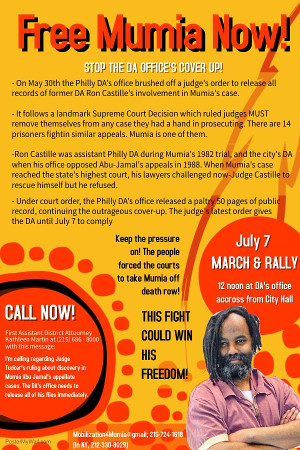 July 7, 2017 - Rally & March for Mumia in Philadelphia, PA, USA
July 7: MARCH & RALLY! 12 noon at the DA's office across from City Hall
- On May 30, the Philly DA's Office brushed off a judge's order to release all records of former DA Ron Castille's involvement in Mumia's case.
- It follows a landmark US Supreme Court decision that ruled judges MUST remove themselves from any case they had a hand in prosecuting. There are 14 prisoners fighting similar appeals. Mumia is one of them.
- Ron Castille was assistant Philly DA during Mumia's 1982 trial and the city's DA when his office opposed Abu-Jamal's appeals in 1988. When Mumia's case reached the state's highest court, his lawyers challenged now Judge Castille to recuse himself, but he refused.
- Under court order, the Philly DA's office released a paltry 50 pages of public record, continuing the outrageous cover-up. The judge's latest order gives the DA until July 7 to comply.
Keep the pressure on! The people forced the courts to take Mumia off death row!
THIS FIGHT COULD WIN HIS FREEDOM!
CALL NOW!
First Assistant District Attorney Kathleen Martin at 001 - 215-686-8000 with this message:
"I'm calling regarding Judge Tucker's ruling about discovery in Mumia Abu-Jamal's appellate cases. The DA's office needs to release all of his files immediately."
Mobilization4Mumia@gmail.com , 001 - 215-724-1618; in New York, 001 - 212-330-8029
Urgent Press Release on Mumia Abu-Jamal
April 2, 2017Contacts: mobilization4mumia@gmail.com
Joe Piette: 610-931-2615
Mumia's Treatment Expected, But *_Not Yet_* Delivered
Delayed Hep C Treatment Leads to Death
On March 31, 2017, Mumia Abu-Jamal received a cruel mix of bad and good news from a prison doctor. The doctor shared the results of his recent lab test, which showed clear signs of cirrhosis, an irreversible scarring of the liver caused by his untreated Hep C. The doctor also informed Mumia that he would be treated with the Hep C cure within a week
The impending victory was bittersweet. Mumia shared his feelings with those he called that morning. His rare expression of emotion was also captured in an interview interview... that evening in which he stated: "My first reaction was really shock, anger, disbelief. If I had been treated in 2015, if I had been treated in 2012 when they say they first diagnosed it, I wouldn't be this far advanced. ...For a lot of guys and a lot of gals inside the Pennsylvania prisons, I think it is a step forward and a great day, but I assure you I don't feel that way right now."
The Pennsylvania Department of Corrections' apparent concession to treat Mumia with the Hep C curewas achieved through an agonizing two-year battle waged in the streets and through two court suits. However, Mumia has *_not yet been treated_* and will not be without our vigilance and continued protests.
If he is treated immediately, Mumia can expect to return to good health; but patients who have developed cirrhosis are more susceptible to developing liver cancer in the future and have to be monitored for the rest of their lives.
In the face of Mumia's battle for humane medical treatment, the PA DOC had adopted a retaliatory posture and accelerated its efforts to silence and kill Mumia by delaying treatment. Because of the failure to treat his Hep C, over the last two years, Mumia fell into a diabetic coma, experienced severe brain swelling, and suffered a painful skin condition that disfigured his body. In the last year, he and others in the prison have been forced to bathe in and drink water that is often visibly contaminated - "black and turbid," as Mumia put it.
Many of Mumia's supporters around the world believed that Mumia received treatment back in early January 2017 because a federal judge rdered the DOC to provide it. But a stubborn and stonewalling PA DOC refused to comply with the ruling. The judge ordered Mumia's immediate treatment citing the unconstitutionality of the PA DOC's Hep C treatment protocol. The judge denounced the DOC, whose protocol "deliberately delays" treatment with the standard Hep C cure until the prisoner experiences bleeding of the throat, among other deadly symptoms. The decision cited eight amendment rights violations prohibiting cruel and usual punishment.
The ongoing foot dragging by the PA DOC was confirmed this week. On the same day that the prison doctor delivered the news to Mumia, PA DOC attorneys filed a scandalous motion in court. They asked the judge to dismiss Mumia's legal health suit on the basis that the DOC had decided to treat Mumia under the guidelines of pre-existing HEP C treatment protocol —the same protocol that the judge previously declared "unconstitutional."
These arguments demonstrate the DOC's attempt to undermine the legal implications of Mumia's legal suit and the DOC's own misconduct. When Mumia is finally administered the cure, his treatment will establish precedent for the treatment of thousands of PA prisoners with Hep C, as well as people on the outside who can't afford the medication. Mumia's battle has exposed the deadly crisis of medical care in the prisons and the barbarism of the U.S. for-profit health care system that charges 90K for the Hep C cure.
As history shows, a judge's ruling does not ensure its implementation, especially when it challenges ruling interests. For this reason, we are asking you to take action and demand immediate Hep C treatment for Mumia, for the more than 700,000 prisoners with Hep C across the country and the millions suffering with the untreated, deadly disease outside the prison walls in our neighborhoods.
This moment has also created an opportunity to uphold Mumia's innocence and fight for his freedom. On Monday, April 24, 2017, the day of Mumia's birthday, his attorneys will challenge his conviction in the Philadelphia Court of Common Pleas. We are calling on you to join us at the courthouse and in the streets.
On April 24, his conviction attorneys, Judith Ritter and Christina Swarns (NAACP Legal Defense Fund), will take advantage of the recent Supreme Court ruling in /Williams v. Commonwealth/ to show how judicial and prosecutorial bias in all of Mumia's state appeals have kept him behind bars. This important Supreme Court ruling determined that a judge cannot fairly adjudicate an appeal of a case for which he/she has previously had a personal role in a significant prosecutorial decision.
In Mumia's case, Judge Ronald Castile, the same judge under scrutiny in /Williams v. Commonwealth/, also was the elected Philadelphia District Attorney responsible for the arguments made to the Pennsylvania Supreme Court in 1988 to uphold Mumia's trial conviction and death sentence. Castille had also been a high-level assistant DA during Mumia's trial. After he was elected to the PA Supreme Court in 1994, he was involved in deliberating and denying all of Mumia's state appeals against the decisions of "hanging judge" Albert Sabo and Pamela Dembe who upheld Mumia's death sentence and denied him a new trial during multiple appeals between 1998-2007. These judges denied a new trial despite Mumia's innocence, that evidence of his guilt was manufactured by the police and prosecution and that he had been denied virtually every due process right and protection owed under the U.S. constitution.
During the appellate filing, Mumia's attorneys asked Judge Castille to recuse himself because of this bias, citing also the judge's close relationship with the Fraternal Order of Police (FOP), which lobbied for Mumia's conviction.The FOP funded Castille's bid for the Pennsylvania Supreme Court and honored him as "Man of the Year." In response to Mumia's attorneys, Justice Castille responded stridently that he would not step aside,noting that he should not be singled out because five of the seven judges of that Pennsylvania Supreme Court were also supported by the FOP. It is no surprise that the court did not find one single error in the original court proceedings and thus upheld hisdeath sentence and denied Mumia the right to a new trial.
We demand the immediate release of Mumia!
We are calling on you to do two things
- Call the DOC to demand immediate treatment for Mumia and all PA prisoners with Hep C:
PA DOC Secretary John Wetzel, (717) 728-2573
Email: ra-crpadocsecretary@pa.gov
(Twitter) @johnewetzel * @CorrectionsPA
- Join us in Philadelphia on Monday, April 24, 2017 at 8:30 AM, at the the Philadelphia Court of Common Pleas to assert Mumia's innocence and call for his immediate release.
Center for Criminal Justice
Courtroom 1101
1303 Filbert Street
Philadephia, PA
Signers in solidarity,
- International Concerned Family and Friends of Mumia Abu-Jamal
- MOVE
- Campaign to Bring Mumia Home
- Abolitionist Law Center
- Free Mumia Abu-Jamal Coalition (NYC)
- Educators for Mumia Abu-Jamal
- Committee to Save Mumia Abu-Jamal
- Mundo Obrero/Workers World
- Philly REAL Justice
- Sankofa Community Empowerment
- Millions for Mumia/International Action Center
- Mobilization to Free Mumia Abu-Jamal/Northern California
- Le Collectif Français "Libérons Mumia"
- German Network Against the Death Penalty and to Free Mumia Abu-Jamal
- Amig@s de Mumia de México
- Saint-Denis Free Mumia Committee
(Democracy Now) Philadelphia Activists Demand Life-Saving Drugs for Mumia Abu-Jamal (December 12, 2016)
In Philadelphia, hundreds of people gathered Friday for a march and protest to demand life-saving medication for imprisoned journalist and former Black Panther Mumia Abu-Jamal, and for all Pennsylvania prisoners suffering from the unconstitutional denial of treatment for their hepatitis C. The protest marked 35 years since December 9, 1981, when Mumia Abu-Jamal was shot by Philadelphia police, arrested and then charged with the murder of white police officer Daniel Faulkner.
(Mexico City) Fotos: ¡Afuera de la embajada, por la libertad y salud de Mumia
Bericht (in spanisch) und Fotostrecke von einer Kundgebung für Mumias Freiheit an seinem 35. Haftjahrestag (9.12.2016) vor der US Botschaft in Mexico City:
Hier zum Artikel und zu den Fotos...
(Courthouse News Service) Abu-Jamal Says Bad Medical Care May Kill Him (October 11, 2016)
Chris Hedges: Mumia Abu-Jamal's Fourth of July
FRACKVILLE, Pa.-Tens or even hundreds of thousands of Americans, like those in the visiting room of the State Correctional Institution at Mahanoy, drove often for hours on the Fourth of July weekend to visit relatives or friends who are locked in cages. Millions suffered the painful absence this weekend of a father, a mother, a brother, a sister, a son, a daughter or a friend. These people, mostly poor people of color, understand a dark truth about the cruelty and ultimate intentions of the corporate state. They know that "freedom", "justice" and "liberty", especially if you are poor, are empty slogans.
Protest walk-in at Philadelphia's City Council
Treat hep C in Philly jails! (January 30, 2016)
Radio-Podcast - Law and Disorder: Mumia Abu-Jamal Health Lawsuit Update by Lawyer Bob Boyle
For three days in late December, the 3rd Circuit Federal District Court heard Mumia Abu-Jamal’s lawsuit against the Pennsylvania Department of Corrections for refusal to provide him treatment for Hepatitis C. Testimony from Dr. Paul Noel, Chief Medical Officer of the Pennsylvania DOC revealed that under the DOC’s new protocols only 5 out of an estimated 5,000 prisoners with chronic Hepatitis C were being treated with the new anti-viral drug beginning this fall – less than 1/10th of one percent.
The trial ended with a stunning revelation that the lawyer representing the DOC had knowingly introduced false evidence. Dr. Noel was the final witness; he stated that an affidavit introduced by defense attorney Laura Neal bearing his signature was NOT his actual testimony. It quickly became evident that the DOC attorney had ignored Dr. Noel’s repeated requests not to insert an erroneous paragraph into the document–in other words, she tampered with the evidence. This same altered affidavit had been a key piece of evidence used by a PA magistrate judge in September to deny Mumia’s injunction against the DOC.
Guest – Bob Boyle, one of Mumia’s attorneys and a long time National Lawyers Guild member.
(Video) December 18th: Demand Medical Treatment for Mumia Abu-Jamal and 10,000 Prisoners with Hepatitis C
Be in court or call the Department of Justice and the Governor Tom Wolf.
Press Release - Mumia Abu-Jamal: Years of Wrongful Incarceration & Current Health Crisis
(Workers World) Mumia supporters highlight HVC epidemic (November 19, 2015)
Philadelphia - An "Emergency Town Hall and Report to the People" was held here Nov. 13 to garner support for a campaign demanding that the state of Pennsylvania immediately provide life-saving drugs for imprisoned journalist Mumia Abu-Jamal and thousands of other prisoners suffering from the hepatitis C virus. The event was held at the Friends Center before a standing-room-only crowd.
(The Black Agenda Report) The People Demand Treatment for Mumia and 10,000 PA Inmates Suffering from Hepatitis C (November 17, 2015)
"They contend that Abu-Jamal and the others are not sick enough to get immediate treatment."
An international coalition of health care professionals, unionists, educators and lawmakers gathered recently at the American Friends Center in Philadelphia to discuss the issue of treatment for Mumia Abu-Jamal and other Pennsylvania inmates suffering from the Hepatitis C Virus.
(WBAI - Radio, New York City) Building Bridges: Mumia Must Live (October 28, 2015)
(Workers World) Pam and Ramona Africa tour Bay Area for Mumia (October 22, 2015)
(Workers World) Health care providers call for hep C treatment for Mumia Abu-Jamal and other PA prisoners (October 7, 2015)
Offener Brief an Tom Wolf: Health care providers call for hep C treatment for Mumia Abu-Jamal and other PA prisoners
In einem Offenen Brief an Pennsylvanias Gouverneur Tom Wolf fordern Gesundheitsarbeiter*innen Hepatitis C Behandlung für Mumia Abu-Jamal und andere Gefangene im Bundesstaat:
(Buchbesprechung) Mumia Abu-Jamal's Eighth Book: Writing On The Wall
Stellungnahme der Autor*innen Gewerkschaft der USA
Resolution to Save the Life of Mumia Abu Jamal from "Medical Neglect"
From the National Writers Union, August 11, 2015
Where as Mumia Abu-Jamal, an African-American journalist and former member of the Black Panther Party for Self-Defense, who was president of the Philadelphia Chapter of the National Association of Black Journalists, was sentenced to the death penalty in 1982 for allegedly killing a white policeman. The judgment was based on fraudulent court proceedings, including an incompetent lawyer who neglected evidence showing Abu-Jamal's innocence, a nearly all-white jury (which studies show often produces the same result as an all-white jury with a Black defendant), self-serving witnesses, and a biased judge, which show that Abu-Jamal is an innocent man who should never have been in jail in the first place and who is a political prisoner in Pennsylvania.
Lehrerin Marylin Zuniga aus New Jersey endgültig gekündigt
Lehrerin Marylin Zuniga aus New Jersey endgültig gekündigt, weil ihre Schüler*innen Gesundheitswünsche an Mumia geschrieben hatten.
Auch wenn die Bezeichnung "Cop Killer" falsch ist - Mumia Abu-Jamal hat
den Polizisten Daniel Faulkner nicht ermordet und es gab und gibt auch
keinen stichhaltigen Beweis dafür - zeigt sich in diesem Artikel des
Independent (UK), was Unterstützer*innen von Mumia Abu-Jamal in ihrem
Berufsleben an Repression in den USA widerfahren kann. Hier das jüngste
Beispiel der am 13. Mai 2015 endgültig gekündigten Lehrerin Marylin
Zuniga aus New Jersey:
Mehr hier...
Mumia Unterstützer*innen in den USA überlegen derzeit, wie die junge Lehrerin weiterhin unterstützt werden kann. Wir bereichten, sobald wir weitere Informationen erhalten.
Free Mumia - Free Them All! - english version
Here you find the new flyer about Mumia
Ein Bericht aus Mexico City
English Version see below..
Dort gelang es Unterstützer*innen von Mumia Abu-Jamal vor wenigen Tagen, mit einem Transparent und einem Protestbrief an US Aussenminister John Kerry heranzutreten, der in einem weitesgehend geheim gehaltenen Programm Mexiko besuchte. In dem Brief, den er an Obama zu übergeben gebeten wurde, forderten sie die sofortige Freilassung von Mumia.
Die Fotos sind von der Aktion. Die mexikanischen
Unterstützer*innen merken an, dass offizielle US Vertreter*innen bei
Reisen eigentlich überall auf der Welt an Mumia und Gefangene in den USA
erinnert werden sollten...
Hello again all,
Well, back to John Kerry's visit to Mexico --as I've mentioned before, we don't think US government officials should be able to visit any city in the world without hearing about Mumia and other U.S. political prisoners. When they come here, we often don't know if they see us or hear us, but this time they definitely did.
As usual, John Kerry's agenda was kept secret until the last minute, but we found out he was going to be in the Mexico City Zócalo and were able to deliver a letter to him demanding that the Obama government push for Mumia's release. Before he got there, we'd tried to give it to a lady who seemed to be in charge of things, but she refused to receive it.
When he arrived, however, he saw our banner that we'd unfurled in the
middle of a small crowd of onlookers (who'd all been given tiny American
flags to wave) and also saw the letter two of our people were waving at
him. He told the lady to accept it, and she did.
read more...
Education was supposedly the major issue of Kerry's talks with government officials and businessmen this time, but security is always on the agenda. So we concentrated on that in an article we published on several independent media sites, "Five Questions for John Kerry", concentrating on the security-related issues none of these officials ever address: mass incarceration, ICE detention centers, Guantánamo, solitary confinement and political prisoners. read more...
Bit by bit....
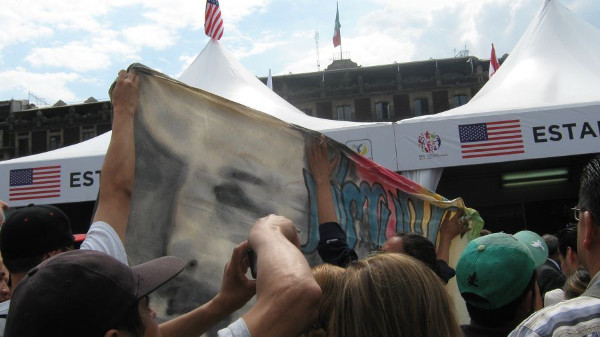
FREE MUMIA Press Conference at FOX Philly
You probably didn't see it on FOX or any mainstream media, but on Friday, January 17, 2014 a press conference was held outside the offices of FOX 29 (WTXF-TV) in Philadelphia. The purpose was to denounce the attacks of FOX analysts and the Fraternal Order of Police on Mumia Abu-Jamal and on Debo Adegbile, President Barack Obama's nominee to head the Justice Department's Civil Rights Division.
Speakers included Professor Johanna Fernandez, Pam Africa, Keith Cook (brother of Mumia Abu-Jamal), Ramona Africa and more.
Video mit Jamal Hart
Zweisprachiges Video von einem Filmgespräch, an dem Mumias Sohn Jamal Hart am vergangenen Montag in Berlin teilgenommen hat.
Jamal Hart Q&A after Mumia film LONG DISTANCE REVOLUTIONARY (Berlin, Germany - bilingual/zweisprachig) (13.01.2014)
Mexico Report on April 24 Activity
*Hi everybody, *
*So glad to hear about the strong campaign kickoff in Philly on April 24th . I'm sending some news and pics from the Mumia birthday activities in Mexico City. *
*After a couple of hours of rain, our rally outside the U.S. Embassy in Mexico City on April 24th started up with dancing and drumming, and we presented a new banner painted by long-time Mumia supporter, Aurelio. Right away two busloads of friends from San Salvador Atenco came in with strong solidarity messages from Ignacio del Valle and others. They consider Mumia an example and an inspiration and have always appreciated the fact that he spoke out in their support when the Mexican government unsuccessfully tried to keep Ignacio and Felipe Álvarez en prison for 112 and 67 years, respectively. *
*A message from political prisoner Alberto Patishtán was also read by his son Héctor. You may remember that Mumia wrote a piece in his support last October, "The State and the Schoolteacher". And this is the second message Alberto has sent in support of Mumia. The first was from the prisoners in the two collectives he has organized inside Chiapas prisons, La Voz del Amate and Solidarios de La Voz del Amate, and the second was his own personal message.*
*Several other solidarity messages were read, and a comrade spoke about the case of another Mexican political prisoner, Pedro Peralta, in Eloxochitlán, Oaxaca. *
*Eva Palma sang and spoke about Mumia's life and struggle. She is a cultural worker and the companion of Kuy Kendall, our comrade who was shot in the head with a "non-lethal" projectile in the December 1 protests against the inauguration of Mexican president Enrique Peña Nieto and is still unconscious in the hospital.*
*Jorge Salinas played the guitar and sang corridos, Luisillo and Andrés played the drums and recited poetry, Revolución Anónima rapped, and the reggae bands Luna Negra and Ollin Roots closed the event. *
*The night before the rally, the screening of COINTELPRO 101 prompted an interesting question and answer session with Claude Marks of Freedom Archives via Skype, organized by the Radio Zapote collective. And the day after the rally, we had a well-attended birthday party at the Che Guevara Auditorium.*
In struggle
Rebel Diaz: Free Mumia - Free Them All!
Life in Prison Is Not an Option
Stand With Mumia On His 59th Birthday In Philadelphia
Wednesday, April 24, 2013
Rally & March 2-6pm
Indoor Campaign Kickoff, 6:30pm- 9:30pm
We demand: District Attorney Seth Williams, Release Mumia Now!
The DA has earned the right to be our focus on Mumia's born-day. The Philadelphia DA's Office has a history of injustice and oppression: Ed Rendell 1978-1986, Ron Castille 1986-1991, Lynne Abraham 1991-2010, and Seth Williams 2010-present
From Mumia's arrest up until now, the Philadelphia DA's office has been a key player in the conspiracy to kill Mumia Abu-Jamal and later to keep him in prison for the rest of his life, despite extensive evidence of his innocence and of police, prosecutorial, and judicial misconduct in the case. Mumia should never have even been arrested, much less found guilty and sentenced to death.
End Solitary Confinement! End the Death Penalty! Reclaim Education!
End Mass Incarceration! Free All Political Prisoners!
Order $10 bus tickets now!
Call the Free Mumia Abu-Jamal Coalition NYC Hotline (212) 330-8029
For further details visit www.freemumia.com
Purchase bus tickets at:
International Action Center 2nd Floor
147 West 24th Street 2nd Floor
(212) 633-6646
By Mail, Make Check or Money Order out to: FMAJC/IFCO, Send to:
Free Mumia Abu-Jamal Coalition NYC
P.O. Box 16 College Station
New York, NY 10030
Departure at 11:00 AM
1199 SEIU Headquarters, 310 West 43rd St. between 8th & 9th Avenues
Riverside Church, 91 Claremont Avenue between 120th & 122nd Sts.
In the Philadelphia area, call International Concerned Family & Friends of Mumia Abu-Jamal (215) 921-8914 (Philadelphia Innocence Project)
Return trips to NYC from Philadelphia available for 6pm and 9:30pm
The Unsilenced Voice of a "Long-Distance Revolutionary"
"I am sitting in the visiting area of the SCI Mahanoy prison in Frackville, Pa., on a rainy, cold Friday morning with Mumia Abu-Jamal, America's most famous political prisoner and one of its few authentic revolutionaries. He is hunched forward on the gray plastic table, his dreadlocks cascading down the sides of his face, in a room that looks like a high school cafeteria. He is talking intently about the nature of empire, which he is currently reading voraciously about, and effective forms of resistance to tyranny throughout history. Small children, visiting their fathers or brothers, race around the floor, wail or clamber on the plastic chairs. Abu-Jamal, like the other prisoners in the room, is wearing a brown jumpsuit bearing the letters DOC-for Department of Corrections...
New Documentary Tells Untold Story of Mumia Abu-Jamal's Life Journey
Amy Goodman interviewt den Filmemacher Stephen Vittoria über seinen
neuen Film über Mumia Abu-Jamal auf "Democracy Now":
"Long Distance Revolutionary: A Journey with Mumia Abu-Jamal"
New Documentary Tells Untold Story of Mumia Abu-Jamal's Life Journey
Interview über den Film "Long Distance Revolutionary - A Journey with Mumia Abu-Jamal"
Ein Interview über den neuen Film "Long Distance Revolutionary - A Journey with Mumia Abu-Jamal" (Fernsprech Revolutionär - eine Reise mit Mumia Abu-Jamal) und die Rolle von Prison Radio.
FREE MUMIA - Now!
OCCUPY FOR JUSTICE: OCCUPY THE JUSTICE DEPARTMENT -- April 24, 11AM
950 Pennsylvania Avenue, NW Washington, DC -- at the Dept of Justice (DOJ)
ENDORSED BY:
International Concerned Family and Friends of Mumia Abu Jamal : Educators for Mumia Abu-Jamal : New York Coalition to Free Mumia Abu-Jamal : Occupy Philly : Occupy DC Now : Occupy DC Criminal Injustice Committee : Occupy the Hood : Decarcerate PA : Supporting Prisoners and Acting for Radical Change [SPARC] : Millions for Mumia : Dead Prez (Sticman and M1) : T alib Kweli : Immortal Technique : Angela Davis : Danny Glover : Alice Walker : Francis Pixen : Amiri Baraka : Marc Lamont Hill : Cornell West : Vijay Prashad : Norman Finkelstein
Spread the Word: Bring 2, 5 or 10 Friends
next stop - Mumia's Freedom
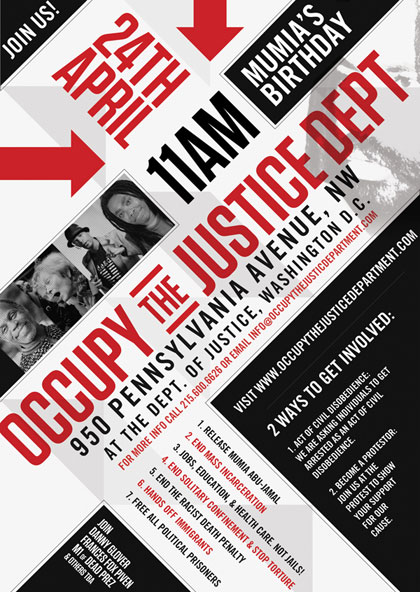 Now that the celebrated, radical journalist Mumia Abu-Jamal, is off death row, many dare to imagine the next step--his release from prison. On December 9, 2011 at the National Constitution Center in Philadelphia, where over 1,100 people gathered to mark the 30th anniversary of Mumia's incarceration, Archbishop Desmond Tutu asked our nation to "rise to the challenge of reconciliation, human rights, and justice" and called for Mumia's "immediate release." And when Frances Goldin--Mumia's literary agent--called on the audience to OCCUPY the Justice Department, the call was met with a roar of excitement.
On April 24, 2012, Mumia's 58th birthday, we will gather at the Department of Justice (DOJ) in Washington, DC. A large-scale, vibrant and colorful rally will amplify our formal request that Eric Holder immediately meet with a delegation to discuss police corruption and civil rights violations in Mumia's case and in the cases of hundreds of other defendants in Philadelphia. Some demonstrators will engage in acts of civil disobedience to draw greater attention to these injustices.
I pledge to occupy the DOJ
On April 24, consider joining a group of renowned citizens in an act of civil disobedience, among them Danny Glover, Frances Fox Piven, Norman Finkelstein, and M1 of Dead Prez. Your pledge to engage in an act of civil disobedience will be critical to reaching our goals of enlisting the participation of other activists and ensuring news coverage of the case and of our broader demands. If you cannot commit to civil disobedience, you can pledge to be at the demonstration.
Because Mumia's removal from death row coincides with the dramatic shift in consciousness brought by the Occupy Wall Stree t movement and the execution of Troy Davis, we now have a unique window of opportunity to fulfill one of the most important moral assignments of our time: to build a movement that will link all of the violations in Mumia's case and his fraudulent trial to the crisis of mass incarceration, so as to win this innocent man's freedom. Short term goal: release Mumia. Long term goal: end mass incarceration.
Attorneys will be available to answer questions and to support this important demonstration.
CLICK HERE TO TAKE THE PLEDGE AND SIGN-UP!
"there is something in the soul...
...that cries for freedom!" Twenty-first century social movements around the world are illuminating the root ca uses of social crises, class inequality, bigotry, human rights violations, and environmental degradation. Here in the U.S. we have seen how, in the face of the growing OCCUPY movements, the state has intensified its campaign to restrain people and silence dissent. From the incarceration of state critics and whistle blowers (Bradley Manning), the pepper spraying of peacefully protesting students in California and the passage of repressive legislation (HR 347 & NDAA) to the warehousing of millions of poor Black and Latino people in American prisons and the increased scapegoating and detention of immigrants -- the state is ramping up repressive measures.
On April 24, we will breath life into the old labor slogan: "an injury to one, is an injury to all." On that day we will say that we are all Mumia, we are all immigrants, we are all Bradley Manning, we are all poor, we are all Palestinian, and we are all Troy Davis.
For 30 years, in a death row cell, Mumia has offered a radical critique of power and injustice through his regular radio commentaries and seven published books. His defiant voice in the face of state repression has taught us all something about courage and the human spirit's inclination toward freedom. His message articulates our highest aspirations as a society. On April 24, make a placard and write on it all of your grievances. They will be welcomed. Above all, on that day, bring your fighting spirit and your desire to live in and create a decent and different world.
why the DOJ
The police who shot, brutalized, and arrested Mumia Abu-Jamal in 1980 -- for the shooting death of Officer Daniel Faulkner -- were under scrutiny by a Department of Justice investigation of the Philadelphia Police Department. The probe, which began in 1979, marked the first time in United States' history that the federal government sued a police department for civil rights violations and charged an entire police department, rather than individual officers, with police brutality. The DOJ suit maintained that the Philadelphia police's practices of "shooting nonviolent suspects, abusing handcuffed prisoners, suppressing dissension within its ranks, and engaging in a pattern of brutal behavior `shocks the conscience.'" Only days after the end of Mumia's fraudulent trial and conviction,
15 of the 35 police officers involved in collecting evidence in his case would be convicted and jailed, as a result of this federal investigation, on charges which included graft, corruption, and tampering with evidence to obtain a conviction. Chief among these officers was Alfonzo Giordano, the police inspector who led the crime scene investigation in Mumia's case. The DOJ investigation remains unfinished: it did not provide relief for defendants like Mumia who were convicted by the testimonies and work of these corrupt an d convicted cops.
our demands
- Release Mumia Abu-Jamal
- End mass incarceration
- Jobs, Education, & Health Care. NOT JAILS!
- End solitary confinement & stop torture
- End the racist death penalty
- Hands off immigrants
- Free all political prisoners
For more info on the case:
http://www.freemumia.com
http://www.emajonline.com/category/mumia-faqs/
http://www.bignoisefilms.com/films/tactical-media/114-justice-on-trial
http://www.amnesty.org/en/library/info/AMR51/001/2000
Dave Lindorff, Killing Time: An Investigation into the Death Row Case of Mumia Abu-Jamal (Common Courage Press, 2002)
Patrick J. O'connor, The Framing of Mumia Abu-Jamal (Lawrence Hill Books, 2008)
To donate:
Mail tax-deductible checks to National Lawyers Guild Foundation, 922 Nassau Street #922, New York, NY 10009 (write A24 in subject line)
Download Flyer (Web Version and 8.5 x 11 Print out)
Download Flyer (Poster Size Print Out)
Top 5 Ways to Get to DC (Web Version and 8.5 x 11 Print out)
Top 5 Ways to Get to DC (Poster Size Print Out)
Stay tuned for pre-event "Teach-Ins" in Philadelphia and Washington, DC.
For more info on A24
info at occupythejusticedepartment dot com
call: 215-600-6626
To get on the bus:
Philadelphia: 215-600-6626
Occupy the Hood, NY: 718-600-5857
New York Coalition to Free Mumia: 212-330-8029
www.megabus.com
www.boltbus.com
--Mumia is Innocent! Stop the Frame Up! Free Mumia!--
Free Mumia Abu-Jamal Coalition, NYC
P.O. Box 16, College Station, NY, NY 10030
212-330-8029,
www.FreeMumia.com,
info@FreeMumia.com
Mumia Abu-Jamal death sentence dropped
Mumia Abu-Jamal death sentence dropped...
Update on Mumia: Call Philly DA: Demand Mumia Be Released to Gen. Population!
Dear Friends:
I visited Mumia yesterday, December 15, in the new prison that houses him, SCI Mahanoy. Even though he has been released from death row, he remains in Administrative Custody while he awaits transfer to general population. Because he is still in Administrative Custody and not yet in general population, visits still take place behind the plexiglass barrier characteristic of the no-contact visits to prisoners on death row.
Mumia boarded a vehicle to SCI- Mahanoy in the early morning hours of December 14th at 4AM. Despite the dehumanizing character of the heavily armored vehicle that transported him from SCI Greene to SCI Mahanoy, Mumia delighted in the opportunity to see cows, horses, and Pennsylvania's beautiful landscape during the 7 hour ride to Frackville, PA.
He described the last number of days as a "crazy whirlwind." Last Friday alone, he spent 6 hours packing up books, letters, and other belongings in preparation for what he believed was a move into general population at SCI Greene. But the Department of Corrections had other plans in mind. As you know, that same day, December 9, his call came through at the National Constitution Center. At the prompting of Pam Africa, the last 30 seconds of that call turned into a rousing ovation to Mumia by the 1,100 people in attendance. This is was he wrote in a letter about his experience that very same night on December 9, "It's been minutes since I've hung up the phone, and I'm still buzzing from the loving vibes zapping through the phone. It's really electric!"
While in Administrative Custody at Mahanoy, Mumia is technically in "the hole." This means that he has absolutely no human contact; absolutely no belongings in his cell other than a rubber pen, 8 sheets of paper and 8 envelopes (4 of which he has used to write letters to family and friends); he gets only one hour in the yard and one visitor a week; and at night the lights in his small cell are dimmed only slightly, and otherwise remain on all day.
Mumia noted that he missed the knock of his next door neighbor on the Row at SCI Greene, Sugarbear, who called for him through a knocked on the wall "at least 20 times a day."
Mumia noted that as he was being escorted to his cell at Mahanoy, the majority of prisoners he saw in "the hole" were black and he immediately thought of Michelle Alexander's evocative analysis and descriptions of mass black imprisonment nationwide.
Mumia is committed to remaining mindful of the challenges of this new period. He remains strong and hopeful about the possibilities of this next phase of struggle, both in his personal day-to-day life, and in the movement. He welcomes and is prepared for the change. Below please also note a special note he dictated to OWS.
Mumia reiterated that despite his isolation and the alienating character of his transfer to Mahanoy, he feels vibrations of love around him.
We await, impatiently, Mumia's transfer to general population and call on the DA's office to complete the transfer immediately. PLEASE NOTE: The DA's number and address below.
Let us remind the DA that Mumia should have been in general population since 2001 when Judge Yohn overturned the death penalty in his case; but the DA's office held him on death row for a decade while it filed losing appeals. By law, Mumia should be in general population, not in "the hole." We demand his immediate transfer.
With love and solidarity,
Johanna Fernandez
Report from Wien
Dear activists for the freedom of Mumia Abu Jamal!
On December 9th, 2011 the Committee for the Freedom of Mumia Abu Jamal/Vienna organized a rally on the busy Mariahilfer Street. In the Christmas hurly-burly we announced our message that we are pleased with the repurchase of the death penalty on the one hand but we vehemently fight "against the creeping death" of Mumia Abu Jamal (Desmond Tutu) of "life imprisonment" on the other hand. So we demanded again and again the freedom for Mumia Abu Jamal! 75 persons signed our petition for freedom for Mumia Abu Jamal. Three of them want to cooperate with our committee!
Please add our video report to your other reports on the international actions on December 9th, 2011:
In solidarity
Free Mumia
Press Release: Response To Da Seth Williams' Decicion On The Mumia Abu-Jamal Case
For Interview Contact
Dr. Johanna Fernandez, 917.930.0804
Dr. Suzanne Ross, 917.584.2135
Dr. Mark Taylor, 609.638.0806
Archbishop Desmond Tutu Calls for Mumia Abu-Jamal's Release
"Now that it is clear that Mumia should never have been on death row in the first place, justice will not be served by relegating him to prison for the rest of his life" yet another form of death sentence. Based on even a minimal following of international human rights standards, Mumia must now be released. I therefore join the call, and ask others to follow, asking District Attorney Seth Williams to rise to the challenge of reconciliation, human rights, and justice: drop this case now, and allow Mumia Abu-Jamal to be immediately released, with full time served."
The news that the DA's Office of Philadelphia is no longer seeking the death penalty for Mumia is no news to supporters of the nearly 30 year Pennsylvania Death Row prisoner. However, because Mumia has for thirty years been subjected to torture on death row and because he is innocent, justice for Mumia will not be served by life imprisonment, but by his release from prison.
Mumia's case is like thousands of other cases in Philadelphia in which the prosecutor, the judge, and the police conspired to obtain a conviction. One of the most important and least known facts of this case is the existence of a fourth person at the crime scene, Kenneth Freeman. Within hours of the shooting, a driver's license application found in Officer Faulkner's shirt pocket led the police to Freeman, who was identified as the shooter in a line-up. Yet Freeman's presence at the scene was concealed, first by Inspector Alfonso Giordano and later, at trial, by Prosecutor Joe McGill. Recently, the U.S. Department of Justice asserted that withholding evidence of innocence by the prosecutor warrants the overturning of a conviction.
The police investigation that led to Mumia's conviction was also riddled with corruption and tampering with evidence. The recently discovered Polokoff photographs that were taken at the crime scene, reveal that officer James Forbes, who testified in court that he had properly handled the guns allegedly retrieved at the crime scene, appears holding the guns with his bare hands. The photos also discredit cabdriver Robert Chobert as a witness; his taxi, contrary to his testimony, is pictured facing away from the fallen officer's car. This evidence hasn't been reviewed by any court.
Our call to Seth Williams is that he honor DA Lynn Abraham's 1995 promise to the city of Philadelphia that she would discard any cases where evidence surfaces that even one of the officers involved in an investigation lied in court or in written reports.
The D.A. may think that the case can be laid to rest by sending Mumia off to life in prison. But an aroused public, with the Supreme Court ruling the death sentence to be unconstitutional, is ready to challenge anew the entire trial. The same judge, jury, and DA that were involved in the unlawful sentencing process committed equally egregious violations in the conviction. This is not an ending, it is a new beginning for the movement supporting Abu-Jamal's quest for release.
The December 9 forum at the National Constitutional Center, featuring Prof. Cornel West, will be preceded by an 11:30 a.m. Press Conference, at the American Friends Service Committee building, 1501 Cherry Street. Then the following day there will be a full-day of organizing and fundraising activities, Saturday December 10, at the Germantown Event Center, 5245 Germantown Avenue, beginning at 12 Noon.
Free Mumia Abu-Jamal Now: 30 Unconstitutional Years on Death Row are Enough! (October 23, 2011)
by Dave Lindorff and Linn Washington, Jr.
Video Link with Judith Ritter
5ème anniversaire de la rue Mumia Abu-Jamal Me Judith Ritter (30.04.2011 - frz/engl)...
Mumia Abu-Jamal's 1982 Death Sentence is Again Declared Unconstitutional
NAACP LEGAL DEFENSE & EDU. FUND (LDF) PRESS RELEASE ON 3RD CIRUIT DECISION
NAACP Legal Defense & Educational Fund, Inc.
For Immediate Release
April 26, 2011
Contact: Melquiades Gagarin, mgagarin@naacpldf.org, 212-965-2783
Mumia Abu-Jamal's 1982 Death Sentence is Again Declared Unconstitutional
The United States Court of Appeals for the Third Circuit has unanimously declared that Mumia Abu-Jamal's death sentence is unconstitutional. In today's decision, the Court of Appeals reaffirmed its 2008 finding that Mr. Abu-Jamal's sentencing jury was misled about the process for considering evidence supporting a life sentence. The Court found that, in violation of the United States Supreme Court's 1988 decision in Mills v. Maryland, the jury was improperly led to believe that that it could only consider unanimously agreed upon evidence favoring a life verdict. This mistake rendered Mr. Abu-Jamal's death sentence fundamentally unfair. The NAACP Legal Defense & Educational Fund, Inc. (LDF) and Professor Judy Ritter of Widener Law School represent Mr. Abu-Jamal in this appeal of his 1982 conviction and death sentence for the murder of a police officer in Philadelphia, Pennsylvania.
"This decision marks an important step forward in the struggle to correct the mistakes of an unfortunate chapter in Pennsylvania history," said John Payton, Director-Counsel of LDF. "Again acknowledging the existence of clear constitutional error in Mr. Abu-Jamal's trial, the Court of Appeals' decision enhances confidence in the criminal justice system and helps to relegate the kind of unfairness on which this death sentence rested to the distant past." Prof. Ritter noted that, "Pennsylvania long ago abandoned the confusing and misleading instructions and verdict slip that were relied on in Mr. Abu-Jamal's trial in order to prevent unfair and unjust death sentences. Courts now use clear and unambiguous language to advise sentencing juries about their ability to consider evidence that favors a life verdict. Mr. Abu-Jamal is entitled to no less constitutional protection."
Mr. Abu-Jamal he has been on death row in Pennsylvania for 29 years. To speak with counsel for Mr. Abu-Jamal, please contact Melquiades Gagarin, mgagarin@naacpldf.org, 212-965-2783.
Hier die Deutsche Übersetzung...
An evening with Mumia's new legal team
(Harlem, NYC) Mumia Abu-Jamal's legal defense gained strength a couple of weeks ago, when the NAACP Legal Defense Fund (LDF) officially joined his defense. Although lawyers of the LDF have been members of the team for several years already they now take on the leading role in the legal struggle to free Mumia Abu-Jamal. On April 3 the newly formed defense team presented themselves to an audience of 150 in Riverside Church in New York.
Call the Justice Department for Mumia. Outline of civil rights violations in Mumia's case. Please distribute widely.
Nov 9 legal procedures + the meaning for Mumia
The Death Penalty, Mumia Abu-Jamal and the European Parliament
Victor Grossman, Berlin Report
What does the USA have in common with China, Iran, Iraq, Saudi Arabia and North Korea? You would hardly guess, but the European Parliament stated loud and all too clear on October 2nd; those are the countries which put lots of people to death. In a long, detailed resolution, approved almost unanimously by 574 members (only 25 opposed and 39 abstained), the members from all over Europe named people on death row and threatened with execution in several countries and right there between those in Iran and Iraq were two Americans: Mumia Abu-Jamal in Pennsylvania and Troy Davis in Georgia. The delegates also voiced regret at the recent executions of Holly Wood in Alabama and Teresa Lewis in Virginia, although both were mentally retarded.
True, as the resolution pointed out, the USA cannot match China, which killed about 5000 inmates last year, but it is was still near the top behind Iran, with 402, Iraq at least 77 and Saudi Arabia with at least 69. In the USA the number was 52.
It was noted that 154 countries have abolished the death penalty completely or almost completely (with occasional exceptions such as for wartime treason). In Europe only Belarus has failed to do so, while the new constitution of far-off Kyrgyzstan just joined the ranks of those who generally agree, as the resolution points out, that "the death penalty is the ultimate cruel and inhuman and degrading punishment, which violates the right to life as enshrined in the Universal Declaration of Human Rights", and "detention conditions created by the death penalty decision amount to torture that is unacceptable to states respecting human rights." It reports that "various studies have shown that the death penalty has no effect on trends in violent crime.whereas evidence shows that the death penalty affects first and foremost underprivileged people."
After listing cases in other countries where pressure is needed, the delegates noted that "35 states in the USA still have the death penalty, although 4 of them have not held executions since 1976" and while executions increased to 52 in 2009 "some states have moved against the death penalty through measures including a moratorium on executions or its abolition".
Mentioning Mumia Abu-Jamal twice in the resolution indicated how people in many European countries are worried about his case, considered typical for many others, and currently nearing some kind of decision, possibly a fatal one.
A delegate of Germany's LEFT party, Sabine Loesing, who was particularly active in getting this resolution passed, told how happy she was that so many from a wide range of political parties had voted for the resolution and added that she would see to it that the pressure on Catherine Ashton, foreign minister of the European body, would not let up so that she raises the position of the resolution whenever she meets with leaders of states where capital punishment still prevails.
Demonstration: From Mexico City: We're with Mumia all the way!
On Tuesday, September 21, around 150 people gathered at the Hemiciclo a Juárez in Mexico City to demand life and freedom for Mumia Abu-Jamal, recognized internationally as a political prisoner. People expressed their support for him in spoken messages, song, dance and graphic art. The event was energized by the arrival of a large group of bicyclists riding in defense of the air we breathe and of all political prisoners.
A number of Mexico's ex political prisoners were present, including Jacobo Silva Nogales, Gloria Arenas, Mariana Selvas and Edith Rosales, along with the family of Victor Herrera Govea, who has been locked up for an entire year for marching against government repression.
Speaking for himself and Gloria, Jacobo Silva said: "We were asked if we could be here today to stand by Mumia. And how could we not be here when there is so much that moves us to stand by Mumia? We're on his side ...because we're on the side of life itself, because we're on the side of all social activists, because we're against racism, because we're for justice, because we're with all political prisoners, because we're with all those people who never give up. That's why we stand by Mumia, that's why we stand up for Mumia. When people shout Viva Mumia Abu-Jamal! it's not just one more joyous chant. It's a shout for the life of someone who must live, for someone whose life is in danger. Viva Mumia Abu-Jamal!"
Among those who participated in the event were human rights observers from the Collective against Torture and Impunity (CCTI), along with individuals and collectives from the Other Campaign, Anarchist Black Cross, student groups, and collectives from the Ché Guevara Auditorium -especially the kitchen, which contributed a delicious vegetarian ceviche. Among the supportive free and independent media collectives were Cronopios, Ke Huelga Radio, CML, Regeneración Radio, Radio Okupa, Noticias de la Rebelión and Radio Zapote.
The event was lively with music by Emexce, Zona Norte and Kukulkan Sonido Anti-sistema, who presented their new song in support of Mumia, and by the b-boys and b-girls of Twisted Flavors and guests. We listened to the blues sound of La Otra Cultura Inlakech, and the original song in support of Mumia by La Otra Cultura del DF, who sing out for him wherever they go.
A representative of Amig@s de Mumia de México stated that it's clear that the government of the United States is not satisfied with the recent Supreme Court decisions leading to the death of Mumia Abu-Jamal; it's necessary to build up public animosity against him in order to justify his execution. It's clear from the trailers that the new documentary Barrel of a Gun (El cañón del fusil) by the supposedly independent filmmaker Tigre Hill, with backing from the Fraternal Order of Police, is nothing but an exercise in defamation. It both a personal attack against Mumia, and an attack against groups that have been important in his life history.
The comrade said: "We're here today to say NO to the criminalization of Mumia Abu-Jamal and of his struggle. Just as Mumia writes in defense of the efforts of the Black Panthers and the MOVE organization to make necessary and positive changes in the world, we...recognize these efforts as valuable experiences. "The Mumia Abu-Jamal that we know through his weekly essays and the six books he's written from death row...is a brave and righteous man committed to social change. He's a writer who knows how to put any one of today's events in a historical context and untangle all that we're going through. We especially appreciate his solidarity with the struggles here in Mexico and in the world".
During the event, different people read Mumia's essays out loud, including one on the death penalty as a modern form of lynching and others on BP, Arizona, the MOVE organization, and the nature of the State.
People also read fragments of a report written by Michael Schiffman and Anton Reiner, published in Abu-Jamal News, of their recent visit with Mumia in which they were accompanied by Linn Washington. They talk about his contagious energy, clear thinking and love of life, even in the hell he lives in, surrounded by steel and razor wire with the lights always on, no physical contact with friends and loved ones, no fresh fruits and vegetables in a small cell with no color. He never leaves his cell without being chained hand and foot. Now he doesn't even have a typewriter; once again, he must write everything seated on his bed with the inner cartridge of a ball-point pen. One of the things he likes most is getting brightly-colored cards. The comrades say that during their visit, "Mumia repeatedly insists that the really important thing is to organize. `Nobody should underestimate what even a small number of organized people can achieve. My own survival is concrete proof for what organized action is capable of.'"
The event at the Hemiciclo reflected many of the current struggles in Mexico. As people expressed their support for Mumia, some urged everyone to join in the mobilizations against COP16 in Cancún this coming November and December and others called for support for the displaced Zapatista communities under attack, and for support of the autonomous municipality of San Juan Copala, where people are living a day to day massacre. Some of those who spoke are resisting the destruction of the urban zones of Magdalena Contreras and Tlahuac on the edges of Mexico City, and others are resisting attacks on students by hired thugs at CCH Vallejo. People were urged to defend the indigenous land recoveries in Ostula, Michoacán, and to support the community police there and in Guerrero, where these groups practice the organized self defense of their communities.
A number of people expressed their support for the political prisoners of Mexico, and especially for young Victor Herrera Govea. His sister Mary said: "...Unjust trials... Yes, we know about them. Down here and up there, they're an everyday thing. They're one of the arms of the government against those bothersome people who never shut up in the face of all the absurd things going on in this unequal, devastating world. In addition to Mumia's case and many others in the world, we have the case of Víctor Herrera Govea, locked up since October 2, 2009 for the crime of going out to march in repudiation of a massacre committed 41 years ago, one that is still going on at this very moment in every corner of the Mexican territory... His trial is also marked by many irregularities... And through all this, we've come to understand that these trials aren't judicial. They're the desperate response of a tyrant whose interests are threatened. They're the smack of a Goliath defending itself against an upstart David ... Mumia's vitality and the consistent denunciations that he makes from death row, along with his refusal to fall down or fall back during the last 29 years, is maddening to the United States government. Mumia's struggle is our struggle. His death is our death. His life is our life. His freedom is our freedom. Victor's freedom is our freedom".
Mexico's political prisoners include the indigenous comrades Alberto Patishtán in Chiapas, Abraham Ramírez Vazquez en Oaxaca, the Loxicha prisoners in Oaxaca, and the anarchists and eco-anarchists arrested in recent months. Support was expressed for international political prisoners, including Leonard Peltier, the MOVE 9, the Angola 3, the 5 Cubans jailed in the United States, the Palestinian prisoners, the Mapuche prisoners on hunger strike in Chile, and the anarchists recently arrested in Chile.
The representative of Amig@s de Mumia said: "We're here today to say NO to the death penalty for Mumia Abu-Jamal and to demand the abolition of the death penalty in the world. We also oppose long sentences, and especially life sentences. Now it is plain to see that the Mexican authorities intend to duplicate these aspects of the United States judicial system, which have only resulted in tremendous injustices and human suffering. We're here today because we want to live in a world without prisons. We are wholeheartedly opposed to the imposition in Mexico of the United States prison system, which has resulted in the massive construction of prisons, the privatization of prisons, and a tremendous explosion in the prison population. We're here today to demand freedom for all political prisoners in Mexico and the world. The recent triumph of the liberation of all the Atenco prisoners shows that it is possible to free all the rest".
It's reported that as the cyclists resumed their ride along Reforma, they didn't have it in them to pass by the United States Embassy without blocking the street for a little while and shouting ¡Free Mumia! again and again.
x Amig@s de Mumia de México
(Video) Test Shows Missing Evidence and Falsified Testimony from Key Witnesses in Abu-Jamal Trial
Als Ergänzung des Artikels über den Test der Journalisten Lindorff and Washington über die fehlenden Einschusslöcher im Gehweg am Tatort von Mumias Verhaftung ist jetzt ein Video erschienen.
(Video) Test Shows Missing Evidence and Falsified Testimony from Key Witnesses in Abu-Jamal Trial
Es erklärt sehr gut in knapp 8 Minuten die gesamte Problematik der offensichtlich falschen ballistsischen Argumentation, die u.a. zu Abu-Jamals Verurteilung führte.
Report Blows Holes in Mumia Abu-Jamal's conviction
New Test Shows Key Witnesses Lied at Abu-Jamal Trial; Sidewalk Murder Scene Should Have Displayed Bullet Impacts
by Dave Lindorff and Linn Washington
During the contentious 1982 murder trial of Philadelphia radio-journalist Mumia Abu-Jamal, a central argument of the prosecution in making its case for the conviction and for imposition of a death penalty was the trial testimony of two key eyewitnesses who claimed to have actually seen Abu-Jamal fire his pistol repeatedly, at virtually point-blank range, into the prone Officer Daniel Faulkner.
This testimony about Abu-Jamal's shooting at the defenseless policeman execution-style solidified the prosecution's portrayal of Abu-Jamal as a cold-blooded assassin.
There was however, always the lingering question, never raised at trial, or even during the subsequent nearly three-decades-long appeals process, of why, if Abu-Jamal had fired four bullets downward at Faulkner, only hitting him once with a bullet between the eyes on the morning of December 9, 1981, there was no evidence in the surface of the sidewalk around the officer’s body of the bullets that missed.
Now two independent journalists have raised further questions about that troubling lack of any evidence of missed shots by doing something that neither defense nor prosecution ever bothered to do, namely conducting a gun test using a similar gun and similar bullets fired from a similar distance into a slab of old concrete sidewalk similar to the sidewalk at the scene of the original shooting on the south side of Locust Street just east of 13th Street in Center City, Philadelphia.
Media Justice On Trial In Philadelphia - The duel of two films about Mumia Abu-Jamal
A new film, entitled The Barrel of a Gun, will be unveiled in Philadelphia on Sept. 21. The film is officially endorsed by the Fraternal Order of Police and Murdered by Mumia authors Michael Smerconish and Maureen Faulkner, and based on the two trailers that have been released and public statements by the film-maker, Tigre Hill, that he believes death row journalist Mumia Abu-Jamal is unequivocally guilty, we can safely expect that the film will be biased against Abu-Jamal, as is the case with the majority of mainstream media coverage about Abu-Jamal, particularly so in Philadelphia.
Supporters of Abu-Jamal are mobilizing to confront Tigre Hill’s film. This film can be particularly dangerous now because of Abu-Jamal’s current legal situation, where the death penalty may be reinstated by the US Third Circuit Court. In response, Journalists for Mumia has just published the latest issue of our newspaper, where we confront Tigre Hill by laying out evidence of innocence and why Mumia’s trial was unfair.
Mumia Is In Great Danger
Interview with Robert R. Bryan
Mumia Abu-Jamal's lead attorney, Robert R. Bryan, San Francisco, was interviewed via the internet on Aug. 19, 2010, at a rally in Neukölln, Berlin, Germany, where Michael Schiffmann translated.
Robert R. Bryan gives an overview where the case stands right now.
Gucci Mane Release Celebrated, Mumia Abu Jamal Still Forgotten (13.05.2010)
Video of Cornel West and Mumia (March 3, 2010)
C-SPAN's Book TV broadcasts the conversation between Cornel West, Mumia Abu-Jamal and Patricia Fernandez-Kelly that had been recorded on March 3, 2010 at Labyrinth Books in Princeton, New Jersey.
Video footage of the event can be seen via C-SPAN's Web site here....
The focus of the event was to discuss Mumia's latest book, "Jailhouse Lawyers: Prisoners Defending Prisoner v. The USA" published by City Lights ( http://www.citylights.com/book/?GCOI=87286100448090 ). The event covers a wide range of issues relating to prisons, freedom struggle, the Obama administration, and efforts to free Mumia through movement organizing.
Mumia began his 15-minute collect call with a reading from "Jailhouse Lawyers," then dialogued with Cornel West and Patricia Fernandez-Kelly. Audience Q & A with West and Fernandez-Kelly followed the call.
Johanna Fernandez, Mark Taylor, and Pam Africa also spoke at the event, addressing Mumia's legal case and the urgency to organize around the demand that Eric Holder and the U.S. Justice Department conduct an investigation into violation of Abu-Jamals civil rights by the U.S. court system, violations well documented by Amnesty International and posted
online here...
Mumia Honored on His 56th Birthday
on Pacifica Radio, 24 April 2010
a report to the movement,
by the Labor Action Committee To Free Mumia Abu-Jamal
Programming for and about the innocent death-row political prisoner, Mumia Abu-Jamal, was initially called for by the World War II, US internment camp survivor, Yuri Kochiyama. Kochiyama issued a letter asking for cards to be sent to Mumia, and for programming to happen on public radio on the 24th of April, Mumia's 56th birthday. This is the 28th year of Mumia's incarceration for a crime he didn't commit--half his life! The Pacifica National Board (PNB), the governing body of the network, responded by passing a resolution encouraging such programming on member stations of the Pacifica Network. Two stations responded:
1. KPFA, Berkeley, CA:
Two hours of programming happened on KPFA from 4 to 6 PM, on Mumia's birthday. The 2 hours were moderated by journalist JR Valrey, of POCC Block Report Radio, and a frequent contributor on KPFA's Flashpoints. The Apprenticeship Program contributed some supporting material to this segment. JR spent a valuable 40 minutes interviewing Linn Washington, a journalist at the Philadelphia Tribune who has covered Mumia's case from the very beginning, in December 1981. It was Washington who, visiting the site of the shooting of a cop early in the morning after, reported that the police had left the scene unguarded, leaving evidence unattended. This reporting provided the first indications that the police had already begun to frame someone up for the crime, and hence had no need for securing evidence.
On the show, Washington covered the "mitigating factors" issue in the penalty phase of Mumia's 1982 trial. Corrupt and unfair on many levels, Mumia's trial was a mockery of justice from beginning to end. Witnesses who saw men fleeing the scene (who could not have included Mumia, who was shot, almost killed, and found at the scene) were never called. Prosecution "witnesses" who never saw anything were forced to lie by corrupt police. The judge, Albert Sabo, an out-racist, was overheard to say, "yeah, and I'm gonna help 'em fry the n____r"!
On the show, Washington covered the "mitigating factors" issue in the penalty phase of Mumia's 1982 trial. Corrupt and unfair on many levels, Mumia's trial was a mockery of justice from beginning to end. Witnesses who saw men fleeing the scene (who could not have included Mumia, who was shot, almost killed, and found at the scene) were never called. Prosecution "witnesses" who never saw anything were forced to lie by corrupt police. The judge, Albert Sabo, an out-racist, was overheard to say, "yeah, and I'm gonna help 'em fry the n____r"!
Among numerous other violations--which included excluding Mumia from his own trial---this judge issued false instructions to the jury in the penalty phase of the trial. He suggested that the jury had to be unanimous in deciding on mitigating factors (such as the fact that Mumia had no prior convictions for anything). Such factors, if decided according to law, would have "mitigated" (ie, prevented) the jury from issuing a death sentence. These false instructions conflicted with a Supreme Court ruling in Mills v Maryland, in which the Court had said that such factors required a simple majority only.
"The Mumia Exception"
Washington mentioned that federal courts have overturned 32 cases--of which 22 originated in Philadelphia, where Mumia was framed--in which mitigating circumstances were mishandled by state courts.
But in Mumia's case, the rules were changed! After rejecting Mumia's appeal against his unjust conviction last year, the Supreme Court virtually threw out its own Mills v Maryland ruling in early in 2010, in order to defeat Mumia's case. The Court sent the case back to the Third Circuit, with instruction to reconsider their Mills v Maryland reason for setting Mumia's death sentence aside.
It was Linn Washington who coined the term "the Mumia exception," to point out how the courts have consistently changed their own rules and precedents in order to maintain the frame-up of Mumia Abu-Jamal.
"Power flows from the barrel of a gun"
Washington also discussed the 1990 Supreme Court ruling, in which the court denied Mumia's appeal against the prosecutor's use of his (years earlier) membership in the Black Panther Party (BPP), also in the penalty phase of the trial. This dealt with an obvious violation of Mumia's first amendment rights. Mumia had stated at trial that he had been treated unfairly. Such a statement by a defendant is not supposed to be subject to cross examination. But judge Sabo, true to his identification as a "prosecutor in robes," allowed the prosecution to cross examine. It was then that the prosecution entered an 8-year-old news piece against Mumia. This report, taken out of context, attributed a famous quote by Mao Tse-Tung to Mumia: "power flows from the barrel of a gun."
The Supreme Court rejected Mumia's appeal against this violation of his rights in 1990, but--in another example of the Mumia exception--reversed itself months later on two other cases! Washington pointed out how the Court reversed itself on two cases on the same question--one of a racist prison gang member, and one of a devil-worshipper, both murderers. In these cases, the "high" Court said that the prosecutor erred in using prior political association against a defendant, when in Mumia's case, they had not done so!
Chairman Fred Hampton Jr, Mumia's Daughter, & Suzanne Ross
JR also interviewed POCC Chairman Fred Hampton Jr, son of the murdered Black Panther leader Fred Hampton. Hampton talked about the outrageous conditions faced by all prisoners in the US, especially prisoners of color and those falsely accused.
JR then interviewed Mumia's daughter Goldie, who was very moving. She discussed how this bogus case affects a family. Mumia has grandchildren that he's never had the opportunity to touch!
Next up was Suzanne Ross, of the New York Coalition to Free Mumia, who explained and defended the petition which has been submitted to Obama's Attorney General, Eric Holder, on behalf of Mumia. The petition calls for a civil rights investigation of Mumia's case by the US Justice Department. Ross mentioned that the Justice Department has rejected this appeal (which was filed last year) in a recent letter. But she said that, "we plan to go back on April 26th," with a new document proving a conspiracy (which is what is required in order to get around the Justice Dep't's 5-yr statute of limitations on such investigations).
Ross said that the idea of this petition originated with then-Congressman Ron Dellums, who followed up on the 1995 Congressional Black Caucus statement by demanding such a civil rights investigation from the Justice Dep't. Ross apologized profusely for mentioning Dellums in a positive light, in consideration of his current actions. Now the Mayor of Oakland, Dellums was more concerned with property values in downtown than he was with the black community, when he condemned protests against the police murder Oscar Grant. Grant, a young black retail grocery worker was lying face-down on a subway platform on New Years Day 2009 when he was shot in the back for no reason!
The response to Dellums in 1995 from the Justice Department focussed on the fact that litigation in Mumia's case was still proceeding then. Now (in 2009), according to Ross, the idea was revived because, with appeals exhausted, "the gig was up; there was nothing left."
JR then interviewed M1 from the rap group Dead Prez, who was very moved by his recent long interview with Mumia. He got to talk to Mumia for hours, and was very impressed with Mumia's fantastic spirit, and ability to speak on many issues. He planned to incorporate many things that Mumia said into his music. Key quotes from Mumia were "everything is political," and, "the culture of resistance is revolutionary."
Jack Heyman of the ILWU
Jack Heyman's interview then came on. Heyman is an executive board member of the International Longshore and Warehouse Union (ILWU) Local 10, and the key leader of an historic West-Coast port shutdown to free Mumia in 1999. In this action, primarily black longshore workers shut all the ports for one shift, and then marched in San Francisco chanting, "An injury to one is an injury to all, free Mumia Abu-Jamal!"
Heyman, who is also a member of the Labor Action Committee To Free Mumia Abu-Jamal, described the port shutdown in context of labor history. In the 1920's and 30's, the communist-led International Labor Defense (ILD) fought the frame ups of Sacco and Vanzetti and the Scottsboro boys. Interested in what's happening now, JR asked, "why is labor interested in Mumia?" "Mumia represents an important part of the class struggle," said Heyman. "Mumia stood with the working class by refusing to be interviewed about his own case by ABC's 20/20 during a lockout," despite the threat of a death sentence hanging over him. And, as Heyman described, Mumia has consistently supported other workers' struggles over the years. His commentaries have repeatedly been played at workers' rallies.
Heyman also mentioned the Rio de Janeiro teachers in Brazil, who were the first internationally to hold a workers' stop-work action to free Mumia. "Capital is global now," said Heyman. He then mentioned the current struggle of locked out ILWU Rio Tinto miners, in Boron, CA. Mining conglomerate Rio Tinto is international, with operations in South African and Canada as well as the US.
At the end, Jack mentioned that some people in the Mumia movement "have illusions" in appealing to Attorney General Holder. "We think that the system will never grant Mumia a new trial," said Heyman "I agree with that," said JR. Jack concluded by saying "we need to get back into the streets."
Mumia Abu-Jamal: "Law is the tool of those in power"
A short interview with Mumia completed the 2-hour segment. About the "Mumia exception" issues mentioned earlier by Linn Washington, Mumia said that "the law is the tool of those in power, so it's not the law, it's power," that's decisive. Mumia also commented on life on death row, which is "22 & 2." ie, mostly a life of complete isolation. "Some men go mad," said Mumia, "and we've seen a spate of suicides." He also mentioned the case of Amadou Diallo in New York, in which "shoot first and ask questions later" was the rule as cops killed an innocent, unarmed man in a hail of bullets while he stood in his own doorway in 1999. These cops were acquitted, and later transferred to Albany. "What does that say about their attitude to the people they're supposed to serve?" asked Mumia.
And finally, on KPFA, Mumia's own greeting to supporters celebrating his birthday was played on Flashpoints (5 PM weeknights), on Monday the 26th of April. In this brief interview, Mumia said, "the movement is what keeps me alive." "Build the movement," he concluded. Right on!
More info on this programming is at....
2. WBAI, New York:
There was a one-hour program on Mumia on "Where We Live," with Sally O'Brien, on Thursday the 22nd. It began with Mumia's birthday greeting to his supporters (see above) and then moved to a clip from the 1995 PCRA hearing, which O'Brien covered for Pacifica. This was followed by 20 minutes with Linn Washington, an interview with Mumia's sister, and concluded with Suzanne Ross on the demand for a civil rights investigation.
Then on Saturday the 24th, NY State Senator Bill Perkins, Ramona Africa of the MOVE organization, and Suzanne Ross appeared on "On the Count," a prison program hosted by Eddie Ellis, at 10:30 AM on Saturday the 24th. Special birthday tributes to Mumia from Assata Shakur and Angela Davis were also on the show.
See the web site at www.wbai.org for more on this programming.
-------------
The Labor Action Committee To Free Mumia Abu-Jamal is organized to promote a class-struggle defense for Mumia Abu-Jamal. We have no confidence in the courts or Justice Department to grant Mumia a new trial, let alone free him. For labor action to free Mumia!
Write Mumia at: Mumia Abu Jamal, AM 8335, SCI Greene, 175 Progress Dr, Waynesburg PA 15370.
US TV: "Mumia Abu Jamal placed on death row 28 years ago"
Ausführlicher US-Fernsehbericht über weltweite Solidaritätsaktivitäten für Mumia und die Petition an Eric Holder vom Montag, 26. April:
>
FBI File on Mumia
For the first time in the history of Mumia's case, we now have electronic access to his much redacted 900 page FBI file which was all collected several years BEFORE there was any question of a crime or of killing a cop. It is a record of the targeting of Mumia since the time he was 14 years old
New York 24.04.2010: Writers for Mumia - Readings and Testimonials
by poets, playwrights, journalists, book authors, wordsmiths, & activists
List in formation:
Loretta Campbell
David Lindorff
Susan E. Davis Sister Lupe
Shelley Ettinger Edwuare X. Osayande
Jose Angel Figueroa Ndigo
Robert Gibbons Louis Reyes Rivera
Rashidah Ismaili Yusef Salaam
Atiba Kwabena Nana Soul
Saturday, April 24
2:30-6 p.m.
Program starts promptly at 3
St. Mary's Church
512 West 126th Street
New York, NY 10027-2406, United States
(212) 665-5992
(between Old Broadway & Amsterdam Ave.)
Mumia Abu-Jamal now faces a most critical moment in his decades-long struggle to be granted a new trial based on solid, incontrovertible evidence of prosecutorial misconduct during the criminal court trial that led to his conviction on charges of killing a Philadelphia police officer. This past January, the Supreme Court overturned the Third Circuit Court of Appeals' 2008 decision to set aside the death penalty based on improper instructions given to the jurors. Instead, the high court has instructed the circuit court to "reconsider" its earlier decision, particularly reinstitution of the death penalty.
To celebrate Mumia's birthdate (April 24, 1954), the New York Coalition to Free Mumia Abu-Jamal and the National Writers Union (NWU/New York Chapter) are organizing Writers for Mumia, an afternoon of readings and testimonials in Harlem. The event immediately precedes a rally scheduled for Monday, April 26, in front of the Justice Department's headquarters in Washington, D.C. to demand a civil rights investigation of Mumia's case.
For more information contact Writers for Mumia through the International Action Center, 212-633-6646; or the New York Coalition to Free Mumia Abu-Jamal, 212-330-8029.
Call the Department of Justice every Thursday
Call the Department of every Thursday, between 9 and 5 p.m. and leave a message on the hotline 202-353-1555, demanding a civil rights investigation into the case of Mumia.
Call the Department of Justice on Thursday, February 25
The 'Mumia Exception' - Explaining Injustice
by Linn Washington Jr.
Mumia Abu-Jamal Case is Stuck in Hellish Limbo
Mon, 02/08/2010 by Dave Lindorff
The recent decision by the US Supreme Court to send convicted police killer Mumia Abu-Jamal's case back down to the Third Circuit Court of Appeals in Philadelphia, with instructions for a three-judge panel there to reconsider its decision to uphold the lifting of the prominent African-American journalist's death penalty, is only the latest in a long string of examples of how courts at all levels have made special exceptions to precedent in order to try and kill this particular prisoner.
Harlem Supporters Protest Supreme Court Ruling On Mumia!
Mumia supporters rally in NYC around the January 19th 2010 US Supreme court ruling granting appeal by prosecutors. The ruling brings Mumia closer to execution. Hip Hop Artist Immortal Techinque, a Baruch College professor as well as Danny Meyers of the National Guild of Lawyers are shown in this clip.
Supreme Court opens door to Mumia's execution
BY JEFF MACKLER
In a dangerous decision and a break with its own precedent, the U.S. Supreme Court, on Jan. 19, opened the door wide to Pennsylvania prosecutors' efforts to execute the innocent political prisoner, murder frame-up victim, award-winning journalist, and world-renowned "Voice of the Voiceless," Mumia Abu-Jamal.
Six months earlier, on April 6, the Supreme Court all but shut the door on Mumia's 28-year fight for justice and freedom when it refused to grant a hearing (writ of certiorari) despite its own decision in the 1986 case of Batson v. Kentucky that the systematic and racist exclusion of Blacks from juries voids all guilty verdicts and mandates a new trial.
In Mumia's 1982 trial, presided over by the infamous "hanging judge," Albert Sabo, Philadelphia prosecutor Joseph McGill, in explicit violation of Batson, used 10 of his 15 peremptory challenges to exclude Blacks from the jury panel. But as with virtually all Mumia court decisions over the past decades, the "Mumia Exception," a consistent and contorted interpretation of the "law," or abject blindness to it, has been employed to reach a predetermined result. Mumia's frame-up murder conviction was allowed to stand.
In contrast, on Jan. 19, 2010, Pennsylvania prosecutors, twice rejected in their efforts to impose the death penalty on Mumia (in 2001 and 2008), were given yet another opportunity to do so when the Supreme Court remanded the sentencing issue of life imprisonment versus execution to the U.S. Court of Appeals for the Third Circuit. The latter was instructed to take into consideration the High Court's new ruling in the Ohio case of Smith v. Spisak.
Frank Spisak was a neo-Nazi who wore a Hitler mustache to his trial, denounced Jews and Blacks, and confessed in court to three hate-crime murders in Ohio. Spisak saw his jury-imposed death sentence reversed in the federal courts when his attorneys, like Mumia's, successfully invoked a critical 1988 Supreme Court decision in the famous Mills v. Maryland case.
The Mills decision required, with regard to sentencing procedures, that both the judge's instructions and the jury forms make clear that any juror who believes that one or more mitigating circumstance exists (sufficient to impose a sentence of life imprisonment as opposed to the death penalty) should have the right to have that issue(s) considered by the jury as a whole. Prior to Mills, Maryland jurors were effectively led to believe that they had to be unanimous on any possible mitigating circumstance for it to be considered in the deliberation process.
Mills explicitly rejected the idea of unanimity; it rejected the notion that a single juror could block from consideration the mitigating circumstances hypothetically found by another juror or even by 11 of the 12 jurors.
Before Mills, the "unanimity" requirement in the way it was presented to juries essentially eliminated the vast majority of mitigating circumstances, and therefore juries had little or no alternative but to impose the death penalty. Under Mills, once all mitigating circumstances were set before the jury, it was then their responsibility to determine whether they were sufficient to impose a sentence of life as opposed to death.
In both Spisak's and Mumia's cases the trial court judge violated the Mills principle and in essence instructed the juries that unanimity on each mitigating circumstance was required for consideration of the jury as a whole. As a consequence, Federal District Courts in both Ohio and in Pennsylvania (in the case of Mumia), later backed by decisions of the U.S. Courts of Appeals, invoked Mills to overrule the jury-imposed death sentence verdicts. They ordered a new sentencing hearing and trial with the proper instructions to the jury and where new evidence of innocence could be presented. The jury remained bound, however, by the previous jury's guilty finding.
Even so, the long-suppressed mountain of evidence proving Mumia's innocence drives Mumia's prosecutors to avoid a new trial at all costs. A new trial of any sort could only expose, with unpredictable consequences, the base corruption of a criminal "justice" system permeated by race and class bias. Executing innocent people does not sit well with the American people. In the courts of the elite, as in life itself, nothing is written in stone. The "law" has more than once been "adjusted" in the interests of the poor and oppressed when the price to pay by insisting on its immutability is too costly in terms of doing greater damage to the system as a whole.
The effect of the 1988 Mills decision was to make it harder for prosecutors to obtain death sentences in capital cases; the effect of Spisak is to make it easier. Armed with this new Supreme Court weapon and order to reconsider the application of Mills, Pennsylvania prosecutors will once again seek Mumia's execution before the Third Circuit.
"States' rights" logic of Spisak decision
Prior to this unexpected turn of events and for the past 22 years, the broad U.S. legal community appeared to agree that Mills applied to all states. That is, if a jury were orally mis-instructed and/or received faulty or unclear verdict forms that implied it needed to be unanimous with regard to mitigating circumstances that would be considered to weigh in against the death penalty, the death penalty would be set aside and a new sentencing hearing ordered.
That is what happened in Mumia's case when Federal District Court Judge William H. Yohn in 2001 employed Mills to set aside the jury's death penalty decision. Yohn gave the state of Pennsylvania 180 days to decide whether or not to retry Mumia or to accept a sentence of life imprisonment.
Since then, Pennsylvania officials have effectively stayed Yohn's order by appealing to the higher federal courts. The Supreme Court gave them the victory they sought.
In deciding to hear Ohio prosecutors' arguments in the Spisak case with regard to Mills the Supreme Court implied that a new interpretation of the concept of federalism was in the making. The political pendulum has swung back and forth on this issue. In past decades, a "states' rights" interpretation was employed to justify racist state laws that denied Blacks access to public institutions and facilities. With the rise of the civil rights movement, federal power was used to compel the elimination of the same racist laws.
Justice is far from blind in America. It is applied to the advantage of the working class and the oppressed only to the extent that the relationship of forces - that is, the struggles of the masses - demand it.
Since Mills was decided based on the facts in the state of Maryland only, Ohio and Pennsylvania prosecutors argued, Mills cannot be automatically applied to other states where a different set of jury instructions and jury forms were involved. Indeed, Ohio prosecutors argued before the Supreme Court on Oct. 13 that Ohio and Pennsylvania were the exception and not the rule and that the norm in other states was to essentially reject a strict interpretation of Mills in favor of various state guidelines regarding jury instructions. It was not by accident that Mumia's Pennsylvania prosecutors filed a friend of the court brief (amicus curiae) in support of the Ohio Spisak appeal.
Undoubtedly, the U.S. Supreme Court found some delight in rendering their Spisak decision. They changed the law in order to allow Ohio to execute a likely deranged Nazi and instructed Pennsylvania prosecutors to use this law to try to execute a revolutionary - that is, Mumia Abu-Jamal.
In every sense Mumia's life is on the line as never before. Pennsylvania Governor Ed Rendell is pledged to sign what could be the third and final warrant for Mumia's execution. Opinions vary as to the timeline for a final decision of the Third Circuit. Indeed, the Third Circuit could in turn remand the Mills issue back to Judge Yohn's Federal District Court, and any decision made therein might well be appealed by either side back to the Court of Appeals and then to the U.S. Supreme Court. The process could take months or years, but the deliberations will be based on new turf that leads closer to the death penalty for Mumia than ever before.
Mumia's supporters around the world and Mumia himself have long noted that the battle for his life and freedom largely resides in our collective capacity to build a massive movement capable of making the political price of Mumia's incarceration and execution too high to pay. Mumia is alive and fighting today because of that movement. Those dedicated to his freedom and who stand opposed to the death penalty more generally are urged get involved. Free Mumia!
Contact the Mobilization to Free Mumia Abu-Jamal in California, (510) 268-9429, or the International Concerned Family and Friends of Mumia Abu-Jamal in Pennsylvania, (215) 476-8812.
Jeff Mackler is the director of the Northern California-based Mobilization to Free Mumia Abu-Jamal. This article was originally published in Socialist Action newspaper, February, 2010.
Rally for the freedom of Mumia Abu-Jamal outside the most hated embassy in México
by Amig@s de Mumia, México
Read the Spanish-language version here.
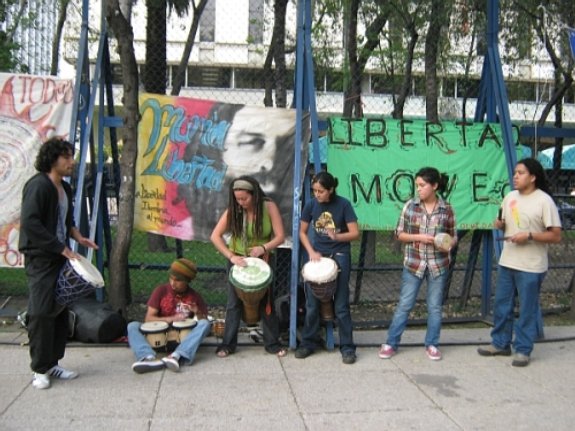
To the sound of drums, a little over a hundred of us demanded freedom for Mumia Abu-Jamal outside the United States Embassy in Mexico City on December 9, 2009, as well as for Leonard Peltier, the men and women of MOVE, the Angola 3, Sundiata Acoli, Los Cinco, Francisco Torres, Hugo Pinell, Ruchell Magee, Marilyn Buck, Dr. Mutulu Shakur, the Puerto Rican Independentistas, David Gilbert, Ramsey Muñiz, the environmental prisoners and all the social activists that this government intends to bury alive. We also demanded freedom for the 11,000 Palestinian political prisoners resisting torture and imprisonment in Israeli jails.
We accuse the United States government of kidnapping Mumia Abu-Jamal and holding him in conditions of torture for 28 years and of making an ongoing attempt on his life. In spite of all the evidence of racial discrimination in his trial, the Supreme Court of the United States the highest court in the land has denied him justice and, in so doing, has become party to these crimes. Despite photographic evidence that completely destroys the ridiculous scenario put forward by the Philadelphia District Attorney's office of the shooting death of policemen Daniel Faulkner in 1981, the managers of the national security state are now redoubling their efforts to execute this revolutionary journalist. If they're not able to apply the death penalty, which is nothing but premeditated murder, they plan to hold him captive in silence for the rest of his life. We support the demand for a federal civil rights investigation and all actions necessary to win his freedom.
We also accuse the United States government of fostering political prison and the extermination of the social struggle here in Mexico by training and equipping military and police forces to repress the social movements. We demand freedom for Ignacio del Valle, Felipe Álvarez, and Héctor Galindo, now held with long vengeful sentences which amount to life in prison, and freedom for the prisoners in Molino de Flores, the recently arrested comrades Victor Herrera Govea and Emmanuel Hernández Hernández, and all political prisoners in Oaxaca, Campeche, Guerrero and the entire country. We say NO to Plan México and NO to the construction of more prisons.
Our moderator Armando spoke of Mumia Abu-Jamal as a comrade we've supported for a long time, condemned to death or life in prison for "being a critic of the highly racist society of the United States, whose own Declaration of Independence refers to indigenous people as "merciless Indian savages' and which is built on the slave labor of people brought there from Africa. The history of the United States has been one of slavery, imperialism, and the robbery of the wealth of other peoples, all of which we have experienced in Mexico. And since Mumia is a good critic, he brings out these things. That's why he's in prison".
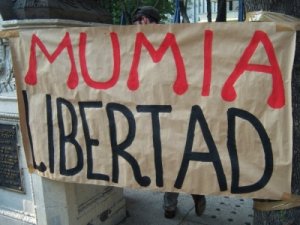
After reading Mumia's essay on Oscar Grant, whose murder by a BART policeman sparked a rebellion in the streets of Oakland at the first of the year, one of our members, Hilda, commented that although Mumia Abu-Jamal is now officially condemned to life in prison, there is a big effort to execute him and that his life is in grave danger. She explained that this essay is one of many things he has written on different issues, including Atenco, Oaxaca, the war in Iraq, from his small cell on death row where he has no physical contact whatsoever with his family or friends. She mentioned that it's a paradox to speak of this situation on the eve of the celebration of International Human Rights Day, and she also denounced the numerous human rights violations in Mexico by the Army, a body that has no business patrolling the streets.
It gave us great pleasure to have ex political prisoner Jacobo Silva Nogales with us at this rally. He and Gloria Arenas Agis, recently won their freedom after spending ten years in prison for guerrilla activity with Jacobo arguing their right to rebellion. He said: "And who is Mumia Abu-Jamal? The first time I heard that name I was in prison, and I learned that he was also in prison. I learned that he was a political prisoner, and I was also a political prisoner". Mumia is a mirror that we're proud to look at because what we see is admired and respected; it's what the rest of us are, if only slightly and in exceptional moments. But he's also a mirror that's feared because it shows what can happen when self and duty become one and the same thing. The mirror admired and respected; that's Mumia an admirable struggle and a death sentence. So it also reflects those who have sentenced him. It reflects their fear of a better world for the many. That's why they want him dead; that's why we want him alive". It may seem hard, at times, to win freedom when you're in a prison where they try to ban your very dreams, but it's possible to get out of there if the dreams from the outside come together with those on the inside". I know this, because not long ago I was in a place like that, and I was able to get out, and so I'd like to tell him that I think he can get out, too that he can, that we can, win out over those bars that are blocking the freedom of his body, like he's been able to win out over those that block his freedom of spirit. By defending Mumia, we're defending our own selves!"
Also present were family members and comrades of Víctor Herrera Govea, recently arrested in the annual October 2nd march in commemoration of the Tlatelolco Massacre, simply for being young and protesting in the streets of Mexico City. His sisters invited everyone to participate in the activities in his support and read a letter that he sent to the rally, which says in part: "Today it's not only in México that we're experiencing the oppression of the prison system. This is also the case in Philadelphia, Pennsylvania, where Mumia Abu-Jamal, who was once a reporter for the Black Panthers, has been in jail for 28 years, sentenced to death or life imprisonment".The way his trials have been conducted reflects the nature of the ghetto experienced in the United States, a country where 42% of the prison population is made up of African-Americans".Once again, we find ourselves under attack by the neoliberal prison system. As lovers of freedom and anarchists who defend life lived in collectivity, we are not exempt from government espionage and measures of repression and oppression".The only thing left to do is keep on struggling for our prisoners in Mexico and those outside the country like Mumia Abu-Jamal, who's been incriminated for a murder he did not commit".There's no evidence whatsoever against us, either".To Mumia, our heartfelt desire to see him free. To the government, the worst of all possible downfalls".
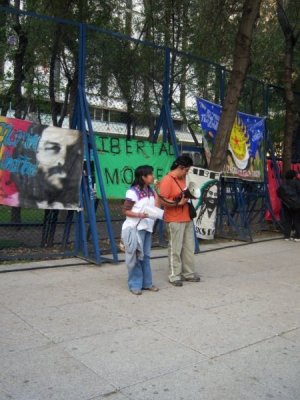
We read a letter recently published in La Jornada by political prisoner Felipe Álvarez of the Peoples' Front in Defense of the Land (FPDT) of San Salvador Atenco: "Eight years after we launched a resistance struggle against an invasive, oppressive, murderous system, I ask you to keep on struggling. There's no torture that will ever make us give up our ideals; they can chain my body but never my consciousness. Neither can they chain the dignity and spirit of our peoples who are fighting for what belongs to them. The government still intends to dispossess us of what is ours and put it at the service of empire, taking our lands, water, oil, light, and the little wealth we have left".It's only those of us who struggle for land, natural resources and freedom who can gain the independence, sovereignty, and homeland that those who are looting our country talk so much about. Brothers and sisters, you live in my heart! Not one step backwards! Zapata lives! The Front continues!"
Doña Fili spoke: "Mumia, there are a lot of young people here who hadn't even been born when you went to jail. We, as mothers, see you as our son and demand your freedom. We will never tire of demanding your freedom. You live in a highly advanced country. Advanced, yes, but in death"You've resisted a country that has killed our peoples"In our countries, they impose tyrants, but we'll bring them down"You are part of our people, Mumia. You've marked our history. That's why we're here, Mumia. Your spirit lives in each one of us."
We appreciated the presence of the Federation of the Socialist Campesino Students of Mexico (FECSM), which has been in a struggle against government plans to convert rural teacher training schools into mere technical schools in places such as Tiripetío, Michoacán and Ayotzinapa, Guerrero. Their representative Isaías sent his greetings to Mumia, and said: "Comrades, as a Federation, we've had prisoners; as a Federation, we've been beaten; as a Federation, we've been tortured by the federal government, so we lend our solidarity to all those who struggle from below".We've seen how the imperialists have increasingly taken over our freedom and our resources. We have the same enemy and we'll struggle with you against this common enemy."
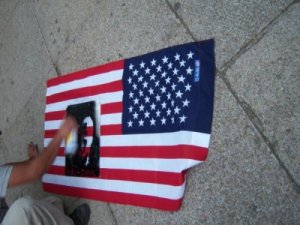
Daniel, speaking for the collective Shouts of Street Rage (GRC), said: "28 years have gone by. Those numbers may be easy to say. 28 años. But I've reached the conclusion that my mother was a child when a person, a thinker, a journalist was taken prisoner. Why? Because, as we know, the State is afraid of people who, with their words, their gaze, their actions, generate actions that destroy the system we talked about. You mothers walking by in the street, I ask you: What if Mumia Abu-Jamal were your son? What if they had taken away his freedom and what if he were locked up on death row thinking, "Damn! They could shoot me up with drugs tomorrow and end my life!? This comrade, in spite of being behind bars, not being able to see the light of day, not being able to hug his family, has stayed active and is still present in the social processes from inside, yes, but he's part of things. Is it right to just stand by when we see a life in danger right before our eyes? When we see false evidence, a new trial denied, the death penalty, a life sentence, total injustice and impunity? And now the question is what are we going to do?
From Chiapas, we received greetings from the poet Xmal Ton, adherent to the Sixth Declaration of the EZLN: "This song is dedicated to all our comrade political prisoners in Abya Yala, which is America, in all the continents of the world. Thank you for your bravery and your force, which are the breath of life to us. Thank you for your spirit of struggle, which is the road we take every day. For the liberation of all of us who struggle for our great, sacred mother, which is the Earth." We read her poem "Four words," dedicated to all political prisoners and especially to the grandfather Leonard Peltier: "Four words fall from the sky. Do not be sad. Four words fall from the sky. They will heal you. Four words fall from the sky. The morning is ready for you. Four words fall from the sky. The fire will warm your heart. Four words fall from the sky. The air will pray for you""
After reading the poem, our comrade Bisharú commented: "I feel very close to Mumia because of his words, because of the way he talks about the social movements. Sometimes I feel ashamed when I think that somebody in his conditions can be much freer than the rest of us. He has shown us that freedom is not only seen in actions, but also comes through in Mumia's words that have brought life and liberty to many of us."
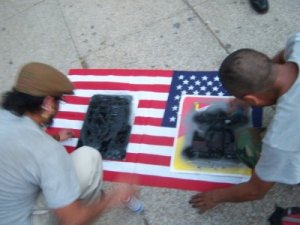
We denounced the attacks against the Zapatista communities and read a recent letter from the Gómez Saragos brothers, of Bachajón, Chiapas, to all the national and international organizations, where they say: ""we belong to the organization of adherents to the other campaign of the EZLN, and we're here for defending our territory while the government wants the PRI party members to have it, but we"don't want them to take away our land because that's where we work to support our children. That's why we're prisoners. But we thank you for your valuable support and hope that you'll continue to support us in reaching our goals."
Yazmín of the Chanti Ollin spoke of the recent effort by the city government to take this occupied space away from us, and then she read the text written this past November 25 by Nzingha Shakur-Ali, daughter of political prisoner, Dr. Mutulu Shakur: "My dad goes before the parole board December 2nd. Thinking about my family and the families of other political prisoners and freedom fighters around the world" i am SO truly blessed to come from the family i do, from the Hearne clan, from the Shakur clan. It's a different way of life in many ways, being children of revolutionaries. Our parents fought, were imprisoned, were exiled, and died fighting for basic human equality; and all the while growing up in discipline and knowledge, love and respect for not only our people, but for all people. we think differently; we see the world differently". now Mutulu is in Florence, Colorado, the #1 maximum security prison in the united states also known as the ADMAX, Supermax, or The Alcatraz of the Rockies, ADX houses the prisoners who are deemed the most dangerous and in need of the tightest control. It is the highest level security federal prison in the united states, and generally considered the most secure prison in the world. Individuals are kept for at least 23 hours each day in solitary confinement." That means he gets 1 hour, by himself, outside his cell in heavily guarded area. All of our visits are behind glass and he often handcuffed". these things come to mind as his parole hearing draws near. They have and continue to do everything they possibly can to keep him in prison" i am humbled by those who, like mutulu, saw their difficult path before them and even still chose to stand and fight, rather than lay down and continue to be enslaved".i give thanks for the people who fought and are still fighting for freedom and equality". My blood? is a million stories. FREE "EM ALL. Peace."
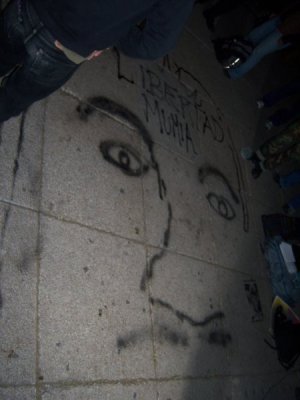
Victor of the Popular Kitchen of the Che Guevara Auditorium talked about the way prisons exemplify capitalism, commenting that for Mumia Abu-Jamal, "the American dream, for whites only, was just a prison and the Black Panther Party was his road to freedom." He quoted from Mumia's book, We Want Freedom: A Life in the Black Panther Party: "I went to jail". I was here for defending my people. I was here because I was a member of the Black Panther Party. Within a few weeks I was back, no worse for the wear. I was out of jail and back in the swing of things. I was working on the paper, selling them, and editing stuff"The days were long. The risks were substantial. The rewards were few. Yet the freedom was hypnotic. We could think freely, write freely, and act freely in the world. We knew that we were working for our people's freedom, and we loved it. It was the one place in the world that it seemed right to be." In speaking of Mumia Abu-Jamal's relationship to the MOVE organization, Victor said: "Mumia rediscovered people bent on freedom and an organization that was an alternative to the logic of the coercion and degradation of human beings by the panoptic prison. But the prison system still existed along with its forms of repression and sabotage. In the face of the genocidal attacks by the North American system against the MOVE movement, Mumia could not remain silent; he denounced the massacre." Victor concluded his presentation, citing Mumia's essay "Absence of Power": "The police are agents of white, ruling-class, capitalist willperiod. Neither black managers nor black politicians can change that reality. The people themselves must organize for their own defense, or it won't get done."
Pachón of Mexico City Anarchist Black Cross read the following text: "Mumia's case is not isolated; it's part of a strategy of social control by
governments to try to break the righteous social movements and silence people who make them uncomfortable. The United States is the country with the highest percentage of its population imprisoned, the majority of whom are Black or Latinos. More and more people in jail. That's what the goverments and private industry want so they can build more and more prisons".Mumia's example should give us the strength to redouble our efforts to win
his freedom. IN conclusion, we want to call attention to the cases of other political prisoners in the United States and name some of them: Abdul Azeez, Abdul Majid, Alvaro Luna Hernández, Antonio Guerrero, Avelino González Claudio, Bill Dunne, Byron Shane Chubbuck, Carlos Alberto Torres, Chuck Sims Africa, Daniel Mcgowan, David Gilbert, Debbie Sims Africa, Delbert Orr Africa, Ed Poindexter, Edward Goodman Africa, Erik Oseland, Eryn Trimmer,
Francisco Torres, Fred "Muhammad" Burton, Garret Fitzgerald, Gerardo Hernandez, Hanif S. Bey (B. Gereau), Herman Bell, Jaan K. Laaman, Jamil Abdullah Al-Amin, Jalil Muntaqim,
 Janet Holloway Africa, Janine Phillips Africa, Jeffery "Free" Luers, Joseph
"Joe-Joe" Bowen, Leonard Peltier, Luce Guillen-Givens, Luis Medina, Malik Smith, Maliki Latine, Marilyn Buck, Marshall Eddie Conway, Matthew Depalpma, Max Specktor,
Michael Davis Africa, Mondo We Langa (D. Rice), Monica Bicking, Dr. Mutulu Shakur, Nathanael Secor, Oscar Lopez Rivera, Rene Gonzalez, Robert Seth Hayes, Romaine Chip Fitzgerald, Ronald Reed, Ruben Campa, Russell Maroon Shoats, Sekou Kambui (W. Turk), Sekou Odinga, Sundiata Acoli (C. Squire), Thomas Manning, Tsutomu Shirosaki, Veronza Bowers Jr., William Phillips Africa, William "Lefty' Gilday, Zolo Agona Azania".
Janet Holloway Africa, Janine Phillips Africa, Jeffery "Free" Luers, Joseph
"Joe-Joe" Bowen, Leonard Peltier, Luce Guillen-Givens, Luis Medina, Malik Smith, Maliki Latine, Marilyn Buck, Marshall Eddie Conway, Matthew Depalpma, Max Specktor,
Michael Davis Africa, Mondo We Langa (D. Rice), Monica Bicking, Dr. Mutulu Shakur, Nathanael Secor, Oscar Lopez Rivera, Rene Gonzalez, Robert Seth Hayes, Romaine Chip Fitzgerald, Ronald Reed, Ruben Campa, Russell Maroon Shoats, Sekou Kambui (W. Turk), Sekou Odinga, Sundiata Acoli (C. Squire), Thomas Manning, Tsutomu Shirosaki, Veronza Bowers Jr., William Phillips Africa, William "Lefty' Gilday, Zolo Agona Azania".
Despite sound problems, the comrades of The Other Culture closed the rally with their original song dedicated to Mumia as a gesture of solidarity, and also brought copies of their new CD highlighting the song. Several images of Mumia were left behind on the ground and the concrete barriers around the Embassy, along with the ashes of the stars and stripes.
Free Mumia: events on Dec 9 in Philadelphia
On Wednesday, December 9, 2009, join International Concerned Family and Friends of Mumia Abu-Jamal and the Free Mumia Coalition NYC, as we gather to protest the 28-yearconspiracy to execute Mumia Abu-Jamal for a crime that an enormous amount of evidence proves he did not commit.
Lynne Abraham, the outgoing District Attorney, and Seth Williams, the newly elected black DA, want to bury the truth and silence Mumia forever.
THE PROTEST BEGINS AT 4 PM IN FRONT OF THE GOVERNOR'S REGIONAL OFFICE, 200 SOUTH BROAD STREET, NEAR MARKET STREET, IN PHILADELPHIA.
There will be an indoor meeting following the protest at 7PM at the American Friends Center, 1515 Cherry Street. To reserve a seat on the bus, call 212 330-8029. For information on our work visit www.freemumia.com
Press Release: Delivery of Mumia Petition to US Department of Justice
For Immediate Release: November 10, 2009
Contact: Suzanne Ross (917) 584-2135 - Pam Africa (215) 476-8812
International Representatives Join US Activists in Delivering to Attorney General Eric Holder Thousands of Letters Demanding a Civil Rights Investigation of the Case of Mumia Abu-Jamal
PRESS CONFERENCE:
New York Avenue Presbyterian Church
1313 New York Avenue
Washington, DC, 11:30 A.M.
MARCH TO JUSTICE DEPARTMENT AND PRESENTATION OF LETTERS FOLLOWS, ARRIVING AT DEPARTMENT OF JUSTICE 1:30 PM
Supporters of Pennsylvania death row political prisoner Mumia Abu-Jamal will march to the US Department of Justice in Washington, DC, on November 12 to deliver thousands of petitions to Attorney General Eric Holder demanding that the department open an investigation into the multitude of violations of Abu-Jamal's civil rights over the past 28 years.
A press conference at 11:30 AM at the New York Avenue Presbyterian Church will be followed by a march to the Department of Justice where the letters demanding such an investigation will be brought.
Among the speakers at the press conference will be Laura Moye, Director, Amnesty International's Death Penalty Abolition Campaign; Steven Hawkins, Vice President, National NAACP; Marvin "Doc" Cheatham, Sr., President, Baltimore NAACP; Pam Africa, International Concerned Family and Friends of Mumia Abu-Jamal; Fignolé Saint-Cyr, President of Autonomous Unions of Haiti; Berlin Coalition to Free Mumia Abu-Jamal; El-Hajj Mauri' Saalakhan, Washington, DC, Director of Operations, Peace and Justice Foundation; Thomas Ruffin, attorney; Joseph "Jazz" Hayden, Riverside Church Prison Ministry; Panama Alba, National Congress of Puerto Rican Rights, Campaign to End the Death Penalty, and others.
Many Muslim organizations are supporting the call for a civil rights investigation of Abu-Jamal's case. Representatives of these groups will be present both at the press conference and the subsequent rally at the Justice Department to express support for Mumia Abu-Jamal while pointing out similarities between the due process and human rights violations in his case and those that are perpetrated daily against the Muslim political prisoners and prisoners of war.
This past July the NAACP passed an emergency resolution at its 100th anniversary convention in New York, asking Mr. Holder to conduct a civil rights investigation. "We're going to ask Attorney General Holder to look into this," said NAACP Chairman Julian Bond, during a broadcast of Pacifica Radio's "Democracy Now" on July 20. "As anyone who's followed this case for a number of years knows, similar doubts have been raised about him as were raised about Troy Davis." Later, Hilary Shelton, director of the NAACP's Washington office, told The Final Call, "We had a meeting with the attorney general, and the subject of Mumia Abu Jamal did surface. The attorney general said he was aware of the case and would look into it and get back to us."
Pam Africa, long-time Chair of International Concerned Family and Friends of Mumia Abu-Jamal, has announced that, "We are not coming to the Department of Justice looking for justice. We are bringing justice to the Department of Justice!" Dr. Suzanne Ross of the Free Mumia Abu-Jamal Coalition adds, "At this critical moment in Mumia's case, a civil rights investigation could mean the difference between life and death for Mumia. It could also open the door for his release."
The call for a civil rights investigation follows the April 2009 U.S. Supreme Court acceptance of the Third Circuit's decision that closed all doors for a new trial or the consideration of Abu-Jamal's innocence. Meanwhile, the Supreme Court is still considering an appeal by the Philadelphia District Attorney's Office to immediately reinstate Abu-Jamal's death sentence.
International legal bodies such as Amnesty International, the International Association of Democratic Lawyers, the European Parliament, and city councils and national governments around the world have argued for decades that Abu-Jamal was wrongfully convicted in a widely denounced trial and appeals process for the 1981 killing of a Philadelphia police officer. They point to suppressed evidence, witness intimidation and consequent witness perjury, a very specious confession, an admittedly biased judge and a long string of twisted appellate court rulings as evidence of a continuing conspiracy by the state of Pennsylvania to execute him. Additionally, and this is a critical basis for a civil rights investigation as occurred during the overturning of the conviction of Senator Ted Stevens of Alaska, there is extensive evidence of consistent withholding of evidence from the defense that could have led to Mumia's acquittal photographs challenging the prosecution's version of what happened on December 9, 1981, and evidence that another person other than Mumia, his brother, and Faulkner were at the crime scene at the time Office Faulkner was shot.
The march to the Justice Department will follow the press conference and is being co-sponsored by International Concerned Family and Friends of Mumia Abu-Jamal, National Lawyers Guild, (NYC Chapter), WESPAC, Riverside Justice Prison Ministry, Iglesia San Romero (UCC), Campaign to End the Death Penalty, International Action Center, Peace and Justice Foundation, Families United for Justice in America, Nat Turner Rebellion, Black August Planning Committee, National Jericho Movement, , and ANSWER, among others.
The delivery of the petitions is expected to take place at 1:30 pm. The campaign has been endorsed by a broad range of individuals including Angela Davis, Ruby Dee, Charles Rangel, Cynthia McKinney, Noam Chomsky, Cornel West, and Tariq Ali.
In 1982 Mumia Abu-Jamal was convicted of murdering a Philadelphia police officer and sentenced to death. His case is one of the most contested in U.S. history. Prosecutors, the Fraternal Order of Police and their supporters, and even the judges involved, have always claimed to possess a watertight case justifying Abu-Jamal's conviction and sentence.
Yet Abu-Jamal's trial, conviction, and death sentence have prompted jurists and human rights organizations worldwide to denounce the trial and death sentence as a travesty of justice. They cite the open bias of the original judge, who was overheard to have said outside his courtroom, "I'm going to help them fry the n - - -- -".
Not only is this a strong indication of racial bias, a reality minimized by the judge who took over the case, but it clearly identified the absence of the requisite "judicial neutrality" expected of a judge.
The racially skewed process of jury selection, furthermore, yielded a disproportionately white jury, the disappearance of key ballistics evidence, and police intimidation of witnesses leading to perjured statements. Amnesty International, in its 2000 report called "A Life in the Balance: The Case of Mumia Abu-Jamal" stated that, "numerous aspects of this case clearly failed to meet minimum international standards safeguarding the fairness of legal proceedings" and strongly recommended a new trial.
Abu-Jamal's defense team identified 29 claims of violation of his constitutional rights, but Abu-Jamal has been repeatedly denied the opportunity to have evidence of his innocence and of police and prosecutorial efforts to frame and convict him seriously considered.
Abu- Jamal has always asserted his innocence and his affidavit on this is included in the press packet.
Clearly Mumia Abu-Jamal's race and his political views, as well as his widely recognized enormous talent in communicating those views, have played a key role in his being the object of a 28 year conspiracy to forever silence his voice.
SF Bay Area Expressing Solidarity With Mumia Abu-Jamal
We Demand A Civil Rights Investigation For Mumia Abu-Jamal!
New Videos of November 8 Event in San Francisco Expressing Solidarity With the November 12 Washington DC Action for Mumia at the Justice Department
On November 8, 2009, the SF Bay Area Mobilization to Free Mumia Abu-Jamal organized an event at Centro Del Pueblo in San Francisco. The event focused on three innocent men who may soon be executed soon, depending on upcoming court rulings: Troy Davis, Kevin Cooper, and Mumia Abu-Jamal.
Counterpunch: Glen Beck's Mumia Obsession / Fox Finds a New Black Boogeyman
by Linn Washingtio, Jr.
Mumia Abu-Jamal faces new execution threat
by Jeff Mackler
After almost 28 years on Pennsylvania's death row and innumerable battles in the U.S. criminal injustice system, innocent political prisoner, journalist and world renowned "Voice of the Voiceless" Mumia Abu-Jamal lost his final appeal on April 6, 2009. Ignoring it's own precedents and those of the Third Circuit U.S. Court of Appeals below it, the U.S. Supreme Court declined to affirm what had been the "law of the land" for decades, that the systematic and racist exclusion of Blacks from juries voids all guilty verdicts and mandates a new trial.
In Mumia's 1982 trial presided over by the notorious "hanging judge" Albert Sabo, the prosecutor Joseph McGill used 10 or perhaps 11 of his 15 peremptory strikes against Black jurors. But as with virtually all court decisions over the past decades in Mumia's case, the "Mumia Exception," the contorted interpretation of the "law" to reach a predetermined result, was once again applied, with the high court refusing to review the twisted logic of its subordinate bodies thereby allowing Mumia's frame-up murder conviction to stand.
But what has caught the attention of both legal observers and human rights activists even more is the fact that the same court, while refusing to hear Mumia's appeal, chose to delay a ruling on a cross appeal filed by the State of Pennsylvania that seeks Mumia's execution. Pennsylvania prosecutors, twice rejected in their efforts to impose the death penalty on Mumia (in 2001 and 2008), may have found new support in the U.S. Supreme Court.
It appears that the court's delay in ruling on the validity of Mumia's original execution sentence was due to its decision to grant oral arguments in the Ohio case of Smith v. Spisak, a case that might re-write or reinterpret the nation's laws to make it easier to obtain jury verdicts calling for execution. The Court heard Ohio prosecutor's arguments for Spisak's execution on October 13, 2009. A ruling is expected in the year ahead.
Frank Spisak, a neo-Nazis who wore a Hitler mustache to his trial, denounced Jews, and Blacks and confessed in court to three hate crime murders in Ohio, saw his jury-imposed death sentence reversed in the federal courts when his attorney's successfully invoked a 1988 Supreme Court decision in the famous Mills v. Maryland case. Mills requires that in order to find mitigating circumstances sufficient to impose a sentence of life imprisonment without parole, as opposed to the death penalty, the jury's majority decision (as opposed to unanimous decision) on each mitigating circumstance is sufficient. In both Spisak and Mumia's case the presiding trial court judge violated Mills and in essence instructed the juries that unanimity, not a majority vote on each mitigating circumstance was required. In both cases the prosecution's appeal was rejected and Mills was upheld, thus staying the imposed death sentences and ordering a new trial or sentencing hearing with the proper jury instructions. In both cases the prosecution, seeking to avoid a new trial in any form, appealed to the U.S. Supreme Court demanding execution.
An April 7, 2009 article in the Legal Intelligencer, the oldest law journal in the country, had this to say about the Supreme Court's decision to delay a ruling on Pennsylvania's request to re-impose the death penalty on Mumia.
"In both cases, [Spisak and Abu-Jamal] the federal courts' decisions to overturn the death sentences hinged on Mills v. Maryland -- a 1988 U.S. Supreme Court decision that governs how juries should deliberate during the penalty phase of a capital trial.
"The Mills ruling struck down a Maryland statute that said juries in capital cases must be unanimous on any aggravating or mitigating factor. [Emphasis added].
"The justices declared that unanimity was properly required for any aggravating factor, but that mitigating factors -- those that weigh against imposing a death sentence -- must be handled more liberally, with each juror free to find on his or her own."
The effect of Mills was to make it harder for prosecutors to obtain death sentences in capital cases. The Intelligencer concludes, "The question now before the courts is whether Mills requires that death sentences in other states be overturned if the juries in those states are misled by faulty instructions or sufficiently vague verdict forms to believe that mitigating factors require unanimity." [Emphasis added].
I emphasize the words "other states" because prior to this unexpected turn of events the legal community appeared to agree that Mills applied to all states. That is, if a jury was orally mis-instructed and/or received faulty or unclear verdict forms that implied it needed to be unanimous with regard to mitigating circumstances sufficient to not impose the death penalty, the death penalty was set aside and a new sentencing hearing was ordered.
This is what happened in Mumia's case when Federal District Court Judge William H. Yohn in 2001 employed Mills to set aside the jury's death penalty decision. Yohn gave the State of Pennsylvania 180 days to decide whether or not to retry Mumia at a new sentencing hearing where new evidence of innocence can be presented by Mumia, but where the jury can only decide between execution and life in prison without parole. At this hearing, the jury cannot make a decision regarding guilt. Since then, Pennsylvania officials have effectively stayed Yohn's order by appealing to the higher federal courts.
In deciding to hear Ohio prosecutors' arguments in the Spisak case with regard to Mills the Supreme Court has implied that one of the key issues they will consider centers on the interpretation of the concept of federalism, that is, that the exercise of power in the U.S. is shared in some measure between the federal government and the states. The political pendulum has swung back and forth on this issue. In past decades, the "states' rights" interpretation was employed to justify racist state laws that denied Blacks access to public institutions and facilities. With the rise of the Civil Rights movement federal power was used to compel the elimination of the same racist laws. Justice has been far from blind in racist America. It is applied to the advantage of the working class and the oppressed only to the extent that the relationship of forces, that is, the struggles of the masses, demand it.
Since Mills was decided in the State of Maryland, the would-be Ohio and Pennsylvania executioners argue that based on the laws of their states, Mills cannot be automatically applied to the situation in Ohio where a different set of jury instructions and therefore jury deliberations were involved. Indeed, Ohio prosecutors argued before the Supreme Court on October 13 that Ohio and Pennsylvania were the exception and not the rule and that the norm in other states was to essentially reject a strict interpretation of Mills in favor of various state guidelines regarding jury instructions.
Should this "states' rights" argument be accepted and Mills be effectively constricted, the Supreme Court could then uphold Spisak's death sentence and, with a mere citation to Spisak and the new interpretation of Mills, uphold the Pennsylvania's appeal seeking Mumia's execution.
While most legal observers previously considered a Supreme Court Mills re-interpretation a virtual impossibility, the stage has now been set for such an outcome. The state's longstanding effort o execute Mumia has been given new legal avenues for success with the top court's decision to re-consider the Spisak case.
What the Supreme Court will do, however, is far from clear. It will also consider Spisak's new attorney's argument that his jury trial lawyers were incompetent in essentially arguing during their trial summation that Spisak was essentially an extreme and horrific nut case who barely understood what he was doing. Should the Supreme Court chose to ignore or side-step Pennsylvania's Mills arguments and rule only on the issue of ineffective assistance of counsel, the chances of Mumia's execution recede considerably. The court could also chose to remand the case back to the lower courts to reconsider their previous Mills interpretation in light of the Supreme Court's possible new instructions on this issue. Second guessing the courts in Mumia's 28-year legal sojourn has stumped virtually the entire legal community, or at least those who believe that the laws of the land should be implemented without prejudice to the individual concerned. In virtually every instance, however, this has not been the case; an unending series of legal atrocities have been perpetrated against Mumia that expose the criminal "justice" system for the fraud it is in racist and classist America.
Mumia is far from out of danger, especially when his very life, in legal terms, presently hinges on the whims of the Supreme Court, the institution that has already denied his request for a hearing before them on another issue, the systematic and racist exclusion of Black jurors. Such exclusion is explicitly prohibited in the historic 1986 Supreme Court ruling in the case of Batson v. Kentucky. But the court once again ignored its own rulings, and even decisions that strengthened Batson claims, to hasten Mumia's demise. In every sense Mumia's life is on the line as never before. Pennsylvania's Governor Ed Rendell is pledged to sign what could be the third and final warrant for Mumia's execution, a warrant that would likely order that his life be taken by lethal injection.
Mumia's supporters around the world and Mumia himself have long known that the battle for his life and freedom would be qualitatively more advanced by the construction of a powerful mass movement in the streets that won the hearts and minds of millions and more than reliance on a court system permeated by its very nature with class and race bias.
The state power's march for Mumia's execution has not been limited to the courts. The 2007 "Murdered by Mumia" book co-authored by Maureen Faulkner, the wife of police officer Daniel Faulkner, who Mumia was falsely convicted of murdering, and rightwing talk radio host, Michael Smerconish, presents an outrageous account of Faulkner's murder. While having little or no basis in the facts of the case the book has nevertheless been used to advance the Fraternal Order of Police's longstanding campaign to execute the "cop killer."
More recently, filmmaker Tigre Hill has produced a work scheduled for a debut in Philadelphia in December and later international distribution entitled, "The Barrel of a Gun," wherein ex-Black Panther leader Bobby Seal's rhetoric about "offing the pig," is coupled with rightwinger David Horowitz's assertions that Mumia was merely carrying out Panther policy. The three-minute preview or trailer to "The Barrel of a Gun" theorizes, without a shred of evidence, that Mumia and his brother Billy Cook, literally planned the Faulkner murder, ambush style.
Those unfamiliar with Mumia's background and the facts of the case could only conclude that Mumia was guilty without question. That Mumia had left the disintegrating Panthers more than a decade before his frame-up trial, that he was an award-winning journalist and president of the Association of Black Journalists, a leading reporter/critic of the Philadelphia Police Department, dozens of whose officers were indicted and convicted on Justice Department charges of involvement in drug-running, prostitution, planting and falsification evidence and intimidation of witnesses, was not mentioned.
Today, having exhausted most all legal remedies, Mumia's supporters are engaged in an important campaign to demand a Justice Department civil rights investigation into charges presented by his supporters that demonstrate illegal collusion between Pennsylvania prosecutors and the judiciary. A delegation of Mumia's defenders across the country has planned a November 12 visit to Washington, D.C. where a meeting with Attorney General Eric Holder will be sought for this purpose. Thousands of petitions demanding Mumia's freedom obtained across the world will also be presented Holder and to officials of the U.S. Supreme Court.
Similarly, a mass antiwar protest in Washington, D.C.'s Malcolm X Park is set for Saturday, November 7. In addition to the immediate withdrawal of all U.S. troops from the Middle East the sponsoring Black is Back Coalition is demanding Mumia's freedom.
In the San Francisco Bay Area the Mobilization to Free Mumia Abu-Jamal is sponsoring a tour with Amnesty International's Death Penalty Abolition Campaign leader Laura Moye. Entitled "Innocent but Facing Execution," the tour will focus on the cases of Mumia, Troy Davis and Kevin Cooper, three innocent frame-up victims of America's racist criminal "justice" system.
For information in Philadelphia call: 215-476-8812. In San Francisco: 510-268-9429.
Get Ready for the Emergency Protests!
They Want to Kill Mumia Abu-Jamal - But Joint Action by Us All Can Prevent This!
The Fantasies of Joe McGill
Recently the lynch mob around M. Smerconish started activities to get the US-public warmed up to the idea of murdering Mumia Abu-Jamal by the state of Pennsylvania. They published articles all over the US and in Europe, too. E.g. the German weekly SPIEGEL fell to their propaganda and published Smerconish influenced lies on almost 5 pages this summer. Now Smerconish paid a filmmaker, Tigre Hill to produce a new vicious attack on reality. They will publish a film about Mumia Abu-jamal and Daniel Faulkner in December 2009. The german author Michael Schiffmann had a look at various press releases and wrote the following article with the title "The Fantasies of Joe McGill"
From the National Writers Union, United Auto Workers Local
From the New York City FREE MUMIA Coalition:
Sisters and Brothers,
We are very happy to announce that the National Writers Union, United Auto Workers Local 1981, has passed a resolution supporting the Civil Rights Investigation of the Case of Mumia Abu-Jamal. Take note, union organizers, community group activists, and church/mosque/synagogue attendees - your group, too, can pass such a resolution!
-------------------------
Whereas award-winning, prolific writer and broadcast journalist Mumia Abu Jamal was accorded honorary membership in the National Writers Union in 1995 and he thereafter worked actively with the Philadelphia Chapter for many years;
Whereas the principle of a fair trial is a constitutional right;
Whereas those who support Mumia believe that he did not receive a fair trial in 1982 based on more than 20 well-documented legal issues;
Whereas extensive evidence of prosecutorial and judicial misconduct in Mumia's trial has surfaced that could have led to Mumia's acquittal (which was the basis on which Attorney General Holder used to overturn the conviction this spring of former Senator Stevens of Alaska);
Whereas Mumia is still on death row in Pennsylvania after 27 years and the Supreme Court this spring turned down a petition to review his request for a new trial;
Whereas the NAACP adopted a resolution at its 2009 convention to press Attorney General Holder to conduct a civil rights investigation of his case;
Hereby be it resolved that the NWU in solidarity with our honorary member Mumia Abu-Jamal endorse the NAACP resolution and sign the petition for a civil rights investigation of Mumia's case.
J. Patrick O'Connor: Civil Rights Investigation for Mumia Abu-Jamal
Very interesting video Interview on the question of what really happened on Dec. 9, 1981 when Mumia was shot and arrested fpor a murder of an police officer.
Campaign Resources
Journalists for Mumia has been working closely with the folks organizing the campaign for a federal civil rights investigation, and we are now releasing two new resources to be used for this campaign. Please help spread the word, and if you have access to photo-copying resources, please help by printing what you can!
- First, is a new, double-sided, 8.5 x 11, ballistics flyer detailing the many different problems
with the ballistics evidence that was used to convict Mumia. This flyer explicitly shows why the
prosecution's scenario of the shooting is ballistically impossible:
here... - Second, there is the 6,000 word article I wrote for the SF Bay View Newspaper, spotlighting the
civil rights campaign, and detailing 5 key pieces of evidence that were withheld. This article is
now available as a four page, 8.5 x 11, pdf file, that can also be made into one double sided,
11X17 booklet/pamphlet:
here... - Right now, organizing efforts are being focused on mobilizing for the July 13 press conference
at the NAACP National Convention in New York City, the day that Attorney General Eric Holder is
speaking. If you don't live close enough to New York City, there are still many ways to help
support this campaign. Please check out the campaign's new web page for more information:
here...
Citing Withheld Evidence, Supporters Of Mumia Abu-Jamal Call For Civil Rights Investigation
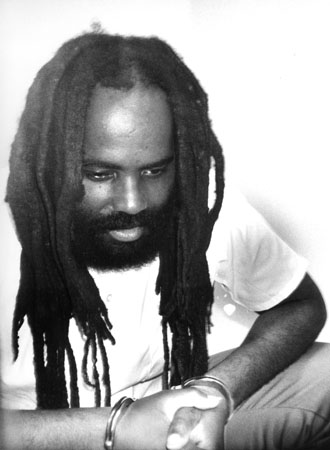
On April 6, 2009, the U.S. Supreme Court refused to consider an appeal from death-row journalist and former Black Panther Mumia Abu-Jamal, who was convicted of first-degree murder in the shooting death of white Philadelphia Police Officer Daniel Faulkner in a 1982 trial deemed unfair by Amnesty International, the European Parliament, the Japanese Diet, Nelson Mandela and numerous others. Citing the Supreme Court denial and several instances of withheld evidence, Abu-Jamal's international support network is now calling for a federal civil rights investigation into Abu-Jamal's case.
Philadelphia Tribune Columnist Linn Washington Jr. speaks about Mumia Abu-Jamal
Mumia and the D.A. candidates
This article by Milton McGriff from May 6, 2009 deals with Philadelphia's D.A.s and their twist of trial notes in order to reach the death penalty against Mumia Abu-Jamal.
Angela Y. Davis Speaks in Support of Mumia Abu-Jamal
Happy Birthday to Mumia Abu-Jamal: We are all prisoners
Interview with Angela Davis by JR Valrey on Mumia Abu-Jamal
The Liberator Magazine BlogFRIDAY, APRIL 24, 2009
In Her Own Words: An interview wit' Angela Davis
Source: The Liberator Magazine
here...
[2-day liberatormagazine.com featured story]
JR Valrey is the Minister of Information for the Prisoners Of Conscience Committee, an Oakland based organization founded by Fred Hampton, Jr. with the mission to liberate the minds and hearts of African and colonized people. The POCC takes the stand that all prisoners are political. JR is a regular contributor to The Liberator.
In Her Own Words. An interview wit' Angela Davis: Angela Davis is a legendary political activist professor in the U.C. System who has a history of resistance. She is a former political prisoner who has done work with the Communist Party, and she is also author of 8 books analyzing race, class, and gender. She also is a cofounder of the prison abolitionist group, Critical Resistance. She recently wrote a foreword to political prisoner Mumia Abu Jamal's new book "Jailhouse Lawyers", in which the Block Report did an interview with her to help promote.
I was first taught about Angela Davis being a political prisoner, later on the first jailhouse lawyer that I met through the mail was her codefendant who is still locked up, Ruchell Magee, whom I used to write occasionally. So this book gave me a better insight into what life as a jailhouse lawyer really is like. I dug the fact that Mumia picked a subject that is rarely discussed on this side of the walls. I learned a lot and it wet my appetite to wanting to learn more about these legal warriors. Check out Angela Davis as she talks about her foreword in Mumia's new book, in her own words...
M.O.I. JR: I want to talk to you today about your foreword in Mumia Abu Jamal's new book, "Jailhouse Lawyers". Since I know a lot of readers do not have the book, I want to start off with reading a few quotes, and I will ask you questions in relation to the quotes. You say in your foreword, "Mumia points to me what was for me a startling revelation. Jailhouse lawyers comprised the group most likely to be punished by the prison administration, more so than political prisoners, Black people, gang members, and gay prisoners whereas jailhouse layers are punished by what Mumia calls 'cover charges'. Historically they could be charged with internal violations for no other reason that they used the law to challenge prison guards, prison regimes, and prison conditions. In your opinion what is the importance of Mumia choosing jailhouse lawyers to be the subject for his new book?
Angela: Well first of all, this is an amazing book. Everyone should read this book. And I was extremely excited to learn that he was working on a book on jailhouse lawyers because the story of jailhouse lawyers is a hidden story. Most people in this country are not aware of the extent to which resistance to the regimes of prisons, state prisons, federal prisons all over the country, has been shaped through the work of jailhouse lawyers. There is a long tradition of resistance. And Mumia, himself, is a jailhouse lawyer. And if one thinks about how many men and women have used the law in order to challenge the prison regimes, one gets a sense of what a powerful legacy that resistance is.
M.O.I. JR: In another quote in your foreword you say, "Mumia argues that the passage of the Prison Litigation Reform Act is a violation of the Convention Against Torture for in ruling out psychological or mental injury as a basis to recover damages such sexual coercion that was represented in the Abu Ghraib photographs if perpetrated inside of a U.S. prison, would not have constituted evidence for a lawsuit. Why did you point this out in your foreword?
Angela: Many people assume that the the P.L.R.A., the Prison Litigation Reform Act, as I tried to point out in the foreword, simply prevents prisoners from engaging in frivolous lawsuits. But as Mumia points out, it is a pointed attack on the capacity of prisoners to use the law itself. It is not about frivolity at all, it is about taking away from prisoners one of the only instruments that they've been able to develop to challenge the whole system. So we can't assume that under the Clinton administration the P.L.R.A. was passed, and that put prison lawsuits to rest. It's important for those of us on the outside to support the rights of prisoners to use the law to resist the violence of the state.
M.O.I. JR: Again to quote you, you say in the foreword of "Jailhouse Lawyer", "The way he situates the P.L.R.A. historically as an inheritance of the Black Codes, which were themselves descended from the Slave Codes, allows to recognize the extent to which historical memories of slavery and racism are prescribed in the very structures of the prison system, and have helped to produce the Prison Industrial Complex." Can you discuss the importance of Mumia making this connection in "Jailhouse Lawyers"?
Angela: Well this is one of the things that I really loved about Mumia, he knows how to make these historical connections. He makes connections with what might appear to be very dispirit and different kinds of phenomenon, for example he points out that the P.L.R.A. was passed at the same time as the disestablishment of the welfare system, and that there is a connection between preventing women primarily from having access to safety nets for their families, and this assault on prisoners being able to defend themselves. So I really like the way that he makes those connections with slavery. I think of the prison system today in this country, and especially the system of capital punishment, I think of it as a historical memory of slavery, as a palpable inheritance of slavery. And as a matter of fact, the existence of those systems provide us with real evidence of the fact that slavery was not fully abolished. So I like the way in which he can show us the similarities between the Black Codes, that were produced in the aftermath of slavery to basically replicate the system of slavery after slavery was allegedly abolished. And the P.R.L.A. serves a similar contemporary purpose.
M.O.I. JR: Again, you write in "Jailhouse Lawyers", in the last sentence, "He (Mumia), allows us to reflect on the fact that transformational possibilities often emerge where we least expect them." Why did you end your foreword with that statement in this book?
Angela: Well you know because people don't usually think of prisoners in general as defending democracy. They think of the prison as the underside, the underbelly, of democracy; as the place where you send people who no longer have the right to be citizens. But I think that what Mumia does, he manages to portray jailhouse lawyers in such a ways as to persuade us regardless of what our political persuasions might be, the jailhouse lawyers have been, in a sense, on the front line of the defense of democracy. I'm not talking about capitalists democracy. I'm not talking about neo-liberal democracy. I'm talking about the kind of democracy that would also tend to not only political equality, but racial equality, economic equality, and sexual equality as well.
M.O.I. JR: What is the importance of us recognizing that Mumia is facing deathrow right at this second, right when he released such an eloquent book on jailhouse lawyers? You also pointed out in this foreword that he rarely speaks of himself, so in the midst of this being a time of the first Black president of America, what does Mumia's imprisonment, with all the flaws in his case, say about the real political climate in America?
Angela: Well, first of all, Mumia's case is so important for us to get involved in. We have to save his life. We have to free Mumia. And yeah, as many people acknowledge he rarely uses his amazing talent and capacities to advocate for himself. He's always advocating for others, and that is all the more reason to be passionate advocates for him. I have traveled in other parts of the world a great deal, and there are movements to free Mumia all over the world. Sometimes I feel very embarrassed that we have not managed to overcome the power of the Fraternal Order of Police for example and the other conservative forces that are determined to put Mumia to death. But this book is yet another reason why we need to defend him, and why we need to use whatever is available to us, whatever knowledge, whatever instruments are available to us to guarantee that his life is saved and that he is eventually set free.
Excerpts from Mumia's book Jailhouse Lawyer's, including Angela Y. Davis's complete foreword can be downloaded as a PDF for free from the City Lights Web site.
FREE MUMIA!
Amy Goodman / Democracy Now - Interview mit Mumia Abu-Jamal
to the article click here...
New Book: Kiilu Nyasha - Mumia's Jailhouse Lawyers
to the article click here...
NAACP Legal Defense Fund Files Brief in Supreme Court in Mumia Abu-Jamal Case
We are pleased to announce a very important new development regarding Mumia's December 19, 2008 appeal to the US Supreme Court: On Thursday March 5, the NAACP Legal Defense and Educational Fund (NAACPLDF) filed an amicus brief (a friend of the court brief) in support of Mumia's claim of racial discrimination in the selection of the jury for his 1981 death penalty trial. Those who have followed Mumia's legal case, will recall that a decision acknowledging such a bias in Mumia's case, that is the granting of the "Batson issue", would mean that Mumia would get a completely new trial on the issue of guilt not just on the issue of the sentence given him (life in prison or execution).
The NAACPLDF's brief supports Mumia's request for a US Supreme Court review of his appeal urging enforcement of the laws that require courts to promptly investigate evidence of discrimination against African American prospective jurors. It objects to the Third Circuit's use of a restrictive interpretation of Batson v. Kentucky that denied Mumia the affirmation of his claim. This very narrow interpretation of "Batson", which many legal observers were surprised by and saw it as violating numerous precedents set by the Third Circuit itself (!), was originally put forward by the three judge panel that many of us saw in Court in Philadelphia in 2007, and was later sustained by the entire Third Circuit on July 3, 2008.
March 5th, 2009
NAACP Legal Defense Fund Files Brief in Supreme Court in Mumia Abu-Jamal Case (New York, NY)
Today the NAACP Legal Defense and Educational Fund (LDF) filed a friend of the court brief in support of Mumia Abu-Jamal's claim of racial discrimination in the selection of the jury for his 1981 death penalty trial. LDF's brief supports Mr. Abu-Jamal's request for United States Supreme Court review of his appeal urging enforcement of the laws that require courts to promptly investigate evidence of discrimination against African American prospective jurors. Specifically, LDF objects to the United States Court of Appeals for the Third Circuit's use of a restrictive interpretation of Batson v. Kentucky, a Supreme Court decision prohibiting prosecutors from excluding prospective jurors on the basis of race, to conclude that Mr. Abu-Jamal failed to present sufficient evidence to support his claim of racial discrimination in jury selection. LDF's brief explains that the Third Circuit's conclusion that the only way to prove that racial discrimination infected the jury selection process is to document the race of all members from the panel of prospective jurors and the race of all stricken jurors ignores other significant indicators of discrimination in jury selection and contradicts the Supreme Court's command that courts examine a wide array of evidence to properly ferret out discrimination in jury selection.
As applied to Mr. Abu-Jamal's case, the Third Circuit decision means that the trial prosecutor's pattern of strikes against African-American prospective jurors, a culture of discrimination in the prosecutor's office (including a videotaped training advocating the exclusion of prospective jurors of color), a comprehensive statistical study documenting a pattern of exclusion of prospective jurors of color by the prosecutor's office and other such evidence is insufficient to suggest discrimination. LDF's brief explains that turning a blind eye to such credible evidence of discrimination not only conflicts with the law but also undermines public confidence in integrity of the courts. "We believe that the Third Circuit's interpretation of the law will have the effect of shielding discrimination and undermining the rights of criminal and capital defendants to a fair trial. It is our hope that the Supreme Court will accept and review Mr. Abu-Jamal's case to mak e sure that courts respond promptly and appropriately when confronted with real questions about the existence of racial discrimination in jury selection ," said John Payton, LDF President and Director-Counsel. # # #
ABOUT LDF
The NAACP Legal Defense and Educational Fund (LDF) is America's legal counsel on issues of race. Through advocacy and litigation, LDF focuses
on issues of education, voter protection, economic justice and criminal justice. We encourage students to embark on careers in the public
interest through scholarships and internship programs. LDF pursues racial justice to move our nation toward a society that fulfills the
promise of equality for all. Mel Gagarin, Media Manager (212) 965-2783 or
mgagarin@naacpldf.org
Fight for Mumia Abu-Jamal at Brandenburg Gate
Victor Grossman, Berlin
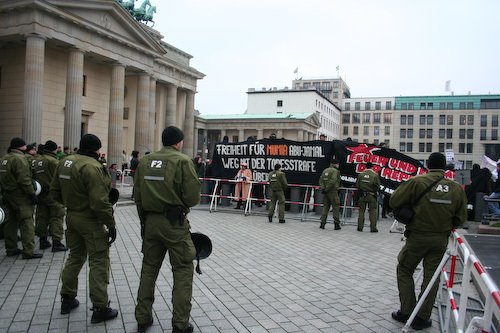
The plain-looking US Embassy, close to Berlin's famous Brandenburg Gate, was left empty when Bush's ambassador and buddy went home. The tourists looked elsewhere - at the famous structure, the newly-built banks partially framing it, the French and British Embassies or, not far away, the contrary symbols of the famous Reichstag Building and the Soviet Memorial which commemorates the liberation of Berlin from fascism and racism.
Then, coming down the famous Unter den Linden boulevard, several
hundred demonstrators moved up as close to the Embassy as the strong
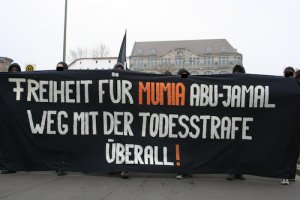 police guard permitted. And although Hitler poisoned himself near
here 63 years ago, racism was still a burning issue. The group
demanded freedom for Mumia Abu-Jamal, the African-American journalist
still in a tiny death cell after 27 years - without once in all those
years receiving his constitutional right of a fair, just trial. The
charge was murder of a policeman, but the trial in 1982 was conducted
by a racist judge and a racist prosecutor using racist methods, and
the hatred toward this progressive journalist with the stirring voice
and amazing will power had only increased with the years. That is why
these Berliners took sides and took part.
police guard permitted. And although Hitler poisoned himself near
here 63 years ago, racism was still a burning issue. The group
demanded freedom for Mumia Abu-Jamal, the African-American journalist
still in a tiny death cell after 27 years - without once in all those
years receiving his constitutional right of a fair, just trial. The
charge was murder of a policeman, but the trial in 1982 was conducted
by a racist judge and a racist prosecutor using racist methods, and
the hatred toward this progressive journalist with the stirring voice
and amazing will power had only increased with the years. That is why
these Berliners took sides and took part.
This march for Mumia's freedom and for the worldwide abolishment of
the death penalty started in Kreuzberg, Berlin's most international
borough after a week of activities by the Berlin coalition for Mumia,
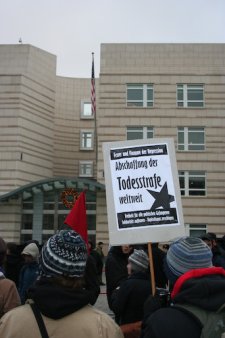 joined by Amnesty International and PEN (with the support of many
writers including Christa Wolf und Günter Grass). On Monday there was
a showing of the stirring British documentary film, "In Prison
My Whole Life", on Tuesday, in CLASH, a traditional meeting-place
of leftwing young people in Kreuzberg, a meeting was held with speeches,
songs and a telephone conversation with Robert R. Bryan, Mumia's lead
counsel. On Wednesday a fundraiser to raise money featured popular
Berlin bands, and the march topped it off on Saturday.
joined by Amnesty International and PEN (with the support of many
writers including Christa Wolf und Günter Grass). On Monday there was
a showing of the stirring British documentary film, "In Prison
My Whole Life", on Tuesday, in CLASH, a traditional meeting-place
of leftwing young people in Kreuzberg, a meeting was held with speeches,
songs and a telephone conversation with Robert R. Bryan, Mumia's lead
counsel. On Wednesday a fundraiser to raise money featured popular
Berlin bands, and the march topped it off on Saturday.
It has not been easy to maintain interest and activity for so many years, and many of the original activists are gone, often taken up with other activities, and it was not possible to come close to the level of the late 1990's, when 8000 marched to the US Embassy in protest. But things are moving again and along the route, while many people heard of Mumia for the first time, a surprising number reacted with V-signs or friendly militant fists to show they knew about the fight and approved the action. Only a tiny handful of tourists reacted in a hostile way.
During the same week there was news of meetings or demonstrations in Hamburg, in the college town of Greifswald, in Vienna, in Berne, Switzerland, in Mexico City and in various US cities.
Thus, despite the long years and the distance to that tiny, lonely
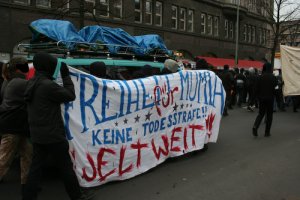 cell in Waynesburg, Pennsylvania, some people are actively working on
ways to spread news of the imminent danger. In his telephone message
Robert R. Bryan explained that he must now prove to the US Supreme
Court that racism was involved in choosing the jury in Mumia's trial,
and that the prosecutor purposely misled the jurors into believing that
Mumia's life was not really threatened by a death penalty, since he
would soon have an appeal. But no appeal was ever permitted, the
cell in Waynesburg, Pennsylvania, some people are actively working on
ways to spread news of the imminent danger. In his telephone message
Robert R. Bryan explained that he must now prove to the US Supreme
Court that racism was involved in choosing the jury in Mumia's trial,
and that the prosecutor purposely misled the jurors into believing that
Mumia's life was not really threatened by a death penalty, since he
would soon have an appeal. But no appeal was ever permitted, the
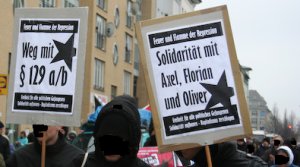 Pennsylvania state prosecutors now want to reinstate the death sentence,
previously put in question by one judge, and Mumia's life may depend in
the end on the vote of the nine Supreme Court judges. Or on protests
around the world but especially in the USA which could now make such a
decision politically unwise. But that takes lots of mobilization. This
past week hopefully marked the beginnings of a new campaign.
Pennsylvania state prosecutors now want to reinstate the death sentence,
previously put in question by one judge, and Mumia's life may depend in
the end on the vote of the nine Supreme Court judges. Or on protests
around the world but especially in the USA which could now make such a
decision politically unwise. But that takes lots of mobilization. This
past week hopefully marked the beginnings of a new campaign.
Anyone wishing to help, with their efforts or with money needed so desperately for the extremely expensive legal work, should contact
Robert R. Bryan
2088 Union Street, Suite 4
San Francisco, California 94123-4117
December 16, 2008
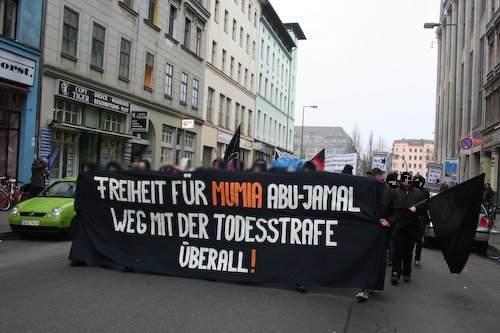
Philadelphia Officials Again Seek Mumia's Execution
by Jeff Mackler / November 2008
In late October 2008 the Philadelphia District Attorney's office announced that it would again appeal the 2001 Federal District Court decision by William H. Yohn that invalidated the death sentence imposed at Mumia Abu-Jamal's 1982 frame-up trial presided over by "hanging judge" Albert Sabo.
Yohn ruled at that time that Judge Sabo had improperly instructed the jury by informing them that they had to be unanimous on each and every mitigating circumstance in order to impose a sentence of life in prison rather than execution by lethal injection. Sabo had sentenced more defendants to execution, the vast majority Black, than any other sitting judge in the country.
Yohn ordered Philadelphia officials to conduct a new sentencing hearing with the proper jury instructions within 180 days. That order has been delayed for the past eight years pending the outcome of the city's appeal.
While akin to a new trial, including the right of the defendant to introduce evidence of innocence, the procedure only allows the jury to impose a sentence of life in prison or execution. A verdict of innocence and freedom is excluded since Mumia's frame-up 1982 trial resulted in a guilty verdict.
Jamal is an awarding-winning journalist, leading critic of the racist Philadelphia Police Department, and perhaps the world's most well-known innocent political prisoner. He was falsely convicted in 1982 of the murder of police Officer Daniel Faulkner. Massive evidence of Mumia's innocence has been systematically excluded from the legal proceedings that have marked this racist persecution for the past 26 years.
Having failed in its first effort to reverse Yohn's ruling before the U.S. Court of Appeals, Third Circuit, Philadelphia officials announced that they would meet the Nov. 19 deadline and ask the U.S. Supreme Court to reverse the two previous court federal decisions and order Mumia's execution.
While many legal specialists as well as Third Circuit precedents indicate that a re-imposition of the death sentence by the Supreme Court is highly unlikely, the experience of the past 26 years teaches that the "law of the land" is subordinate to the single-minded institutional hatred of Mumia Abu-Jamal, a leading revolutionary critic of capitalist society. The desire to demonstrate that the criminal "justice" system has acted properly at all junctures of the case weighs heavily on the system's most ardent defenders.
A case in point is the recent interview with Barack Obama by right-wing Philadelphia talk-show host Michael Smerconish - co-author of the new book, "Murdered by Mumia" and a major advocate for executing Mumia. Smerconish asked Obama where he stood. Obama responded that while he didn't know much about the case, "let just me lay out a very clear principle: In my mind if someone killed a police officer, they deserve the death penalty or life in prison" (Philadelphia Inquirer, Oct. 10, 2008).
It is curious that the diplomatic Obama did not respond to Smerconish, a former Republican recently turned Obama supporter, "if someone is innocent, they should be freed."
Obama might even have pointed out, "There is significant evidence of his innocence and even more evidence that the court's own precedents have been violated." But this would be too much to expect from a candidate wedded to a system in which institutional racism is the norm.
If the past record of misapplication of the law to Mumia's case continues as it has during the past 26 years, a Supreme Court decision ordering his execution cannot be excluded, however unlikely it might be from a "legal" point of view.
In his dissenting opinion before the Third Circuit, Judge Thomas Ambro, for example, expressed his annoyance with his colleagues' blind eye to their own previous rulings when he wrote, "I see no reason why we should not afford Abu-Jamal the courtesy of our precedents." Ambro's dissent referred to the court's application of the historic 1986 Batson v. Kentucky ruling, which held that the exclusion of Black jurors based on race was unconstitutional. Out-voted by 2-1 in the Third Circuit, Ambro stated that the majority's decision, "goes against the grain of our prior actions."
Indeed, the Third Circuit's anti-Batson ruling violates the most recent Supreme Court decision on the same issue, which held that the exclusion of a single Black juror on account of race necessitates a new trial. In Mumia's case 11 Blacks were excluded! Nothing can be taken for granted today. Mumia's life is still very much on the line.
Mumia's legal team is now seeking to reverse the Third Circuit decision denying him a new trial. His lead counsel, Robert R. Bryan, was recently successful in extending the deadline for the filing of an appeal to the U.S. Supreme Court to Dec. 19.
The Supreme Court has no legal obligation to certify that it will even hear Mumia's final appeal. Indeed, it rejects some 95 percent of the 2500 petitions it receives in death penalty cases every year.
This "killing machine" is driven forward by a series of laws and court decisions that severely restrict appeal rights in the federal courts, with the infamous 1996 Clinton-signed Anti-terrorism and Effective Death Penalty Act (AEDPA) being first on the list. This heinous legislation requires federal courts to grant a "presumption of correctness" to state court findings of fact - in this case, the findings of the overtly racist Judge Albert Sabo. It was designed to make state level decisions "effective," that is, virtually totally immune to federal appeal.
Similar court decisions, applied to Mumia in the past and to Troy Davis today, include the 1993 Supreme Court decision in Herrera v. Collins, holding that "innocence is no defense" and that it is trumped by "timeliness." Both laws were designed to facilitate the execution of innocent people, mostly oppressed nationalities.
According to Herrera, evidence of innocence that is presented beyond whatever state statutory deadlines have been put into place is inadmissible. In the case of Troy Davis, whose life now hangs in the balance, seven of the nine so-called witnesses who testified against him have recanted their testimony and stated that it was originally given under police pressure.
The Davis case is among the most blatant applications of capitalist law today. Eight years ago, Gary Graham was executed in Texas, although his post-deadline evidence of innocence included several extremely credible eyewitnesses proving that he was nowhere near the murder scene and a county sheriff who demolished the prosecution's murder-weapon theory with irrefutable evidence.
Mumia is alive today only because a broad and unrelenting national and international movement has been constructed in his defense.
While Pennsylvania Gov. Ed Rendell has pledged to sign a third warrant for Mumia's execution (if the Supreme Court reverses its previous legal precedents), Mumia's supporters are pressing forward with a public campaign that has captured the imagination of millions who cherish human rights and freedom.
The recent publication of J. Patrick O'Connor's book, "The Framing of Mumia Abu-Jamal," has been acclaimed across the country and cited in The New York Times, a publication that has previously failed to publish any favorable material on Mumia's case. In late October, O'Connor spoke at 13 public meetings and radio and television appearances in California organized by the Mobilization to Free Mumia Abu-Jamal. These will be followed this month by meetings organized in Connecticut and in New York.
Also, a new award-winning documentary, "In Prison My Whole Life," recently purchased by the Sundance Channel, is to be premiered on HBO-TV in the coming months and then scheduled for local distribution across the country.
Mumia's national defense network, led by the International Concerned Family and Friends of Mumia Abu-Jamal, has set Saturday, Dec. 6, for local protests across the country.
A victory for Mumia and his freedom would be a victory for democratic rights for everyone. A free Mumia will contribute immensely to the power of the mass movements that will inevitably arise to challenge the foundations of the present system of war, racism, poverty, and corruption.
For further information contact, (West Coast) The Mobilization to Free Mumia Abu-Jamal: (510) 268-9429, freemumia.org alerts@freemumia.org (East Coast) ICFFMAJ, (215) 476-8812, or www.Abu-Jamal-News.com.
Video from Philly
Hier ein Videodownloadlink aus Philadelphia von den Journalists for Mumia. Das Video beschreibt FREE MUMIA Aktivitäten in Philly über 2008 und ist bereits vor dem 6.12. erschienen. Verschiedene Aktivist_innen kommen zu Wort, es geht häufig um ihre ganz pers&oauml;nlichen Motivationen, sich für Mumias Freilassung einzusetzen.
Geo.Clan Interview with Hand Bettet (Video)
Philadelphia News Website Geo.Clan interveiwed Hans Bennett, co-founder of "JOURNALISTS FOR MUMIA" in early December 2008. This interesting interview covers a wide range of aspects reagrding the campaign to free Mumia.
Robert R. Bryan at the Humboldt Uni 3th nov. 2008 (film)
Interview with Robert R. Bryan
here you find the film interview
DA wants to Execute Mumia Abu-Jamal
DA wants to Execute Mumia Abu-Jamal
The Philadlephia DA has just anounced that it will be appealing to the Supreme Court, so that Mumia could be executed without a new penalty phase trial. The DA will file their appeal by the deadline of Nov. 19th, 2008.
read more here from "Journalists for Mumia"
FREE MUMIA: global week of action, December 6th until 13th, 2008
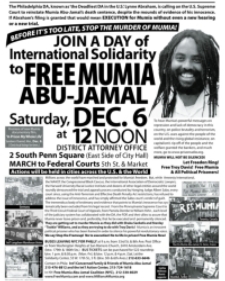
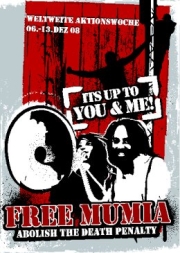
Dates in Berlin, Germany:
Mo. Dec. 08, 2008, doors open 8pm
"In Prison My Whole Life" (UK 2007, with german subtitles) - Film on Mumia Abu-Jamal
Guests for discussion afterwards: Annette Schiffmann (Network for Mumia Abu-Jamal, Germany), Holger Schamberg (Amnesty International Germany)
Entrance 6,50 EUR, 50% go towards the campaign/defense of Mumia Mumia Abu-Jamal
Cinema Babylon Mitte, Rosa-Luxemburg-Str. 30, 10178 Berlin, Metro U2 Rosa-Luxemburg-Platz
Tu. Dec. 9, 2008, doors open 7.30 pm
Evening of culture and discussion on the 27th anniversary of Mumia's incarceration
Host: Heike Kleffner (journalist), guests for discussion: Georg Pumphrey, VVN/BDA (Antifascists), Berlin Coalition to Free Mumia Abu-Jamal
reading from Mumias books: Victor Grossmann and Jutta Kausch (actress)
acoustic live music afterwards
Clash im Mehringhof, Gneisenaustr. 2a, 10961 Berlin, Metro U6/7 Mehringdamm, no entrance fee
We. Dec. 10, 2008, doors open 8pm
Solidarity Concert for the FREE MUMIA campaign in Germany on the International Day Of Human Rights
Berlin Boom Orchestra (Ska), DeTrend.City.Rockers (Soundsystem), Marycones (Chanson, Ska, Rock), RotFront Soundsystem
+ Big Surprise Appearance, Host: MC Rebell der Welt
(we might organize an internet live streaming of the event, details soon)
entrance fee between 8-10 Euros, all for the Campaign to FREE MUMIA ABU-JAMAL!
SO36, Oranienstr. 190, 10999 Berlin, Metro U1/8 Kottbusser Tor
Sa. Dec. 13, 2008, 1.30pm
Demonstration FREE MUMIA ABU-JAMAL! Abolish the death penalty everywhere!
Start: Oranienplatz, 10999 Berlin, Metro U1/8 Kottbusser Tor
Finish: New US Embassy, Pariser Platz
For more details about the international day of Solidarity look at Termine
Letter from Mumia's lead atourney on Supreme Court
Dear All:
We are in France on Mumia for meetings and the Lyon film festival.
Today, as expected, the U.S. Supreme Court denied the Petition for Writ of Certiorari which I filed some time ago on behalf of Mumia. As reported in my recent Legal Update, this concerned suppressed evidence of prosecutorial and police fraud. Even though I now have proof that the 1982 trial was literally a trial by fraud, there were procedural problems caused by the previous lawyers not presenting the new evidence in a timely and proper manner. As you know, I took over the case six years ago (Mumia first began seeking my representation in 1985; I was too busy at the time to accept).
Please understand that this is unrelated to the petition I will file later in the year in the Supreme Court. That will relate to the 2-1 decision by the U.S. Court of Appeals for the Third Circuit, Philadelphia, concerning racism-jury-selection, and material misrepresentations made by the prosecutor at the guilt-phase argument.
With best wishes,
Robert
Eaux-Puiseaux, France
---------------
[Robert R. Bryan
Law Offices of Robert R. Bryan
2088 Union Street, Suite 4
San Francisco, CA 94109-4117]
Mumia Abu-Jamal Faces US Supreme Court as New Book and Film Expose Injustice
On Monday, Oct.6, in a ruling unrelated to death-row journalist Mumia Abu-Jamal's upcoming appeal of the recent Third Circuit decision denying a new guilt-phase trial, the US Supreme Court rejected his Post Conviction Relief Act (PCRA) appeal, which was asking the courts to hear newly discovered testimony from Kenneth Pate and Yvette Williams (read the affidavits here). The appeal had been filed in July, after it was rejected by the PA Supreme Court in Feb, 2008, and in 2005 by Philadelphia Judge Pamela Dembe.
New review of "the Framing Of Mumia Abu-Jamal"
Opponents of Abu-Jamal always say that his supporters should just "read the transcripts" of the trial for evidence of his guilt. Supporters can now reply: Read The Framing of Mumia Abu-Jamal. here more about this book...
The Suppression of Dissent in America, by Linn Washington
By LINN WASHINGTON, Jr.
In presenting a compelling examination of the plight of death row journalist Mumia Abu-Jamal the documentary "In Prison My Whole Life" also probes one of the deeper contradictions of America: persistent suppression of dissent.
For a nation that extols the provisions of the First Amendment, politicians and police have histories of running roughshod over the rights of citizens to exercise their constitutional freedoms of speech, assembly and presenting grievances to government.
The recent actions against peaceful demonstrators and non-mainstream journalists by federal and local law enforcement personnel during the Republican National Convention in St Paul, Minnesota is yet another example of suppression of dissent.
Amnesty International is among the organizations condemning the assaults and arrests at the Republican Convention, terming that use of force and mass arrests excessive.
Amnesty International has officially endorsed "In Prison My Whole Life" - the first time this respected human rights organization ever placed its imprimatur on a film.
This well received documentary that premiered simultaneously last October 25th at the London and Rome Film Festivals focuses on the journey of one young man - William Francome - to discover more about the death row inmate arrested on the day he was born.
Francome's birthday is December 9, 1981 - the day Abu-Jamal was arrested for murdering of a Philadelphia policeman. Francome's American-born mother followed the Abu-Jamal case, reminding her son on each of his birthdays about the man languishing on death-row for a conviction based on what the AI report determined was a grossly unfair trial.
The film follows Francome across America from New York City to California's Bay Area in his journey to discover more about the Abu-Jamal case and related issues like racism, class prejudice and suppression of dissent.
"In Prison My Whole Life" will have two screening in New York City at the Urbanworld Film Festival - on Thursday 9/11 and Saturday 9/13. Additionally, a screening is set for 9/26 at the CR10 Conference in Oakland, California.
The only previous US screening of this documentary occurred this past January during the Sundance Film Festival.
In 2000, Amnesty International authored the comprehensive yet concise report on the Abu-Jamal case that presented a unique examination of unethical and suspect conduct by the Pa Supreme Court in this controversial case - newsworthy material that the US news media buried.
Only two American daily newspapers carried articles on that news-laden AI report according to the NEXUS newspaper database and both of those articles were 'news briefs.' The news brief on the AI report published by the Philadelphia Inquirer in Abu-Jamal's hometown was the fifth of six items in the B Section, listed below reporting on two non-fatal shootings, a small nightclub fire and a proposal to ban cell phone use while driving.
The Abu-Jamal case is fraught with suppression of dissent.
Incidents of suppression include the well publicized 1994 action by police and politicians forcing NPR to cancel airing prison commentaries by the award-winning journalist, the little known 2000 federal imprisonment of a leading Abu-Jamal activist for speaking at an anti-death penalty rally during the GOP national convention held that year in Philadelphia and 2007 strong-arming by Philadelphia's police union to block a pro-Abu-Jamal program.
Francome's "In Prison My Whole Life" interviews include Noam Chomsky, Angela Davis, Mos Def, Snoop Dog and Alice Walker - famed persons who've endured violations of their First Amendment rights.
This documentary also presents the first film interview with Abu-Jamal's brother, Billy Cook. The slain officer's beating of Cook during a traffic stop allegedly triggered the shooting. Cook shows a head scar he still carries from that beating. Cook also confirms the presence of his close friend long suspected by some as the person who fatally shot the officer.
Producers for the documentary are acclaimed British actor Colin Firth and his wife Livia Giuggioli who enlisted renowned director Marc Evans.
Producer Livia Giuggioli, during a recent interview with Hans Bennett, said intense passions displayed by advocates and enemies of Abu-Jamal is one of the things that interested them about pursuing this project.
"This is what really fascinated us all when we started to approach the subject and research," said Giuggioli who lives in London.
"If you detach everything from this "figure" you just find a man who has been a victim of politics more than anything else," Giuggioli noted echoing a conclusion of the 2000 AI report that politics had polluted judicial rulings in the Abu-Jamal case.
"In Prison" presents extraordinary evidence pointing to Abu-Jamal's innocence inclusive of crime scene photographs discovered in 2006 that contradict core elements of the prosecution's case against the man whose written five books while on death row.
The photos, for example, show no bullet marks in the sidewalk where prosecutors declared Abu-Jamal shot into the sidewalk around the fallen officer three times before shooting him once in the face. The photos show no cab behind the officer's squad car where prosecutors told jurors a cab driver observed the murder. Additionally, the photos show police tampering with evidence at the crime scene.
A consultant for the documentary, German professor Dr. Michael Schiffmann, located these photos shot by a Philadelphia news photographer who arrived at the shooting scene minutes after the crime.
Schiffmann published the 2006 book "Race Against Death" one of the two most thorough examinations of the Abu-Jamal case. The other book is "Killing Time" by Philadelphia-area investigative reporter Dave Lindorff. Both Schiffmann and Lindorff have "In Prison" appearances, walking Francome through various aspects of the Abu-Jamal case in Philadelphia.
"Hopefully the film will help people to think and realize that maybe there is more to the story," Giuggioli said. "Until there is a proper new trial - Mumia is just a man who has been sitting in solitary confinement for 27-years and it is a disgrace."
The Abu-Jamal case is presently heading for an appeal to the US Supreme Court after the federal Third Circuit Court of Appeals earlier this year rejected a request for a new hearing, principally on the issue of racial discrimination during the selection of the jury at Abu-Jamal's 1982 trial.
That Third Circuit ruling created new standards for jury discrimination appeals that are more stringent than standards established by the US Supreme Court. That 2000 Amnesty International report faulted courts for improperly creating new legal standards to deny justice to Abu-Jamal.
--Linn Washington Jr. is a Philadelphia journalist who's followed the Abu-Jamal case since 1981. Washington appears briefly in the "n Prison" documentary talking about police brutality in Philadelphia.
An interview with Livia Giuggioli Firth, co-producer of "In Prison My Whole Life"
New British Film About Mumia Abu-Jamal Showing in NYC this week
By Hans Bennett
estival last January, "In Prison My Whole Life" will be shown to a US audience. This new film about the internationally renowned death-row journalist Mumia Abu-Jamal will be shown this week at the Urbanworld Film Festival in New York City. The film has two different screenings, both at the AMC Loews 34th Street Theatre: Thursday, Sept 11, 1:45pm, at Theatre # 11 and on Saturday, For the first time since the film's US Premiere at the Sundance Film Sept 13, 6:15pm, at Theatre # 9. In Prison is also being shown at the CR10 Conference in Oakland, CA, on September 26.
This new British documentary premiered at the prestigious London Film Festival and at Rome's International Film Festivals on October 25, 2007, at which point I interviewed William Francome, who is a central character in the film. The film's trailer begins with Francome, explaining that he's "been aware of Mumia for as long as I can remember. That's because he was arrested on the night I was born, for the murder of a Philadelphia police officer. As my mom would often remind me, every birthday I had, has been another year that Mumia has spent in prison.... I am going on a journey to find out about the man who has been in prison my whole life."
With the acclaimed British actor Colin Firth as an executive producer, "In Prison My Whole Life" is directed by Marc Evans and produced by Livia Giuggioli Firth and Nick Goodwin Self. The film has interviews with such figures as Alice Walker, Angela Davis, Noam Chomsky, Amy Goodman, Ramona Africa, and musicians Mos Def, Snoop Dogg and Steve Earle. Amnesty International concluded in a previous report that Abu-Jamal's original 1982 trial was unfair, where he was convicted of fatally shooting Philadelphia Police Officer Daniel Faulkner and sentenced to death. Amnesty International is supporting In Prison as part of its international campaign to abolish the death penalty. Amnesty International UK Director Kate Allen says: "It's shocking that the US justice system has repeatedly failed to address the appalling violation of Mumia Abu-Jamal's fundamental fair trial rights."
In the 2007 interview, Francome disclosed that the film will prominently feature the startling Dec. 9, 1981 crime scene photos that were recently discovered by German author Michael Schiffmann, and are published in his new book.
The July 4, 2008 issue of Abu-Jamal-News revealed that In Prison also features an interview with Abu-Jamal's brother Billy Cook, who was at the scene on Dec. 9, 1981, after Officer Faulkner pulled his car over. The first time he has ever been interviewed on camera, Cook denies the accusation that he struck Faulkner in this face, from which he allegedly instigated the undisputed beating given to him by Faulkner, from which Cooks shows In Prison's interviewers the scars he still has on his head today. Cook says: "They arrested me for assaulting him, but I never laid a hand on him. I was only trying to protect myself. I never hit him. I never hit him."Cook says that right before he was beaten bloody with the police flashlight, Faulkner" was kind of vulgar and nasty. And if I remember correctly he threw a slur in.... Nigger get back in the car."
Regarding the assault charges against Cook, and his subsequent trial, Michael Schiffmann defends Cook's account in his recent essay, arguing that there was never any credible evidence that Cook ever struck Faulkner, and also that the prosecution's two alleged eyewitnesses gave unbelievable accounts of how Abu-Jamal approached Faulkner and allegedly shot him in the back.
In this new interview with co-producer Livia Giuggioli Firth, she talks about when she first learned about Mumia Abu-Jamal, making the film, the new appeal to the US Supreme Court, and more. "I hope Mumia will have a new trial, because has been sitting in solitary confinement for 27 years, and it is a disgrace. We will never know the truth about Dec. 9, 1981 until then," says Firth.
Hans Bennett: When did you first hear of Mumia Abu-Jamal?
Livia Giuggioli Firth: A couple of years ago, at a dinner party at some friends' house, I met William Francome and we started to chat (as you do at parties!). He told me he just finished college and wanted to make a documentary about Mumia. I'd never heard of him so he explained me who he was. When I got home and googled him... it was like opening Pandora's vase! That was enough to say: we need to dig into this!
HB: What was it like making the film? What role did you play as a producer?
HB: Marc Evans, the director, is
the one who did the film. I produced it - which means my role has been
the ball-breaker! But it was very interesting to start the "Mumia
quest" from scratch and with folks who had never heard of him. Apart
from William, none of us (Marc the director, Colin, Nick and I who produced it,
Mags the editor and so on for the whole crew) had any idea of the implications
in Mumia's case.
If you detach everything from this "figure" constructed by both
Mumia's supporters and detractors, you just find a man who has been victim of
politics more than anything else. This was what really fascinated
us all when we approached the subject, and this is why Marc Evans wanted to
contextualize Mumia's case within the African American political story.
If you do not put Mumia in context - you can not understand this story.
Because the whole scenario around Dec. 9, 1981 was so complicated, distorted,
and messed up, we decided to go to Amnesty International--an organization
recognized worldwide for being completely objective and impartial--and asked
for their guidance. They published a book in 2000 about Mumia's case and
concluded that it is impossible to know whether this man is guilty or not
because the trail was in violation of international law--a completely unfair trail.
HB: After researching this case, what are 3 facts that you consider most striking regarding the need for a new trial?
HB: There are so many compelling
things about this case that overcome any & all assaults from those who
refuse to accept that the core issue here is an unfair trial. Having said this,
some examples are:
First, there was no real forensic evidence presented in court. They
never officially tested Mumia's hands for traces of gun powder, never
officially found the bullet shot through Faulkner's back, and more. With
the discovery of Pedro Polakoff's crime scene photographs, you can clearly see
how messed up the crime scene was that night!
Second, the testimonies supporting the prosecution scenario were false - all
of them!
Third, the presiding judge, Albert Sabo was heard saying, on the FIRST DAY of
the trail, "I am going to help them fry that nigger."
Then, shocking us even more, Mumia's 1995-97 PCRA appeal was before this same judge. Are you joking?
HB: Mumia's current appeal to the Supreme Court will be citing 3rd Circuit Judge Thomas Ambro's dissenting opinion, which declared that the court had actually created new standards for a Batson claim, when it denied Mumia's claim. Do you think this strong statement has received adequate coverage in the mainstream media?
HB: Not really, but again, there
are so many awful cases in America
like Mumia's. So many innocent people are sentenced after unfair
trails. Look at Troy Davis! That is another horrible case.
Hopefully the film will help people to think and realize that maybe there is
more to the story. And hopefully it will help other cases too.
You can't dismiss Mumia as a "cop killer". Also, until there is a
new trial, you will never know if he really is a "cold blooded
monster" as they call him.
HB: Do you think the Supreme Court will now consider Mumia's case?
HB: This is a very difficult question. I do not know. It is not very likely, but you never know! If I did not have hope, I would never have produced this movie!
HB: Your film features a new interview with Billy Cook. What do you think is the significance of this interview?
HB: Well, first of all Billy has never spoken since the night of the shooting. He was not called to testify and "disappeared" after that. So this is the first time he gets to talk about what happened that night. He will not tell the whole story until there is a new trial but he confirmed a few interesting things. You must see the movie!
HB: Anything else to add?
HB: I hope Mumia will have a new trial, because has been sitting in solitary confinement for 27 years, and it is a disgrace. We will never know the truth about Dec. 9, 1981 until then.
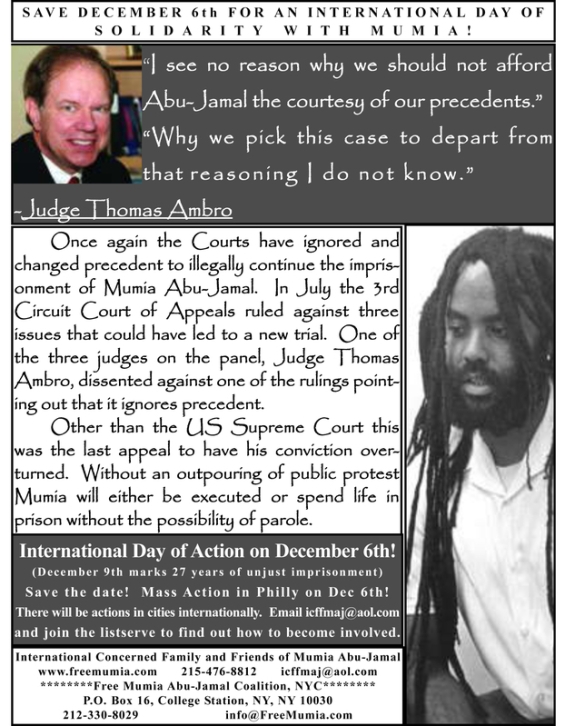
RIGHTS-US: Death Row Activist Prepares New Appeal
The criminal "justice" system and the case of Mumia Abu-Jamal
by Jeff Mackler
Monday Aug 4th, 2008 9:42 AM
This is a new article by Jeff Mackler of Socialist Action and the SF Bay Area Coalition to Free Mumia. Mackler argues that problems in Mumia's case are much bigger than just him. Indeed it is the system itself that is the problem.
The criminal "justice" system and the case of Mumia Abu-Jamal U.S. Court of Appeals Rejects Mumia's Petition for a re-hearing
By Jeff Mackler
When I learned that the U.S. Court of Appeals for the Third Circuit had on July 22, 2008, denied Mumia Abu-Jamal a re-hearing - thus leaving Mumia's fight for justice and freedom in the hands of the court of last resort, the U.S. Supreme Court - my immediate thought was that we were once again witnessing the operation of the racist "Mumia Exception."
This is the notion that regardless of previous decisions and precedents of the U.S. judicial system - from the Third Circuit to the U.S. Supreme Court - when it comes to their application to Mumia's case, the "law" means nothing.
A close look at Mumia's case lends some credence to the "Mumia Exception," or "Mumia Law" concept, as it is sometimes called. In virtually the exact same circumstances, bound by the important U.S. Supreme Court decision in the case of Batson v. Kentucky, the Third Circuit had previously thrown out convictions in capital cases when Blacks were excluded from juries.
In Mumia's case, 11 of 14 Black jurors were excluded by preemptory challenges of the prosecution. One might have concluded that the three-judge panel of the Third Circuit that decided this issue four months ago in March 2008, might apply the same precedent and grant a new trial. They didn't.
That's why Mumia asked for a re-hearing before the whole panel, or nine judges of the Third Circuit. Maybe the entire court would remember that they themselves had previously decided this issue in several cases before them. Maybe they would remember that one of their own, Justice Alito, now sitting on the U.S. Supreme Court, had written the decision and had sharply noted that the exclusion of even one juror on account of race, voided the trial result. And maybe the Third Circuit would take into account that the U.S. Supreme Court, in a powerful decision in the Snyder case, only months before, had affirmed, if not strengthened its Batson ruling.
But this did not to come to pass. The Third Circuit, with nine judges participating, without comment, rejected the en banc (entire court) re-hearing that Mumia had requested.
Mumia's attorney, Robert R. Bryan, commented: "Simply put, we did not receive the needed majority vote from the nine sitting judges; at least five votes for a rehearing were necessary. However, Justice Thomas L. Ambro continues to urge the granting of relief on the issue of racism in jury selection. That position, as detailed in his brilliant dissenting opinion of March 27, 2008, will continue to serve as a beacon of hope as we press on for a new trial and Mumia's freedom.
"Judge Ambro said that the 'core guarantee of equal protection, ensuring citizens that their State will not discriminate on account of race, would be meaningless were we to approve the exclusion of jurors on the basis of ... race.... I respectfully dissent...'"
Bryan's report continued: "Mumia and I had a legal conference this afternoon (July 22). He, as I, was stunned by the federal court's refusal to grant relief since it flies in the face of established legal precedent in both the U.S. Court of Appeals and the U.S. Supreme Court. I am furious because racism continues to raise its ugly head in this country, and should have no place in our legal system.
"The indisputable facts are that the prosecutor engaged in racism in selecting the jury in this case, and that bigotry lingers today in Philadelphia. It would be naive not to realize that this case continues to reek of politics and injustice."
Bryan told Socialist Action that he would file a petition for a writ of certiorari with the U.S. Supreme Court within 90 days or by Oct. 20, 2008. This is a request that the U.S. Supreme Court certify that they will hear the case. The court has no legal obligation to do so. Indeed it routinely rejects 90 percent of such petitions in death penalty cases.
If the Court denies the petition, Mumia's legal options are finished. He will either remain in prison for the rest of his life with no possibility of parole, or will have to defend against renewed efforts by the state to seek his execution.
Bryan will also appeal the Third Circuit's rejection of another critical issue raised in his defense. This is the fact that Pennsylvania prosecutor Joseph McGill told the jury in his summary remarks at Mumia's 1982 trial that they need not concern themselves if they were not certain about Mumia's guilt or innocence. McGill explained that this was because Mumia would have "appeal after appeal," and therefore any errors that might have occurred could be corrected.
McGill's "appeal after appeal" formulation had been the subject of appeals in several cases prior to Mumia's, with the result that the convictions obtained was struck down and new trials ordered. In Mumia's case the Third Circuit, apparently "forgot" its own precedent - that is, a reassertion of the fundamental principles that juries must find guilt "beyond a reasonable doubt," that juries must begin with the presumption of innocence," and that juries and only juries have the responsibility of determining guilt or innocence.
McGill's assertion to the jury that they could effectively suspend any reasonable doubt they might have - and by implication, leave it to higher courts to determine guilt or innocence - was not challenged at trial by the presiding "Hanging Judge" Albert Sabo or by the Third Circuit.
"The Mumia Exception:" another look
A closer examination reveals that the "Mumia Exception" really doesn't exist. The vast majority of capital cases, if not all cases, that come before the courts in capitalist America are riddled with race and class bias.
The ruling class itself is well aware of this fact, as is any student who embarks on the study of law in the U.S., not to mention the millions who are victims of this supposed system of "blind justice." Capitalist law is the product of capitalist power - that is, it reflects the needs and interests of the corporate elite who rule America today. The U.S. has the highest incarceration rate in the world and the largest percentage of its population on death row.
This is not a statistical aberration. The United Nations recently issued a report condemning the U.S. for its race bias in what passes for its criminal "justice" system.
Today's "prison industrial complex" serves multiple purposes. It provides a cheap source of labor, a few cents an hour, for hundreds of major capitalist industries and the increasingly privatized prison "industry" provides a ready source of capital paid to corporate outfits who profit handsomely from prison construction and administration.
Prior to 1996, when the U.S. Congress passed the infamous Anti-terrorism and Effective Death Penalty Act (AEDPA), signed by then President Bill Clinton, a full 40 percent of all state court convictions in capital cases were reversed on appeal to the federal courts. The reason? An important study found that police intimidation of witnesses, planting and falsification of evidence and incompetent counsel were rampant in the system.
But rather than correct the racist and classist "system," an impossible task in the framework of capitalism, the government sought to intensify it by "effectively" eliminating appeals to the federal courts.
The AEDPA was in fact designed to abolish habeas corpus, the right to appeal to the federal courts. It accomplished this by replacing the historic "presumption of innocence" with a new requirement that federal courts were required to grant a "presumption of correctness" to the findings of what are essentially racist and classist state courts.
The implementation of this new criteria, essentially the barbaric imposition of a presumption of guilt, has produced an explosion of death-row inmates, a killing field of the oppressed who are awaiting execution, a phenomenon condemned throughout the world as the U.S. remains among the two or three nations to retain the death penalty.
It is therefore fair to say that the bias in Mumia Abu-Jamal's case is symptomatic of the racism that permeates the criminal justice system in the U.S. rather than an exception to it. At the same time, it is also accurate to conclude that the entire court system - in the face of the power of the international movement that for 26 years has worked to challenge Mumia's frame-up and prevent his execution - has geared up to justify its existence in the eyes of millions who still have illusions that they live in a democratic society.
The "appearance" of justice is important to the ruling rich, as they find it increasingly difficult to maintain this illusion. Hence the passage of the AEDPA, the Patriot Act, and the associated and massive infringements of civil and democratic rights that are justified in the name of pursuing the government's "war on terrorism."
The July 22 decision to reject Mumia's appeal is but the tip of the iceberg in regard to the legal atrocities that have been committed to keep this innocent man on death row. His is a case study in the use of lying witnesses, falsification of evidence, manipulation of the crime scene, witness intimidation, police lying, exclusion of evidence proving innocence. His case also contains a myriad of constitutional violations, including rejection of Mumia's right to act as his own counsel, his physical exclusion from a majority of trial proceedings against him, the racist exclusion of Black jurors, and a racist judge who ruled against more than 100 motions presented by Mumia's defense team.
Indeed, Mumia's original federal appeal included 29 instances of constitutional violations based on the facts of the case, 28 of which were rejected on the grounds that the AEDPA today requires federal courts to presume that the "facts" found by the racist court of Judge Sabo must be presumed to be correct. After 26 years, they have all been proven to be fabrications, a fact that has zero weight in today's criminal justice system.
This is no exaggeration. A low point in Mumia's legal battle came in the statement of Federal District Court Judge William H. Yohn Jr., who cited a Supreme Court ruling that "innocence is no defense."
Yohn's citation was in response to clear evidence produced by Mumia that he had not been and could not have been the person who murdered Police Officer Daniel Faulkner on Dec. 9, 1981. Yohn's logic held that innocence is trumped by timeliness - that is, if the evidence is submitted beyond a statutory deadline, even if conclusive, it is irrelevant. The legal process must embody "finality," says the "law of the land" today, even if the final result is the execution of an innocent man.
Mumia's legal appeal must be accompanied by a reinvigorated and massive expansion of the movement that has fought so hard and long for his freedom. As we go to press, the International Concerned Family and Friends of Mumia Abu-Jamal, the Mobilization to Free Mumia Abu-Jamal, and several other defense groups across the country are preparing coordinated plans to challenge the latest court decision and to make the political price of Mumia's continued incarceration too high to pay. They seek a new trial and Mumia's freedom.
At the same time, the state of Pennsylvania is evaluating whether it will proceed with their efforts to reverse a previous federal district court decision that ruled that the death penalty had been improperly imposed. Pending the outcome of the state's decision, Mumia remains on death row. The threat of execution by lethal injection remains on the table.
For further information contact ICFFMAJ, (215) 476-8812 or the Mobilization to Free Mumia Abu-Jamal, (510) 268-9429,
Abu-Jamal loses latest appeal for new trial
Paris: News from the worldwide Movement to free Mumia Abu-Jamal
The Paris-based National United Collective In Solidarity with Mumia Abu-Jamal joined in the annual Die-In against the reinstatement of the U.S. Death Penalty and for the release of Mumia on Wednesday evening, July 2, 2008. The Collective acted in solidarity with the U.S. actions to mark the 26th anniversary of Mumia's unjust conviction and death sentence. The dramatic Die-In on Place de la Concorde is in full view of the tourist attraction of the Eiffel Tower and directly in front of the U.S. Embassy, where the Collective has held weekly vigils in solidarity with Mumia for many years. This is the 13th annual Die-In, performed in coalition with anti-Death Penalty groups, and attracts hundred who die-iin and bear silent witness. France abolished the Death Penalty in 1981.
Write to Mumia Abu-Jamal
Mumia's Lead attourney Robert R. Bryan told us several times that it would be a great support to write to Mumia in his prison cell.
Mumia's adress:
Mumia Abu-Jamal
AM 8335
SCI Greene Prison
175 Progress Drive
Waynesburg, PA 15370
USA
First of all Mumia really enjoys receiving post in his 6 square metres of cell in the death row. He can't answer most but it means a huge moral support for him - to see he is not forgotten despite his isolation.
Furthermore post means protection for him. The censors and the court see that they are under international observation. This can have an effect on actual decisions.
You could use the postcards provided by the Berlin Coalition To Free Mumia Abu-Jamal. If you didn't get one with this flyer contact us on
info@mumia-hoerbuch.dePlease keep in mind that every letter or postcard needs a sender's adress. Without that post will not be delivered to Mumia.
Free Mumia rally in Philadelphia on July 4, 2008
Video by the "Abu-Jamal-News" on recent protest to demand Mumia Abu-Jamal's freedom on Independance Day 2008
Book Asserts Black Reporter Didn't Kill White Officer in '81 (NY Times)
The Framing of Mumia Abu-Jamal: An interview with author J. Patrick O'Connor By Hans Bennett
On March 27, the US Third Circuit Court of Appeals ruled against granting a new guilt-phase trial to world-famous journalist and death row prisoner Mumia Abu-Jamal. While ruling against the three issues that could have led to a new guilt-phase trial, the court affirmed US District Court Judge Yohn's2001 decision overturning the death sentence. If the District Attorney wants to re-instate the death sentence, the DA must call for a new penalty-phase jury trial that would be limited to the question of life in prison without a chance of parole or a re-instatement of the deathsentence.
Outraged by this decision, Abu-Jamal's supporters around the world held "day after" protests, and are now organizing a mass demonstration in Philadelphia on April 19, just days before the PA Presidential Primary Election. Simultaneously, Abu-Jamal is appealing the court ruling "en banc" to the entire Third Circuit, and if unsuccessful there, he will appeal to the US Supreme Court, in an effort to be granted a new guilt-phase trial.
At this critical juncture in Abu-Jamal's case, an explosive new book is set for release in May, titled "The Framing of MumiaAbu-Jamal," by J. Patrick O'Connor, and published by Lawrence HillBooks. O'Connor explains that he "was an associate editor for TV Guide at its headquarters in nearby Radnor, Pennsylvania during the time Officer Faulkner was killed and Abu-Jamal was put on trial and convicted of murdering him... . Sometime in the mid-1990s I began hearing and seeing the "Free Mumia" slogan. In 1996, when HBO premiered the one-hour documentary "Mumia Abu-Jamal: A Case for Reasonable Doubt?", I developed some questions about the verdict and certainly the fairnessof his trial." Soon, O'Connor had "read all the trial transcripts as well as all of the transcripts from Abu-Jamal's Post Conviction Relief Act hearings that were held in 1995, and continued in 1996 and 1997. I also read all the contemporaneous newspaper articles from ThePhiladelphia Inquirer and Philadelphia Daily News, as well as all the books published about the case."
In his new book, O'Connor argues that Abu-Jamal was clearly framed by police, and that the actual shooter was a man named Kenneth Freeman. O'Connor criticizes the local media, who, he says "bought into the prosecution's story line early on and has never been able to see this case for what it is: a framing of an innocent and peace lovingman."
In his review of the recent book "Murdered by Mumia," O'Connorwrites that "there's a great deal to admire about Maureen Faulkner, the widow of Philadelphia Police Officer Daniel Faulkner," but concludes that her "obsessive hate for Abu-Jamal has blinded her to the prosecutorial misconduct and judicial bias that plagued his trial and justifiably fueled his rise to a world stage. The real villains in her life were the police and prosecutors who framed Abu-Jamal for Officer Faulkner's killing. They are the ones, not the long drawn out appellate process that has kept Abu-Jamal alive, who have denied her the closure she was due more than twenty-five years ago."
For more background on "The Framing of Mumia Abu-Jamal" and J. Patrick O'Connor, Abu-Jamal-News.com is featuring an excerpt from the new book, a previous interview with the author, and O'Connor's review of"Murdered By Mumia." This new interview was conducted on April 11,2008, and will be featured in the "Journalists for Mumia" newspaper, tobe released days before the April 19 demonstration in Philadelphia.
Hans Bennett: Advocates of Abu-Jamal's conviction and execution always say that a police frame-up of Abu-Jamal is a lunatic, far-fetched 'conspiracy theory' that should be dismissed by any sane observer. What do you mean when you say he was 'framed'? How was this done?
J. Patrick O'Connor: Mumia's early association with the Philadelphia branch of the Black Panther Party marked him as a subversive to George Fencl, the chief inspector of the Philadelphia Police Department's Civil Defense Bureau. His subsequent sympathetic coverage of MOVE while reporting for the local public radio station made him an avowed enemy of Mayor Frank Rizzo. Minutes after OfficerFaulkner was shot at 3:55 a.m., Inspector Alfonzo Giordano - who reported directly to Fencl - took command of the crime scene and personally set in motion the framing of Abu-Jamal. It would be Giordano who claimed that Mumia told him in the paddy wagon that he dropped his gun after he shot Faulkner; it would be Giordano who arranged for prostitute Cynthia White and felon Robert Chobert to identify Abu-Jamalas the shooter. Giordano and White would be the D.A. Office's only witnesses at the preliminary hearing to hold Abu-Jamal over for trial where Giordano repeated this "confession."
Giordano is as corrupt a police officer as one can imagine. For years he had been extorting kickbacks - personally averaging $3,000per month - from Center City prostitutes, pimps and bar owners, which explains his early arrival at the crime scene. He knew Cynthia White and her pimp. He coerced her at the scene to identify Abu-Jamal as the shooter. She would be the only witness the D.A. had to claim to see Abu-Jamal holding a gun over Faulkner. In her original statement to the police - given within an hour of the shooting - she had Abu-Jamal running from the parking lot and from as far away as 10-yards firing off "four or five shots" at Faulkner before the officer fell. In her third interview with police detectives, given on December 17, she fine-tuned her statement to comport with the actual evidence in the case that Faulkner was shot at close range. (In one of the most sinister aspects of Abu-Jamal's case, the police department waited until the Monday after Abu-Jamal's conviction to "relieve" Giordano of his duties on what would prove to be well-founded "suspicions of corruption." Four years after Abu-Jamal's trial, Giordano pled guilty to tax evasion in connection with those payouts and was sent to prison.)
Incredibly, the police arriving at the crime scene would later claim not to have conducted any tests to determine if Abu-Jamal had recently fired a gun by checking for powder residue on his hands or clothing, nor did they claim to even feel or smell his gun to determine if it had been recently fired. Tests such as these are so routine at murder scenes that it is almost inconceivable the police did not run them. It is more likely that they did not like the results of the tests.
From the outset, the investigation into the shooting death ofOfficer Faulkner was conducted with one goal in mind: to hang the crime on Mumia Abu-Jamal. There was no search for the truth, no attempt at providing the slain officer with the justice he deserved. Giordano handed Abu-Jamal to the D.A.'s Office with his own lie about Abu-Jamal confessing to him and packing off Cynthia White in a squad car to tell her concocted account of the shooting. When the D.A.'s Office was forced to back away from the corrupt Giordano, Assistant D.A. Joseph McGill elicited a new "confession" to replace Giordano's in February when security guard Priscilla Durham and Officer Garry Bell, Faulkner's best friend on the police force, responded to his promptings by saying they heard Abu-Jamal blurt out at the hospital, "I shot the mother-fucker and I hope the mother-fucker dies." Not one of the dozens of other officers present at the hospital would make such a claim. Infact, the two officers who accompanied Abu-Jamal from the time he was placed in the paddy wagon until he went into surgery, reported that he made no comments in signed statements given to detectives assigned to the case that morning.
The prosecution knew that its new "confession" could be skewered if Abu-Jamal's defense attorney, Anthony Jackson, called the two officers who accompanied Abu-Jamal to the stand, so all the prosecution really had was Cynthia White. With White saying she saw it all from beginning to end, and willing to testify that she saw Abu-Jamal blow the helpless Faulkner's brains out in ruthless coldblood, McGill had his case made, providing White's credibility could survive Jackson's cross-examination. McGill bet the entire case that it could, and despite the utter web of lies she told the jury, was right.
Bennett: Why do you think that Kenneth Freeman was the actual shooter of Police Officer Daniel Faulkner?
O'Connor: Kenneth Freeman was Billy Cook's street vendor partner and was riding with him in the VW when Faulkner pulled the VW over. Freeman got out of the VW and subsequently handed Faulkner a phony driver's license application bearing the name of Arnold Howard, which Howard had recently loaned to him. Howard's papers were found in Faulkner's shirt pocket. Police rounded up both Howard and Freeman in the early morning hours of December 9 and brought them in for questioning. At the Post-Conviction Relief Act hearing in 1995, Howard testified that on several occasions, Cynthia White picked Freeman out of a line up.
At Billy Cook's March 29 trial for assaulting Officer Faulkner, with McGill as the prosecutor, White told McGill in direct testimony that the passenger in the VW "had got out." McGill said, "He got of the car"? White responded, "Yes." (At Abu-Jamal's trial, McGill got White to testify that only Abu-Jamal, Cook, and Faulkner were at the scene.)
Various witnesses said they saw a black man running from the scene right after the shooting. Some of the eyewitnesses said this man had an Afro and wore a green army jacket. Freeman did have an Afro and he perpetually wore a green army jacket. Freeman was tall and burly, weighing about 225 pounds at the time.
Cab driver Robert Harkins was driving right by the parked police car and the VW when he saw a police officer grab a man. The man "then spun around and the officer went to the ground," falling facedown backwards, landing on his hands and knees. The assailant shot the officer in the back, causing him to roll over on his back, and then executed him with a shot to his forehead.
Harkins described the shooter as a little taller and heavier than the 6-foot, 200-pound Faulkner. Robert Chobert told police in his first statement that the shooter had an Afro and weighed about 225pounds. (Abu-Jamal, also about 6-foot, wore in his hair in dreadlocks and weighed 170 pounds at the time.)
In Billy Cook's April 29, 2001, affidavit he declared thatFreeman was with him the night of the shooting, was armed, and fled the scene after Faulkner was shot. Cook said he did not see who shot Faulkner.
Freeman would meet an ignominious death hours after Philadelphia police firebombed the MOVE house on Osage Avenue in 1985,killing 11 MOVE members, including John Africa, whose corpse had been beheaded. Freeman's dead body was found bound, gagged and naked in avacant lot. There would be no police investigation into this obviousmurder. The coroner listed his cause of death as a heart attack. The timing and modus operandi of the abduction and killing alone suggest an extreme act of police vengeance.
Bennett: In your book, you were very optimistic about theThird Circuit granting Abu-Jamal a new guilt-phase trial. Were you surprised by the March 27 ruling? If so, how do you account for such asurprising ruling?
O'Connor: I was incredulous. I thought the oral argumentson May 17 had gone extremely well for Abu-Jamal and that he would get a new trial. The 2-1 majority ruling demonstrated anew just how politicized this case always has been from the beginning and continues to be still. The two Republican-appointed judges on the panel formed the majority and the lone Democrat-appointed judge dissented. I hate to make it sound that simple, but the U.S. Supreme Court itself is not above making decisions based on party or ideological lines, and all too frequently does.
In its ruling, the majority stated it believed Abu-Jamal had "forfeited his Batson claim by failing to make a timely objection. But even assuming Abu-Jamal's failure to object is not fatal to his claim, Abu-Jamal has failed to meet his burden in providing a prima facie case." The majority stated that he failed because his attorneys at his PCRA evidentiary hearing neglected to elicit the prosecutor's reasons for removing 10 otherwise qualified blacks by means of peremptory strikes during jury selection.
"Abu-Jamal had the opportunity to develop this evidence at the PCRA evidentiary hearing, but failed to do so. There may be instances where a prima facie case can be made without evidence of the strike rate and exclusion rate. But in this case, we cannot find the Pennsylvania Supreme Court's ruling [denying Abu-Jamal's Batson claim] unreasonable based on this incomplete record," the majority wrote. In a nutshell, the majority denied Abu-Jamal's Batson claim on a technicality of its own invention, not on its merits.
Judge Ambro's dissent was sharp: "...I do not agree with them [the majority] that Mumia Abu-Jamal fails to meet the low bar for making a prima facie case under Batson. In holding otherwise, they raise the standard necessary to make out a prima facie case beyond what Batson calls for."
In other words, the majority, in this case alone, has upped the ante required for making a Batson claim beyond what the United StatesSupreme Court stipulated. When ruling in Batson in 1986, the U.S.Supreme Court imposed no timeliness restrictions as to when a Batson claim may be raised, nor has the court done so in the intervening 22years. Neither did it require that the racial composition of the entirejury pool be known before a Batson claim could be raised. (In fact, theSupreme Court recently added heft to its Batson ruling, ruling in Synder that the purging of only one black juror on the basis of racial discrimination was grounds for a new trial.) In addition, the SupremeCourt ruled in 1986 that to establish a prima facie case for a Batsonclaim, the defendant must show only "an inference" of prosecutorial discrimination in purging even one black from a jury. Even the ThirdCircuit has never previously allowed the timing of a Batson claim to be material, nor had it ever ruled previously that not knowing the racial composition of the entire jury pool was a fatal flaw in lodging a Batson claim.
The fact that the prosecutor in Abu-Jamal's case used 10 of the15 peremptory challenges to exclude blacks from the jury - a strike rate of 66 percent against potential black jurors - is in itself an inference of discrimination. The result was that only three of the 12 jurors impaneled were black.
The Third Circuit should have remanded the case back to Federal District Court Judge Yohn - the judge who ruled on Abu-Jamal's habeascorpus petition in 2001 - to hold an evidentiary hearing to determinethe prosecutors' reasons for excluding the 10 potential black jurors hestruck. If that hearing revealed racial discrimination on the part ofthe prosecutor during jury selection, Judge Yohn would be compelled toorder a new trial for Abu-Jamal.
Abu-Jamal is left with only two remedies to correct the flawedThird Circuit ruling. His first option is to request the Third Circuit to review its decision en banc where the entire panel of judges sitting on the Third Circuit would conduct oral arguments anew. There is some likelihood that the Third Circuit might agree to meet en banc because the panel's decision to deny Abu-Jamal's Batson claim went against that court's own well-established precedents in granting similar Batson claims in the past. However, the barrier to en banc deliberations is a high one: a majority of the sitting judges must vote to reexamine the case. On the Third Circuit Court, there are 12 judges eligible to vote,but four have already recused themselves from this particular case,meaning five of the remaining eight judges would be needed to go forward en banc. Abu-Jamal has most probably had his one day before theThird Circuit.
Barring a reversal by the Third Circuit, Abu-Jamal's final option is to appeal the Third Circuit's ruling to the U.S. Supreme Court, which has on three previous occasions denied to take up his case. This time, though, there is a remote possibility that the highcourt may take the case up because the Third Circuit's ruling created new law by placing new restrictions on a defendant's ability to file a Batson claim.
Bennett: With the media spotlight on the PA Primary Elections, and the major demonstrations supporting Abu-Jamal on April19, what would you like the world to know about this famous death-row case? How far has the city of Philadelphia come since the days ofPolice Commissioner and Mayor Frank Rizzo, a notorious racist and public advocate of police brutality?
O'Connor: In a real sense, D.A. Lynn Abraham, just as Frank Rizzo before her, embodies the worst of Philadelphia. Known as "the Queen of Death" for her zeal in seeking the death penalty, she was depicted as the nation's "deadliest D.A." in a New York Times Magazine article in 1995. Her personal vendetta against Abu-Jamal equals that ofOfficer Faulkner's widow. The day Federal District Court Judge Yohn overturned Abu-Jamal's death sentence in 2001, Abraham put her antipathy for Abu-Jamal this way: "Today, Mumia Abu-Jamal is what he has always been: a convicted, remorseless, cold-blooded killer."
The case of Mumia Abu-Jamal represents an enormous miscarriage of justice, representing an extreme example of prosecutorial abuse and judicial bias. What makes getting to the truth about this case so difficult for people, particularly people in Philadelphia, is that the prosecution built its case on perjured testimony with a calculated disregard for what the actual evidence established. The local media bought into the prosecution's story line early on and has never been able to see this case for what it is: a framing of an innocent and peace loving man.
Two things account for the unprecedented national and international interest in this case. First and foremost is the man himself. Despite more than 25 years of the bleakest existence possiblein isolation on death row, Mumia Abu-Jamal remains what he has always been: an articulate, compassionate righter of wrongs. The second thing that makes this case so compelling to such a wide audience is that histrial represents such a monumental abuse of government power to railroad one man that it really says no citizen is truly free until this wrong has been undone.
--Hans Bennett is a Philadelphia journalist and co-founder of Journalists for Mumia, whose website is Abu-Jamal-News.com.
The New York City Coalition to free Mumia Abu-Jamal:
WE ARE ASKING MUMIA SUPPORTERS TO PLEASE CALL THESE NUMBERS AND WRITE THE CONGRESSIONAL BLACK CAUCUS AS TO WHY ARE THEY ARE NOT RESPONDING TO THE THIRD CIRCUIT'S RECENT DENIAL OF A NEW TRIAL FOR MUMIA. WE ARE ASKING PEOPLE TO ASK THEM TO WHY THEY ARE NOT CALLING CALLING PRESS CONFERENCES, OR MAKING A COLLECTIVE OR INDIVIDUAL COMMENT ABOUT THE RECENT COURT DECISION.
CALL THE CBC, THE NATIONAL CAUCUS OF BLAKC LEGISLATORS AND THE NATIONAL NAACP WHO PASSED A RESOLUTION IN 2004 AT THEIR NATIONAL CONVENTION SUPPORTING MUMIA. THESE ORGANIZATIONS SHOULD BE COMING TO MUMIA'S SUPPORT AT THIS TIME!
-----------------
Chairwoman of congressional black caucus
Rep Carolyn cheeks Kilpatrick
001 202 225 5006
Dr Joe Leonord, Exec director of CBC
001 202 225 4356
National NAACP
001 410 580 5777
Mumia press conference at the Federal Courthouse in Philadelphia
Mumia Exception's' ugly head again by Dave Lindorff
Abu-Jamal supporters protest ruling
Philadelphia Inquirer, April 1, 2008
By Emilie Lounsberry
Inquirer Staff Writer
Posted on Tue, Apr. 1, 2008
Carrying signs and chanting "Free Mumia," about two dozen supporters of Mumia Abu-Jamal turned out yesterday at the federal courthouse to protest last week's appeals court decision that gave him a reprieve from death, at least for now, but let stand his murder conviction. "What they came up with was wrong," Pam Africa, a member of MOVE, said of Thursday's ruling by a three-judge panel of the U.S. Court of Appeals for the Third Circuit.
Africa and other supporters said they wanted a new trial for Abu-Jamal or at least a hearing on his legal claim that black people had been intentionally excluded from the jury in his trial for the 1981 killing of Philadelphia Police Officer Daniel Faulkner.
"If you objectively examine the evidence, there are major flaws, at least flaws enough to justify a new hearing or a new trial," said Linn Washington, a Temple University journalism professor who has followed the case and attended the protest yesterday.
Abu-Jamal, 53, a former Black Panther and radio reporter, has been appealing his conviction since a Philadelphia jury sentenced him to death in 1982 for murdering Faulkner near 13th and Locust Streets.
The Third Circuit panel upheld the 2001 decision of Judge William H. Yohn Jr., who ruled that Abu-Jamal must be sentenced to life in prison or given a chance to persuade a new jury that he deserves a life sentence instead of death. The judges agreed with Yohn that the jury might have mistakenly believed it had to be unanimous in considering any mitigating circumstances, factors that might have caused jurors to opt for a life sentence.
Oom Harrison, 59, a truck driver from Germantown, started following the case in 1995 after watching a documentary about Abu-Jamal's trial. "Too many questions" remained, he said, for the conviction to stand. "He already spent his life in prison," said Harrison, pausing to respond to a passing motorist's angry shout at the protesters.
The brief exchange illustrated the strong emotions the case has triggered in those who believe Abu-Jamal should be put to death and those who believe he did not receive a fair trial and may be innocent. "Read the facts about the case!" Harrison called back to the driver.
Robert R.Bryan on Democrcy Now Radio - Transkription
Democracy Now!
March 28, 2008
democracynow.org
Following Mixed Court Ruling, Mumia Abu-Jamal's Lead Attorney Maintains Hope for Overturning Conviction
A federal appeals court Thursday refused to overturn the conviction of imprisoned journalist and former Black Panther Mumia Abu-Jamal and rejected his call for a new trial. However, the long-awaited ruling said Abu-Jamal, who has been on death row for twenty-six years, deserves a new sentencing hearing because of flawed jury instructions. If he is re-sentenced, he will face either death or life in prison without parole. We speak to Abu-Jamal's lead attorney, Robert Bryan. [includes rush transcript]
Guest: Robert Bryan, Lead counsel for Mumia Abu-Jamal.
JUAN GONZALEZ: A federal appeals court Thursday refused to overturn the conviction of imprisoned journalist and former Black Panther, Mumia Abu-Jamal, and rejected his call for a new trial. However, the long-awaited ruling said that Abu-Jamal, who has been on death row for twenty-six years, deserves a new sentencing hearing because of flawed jury instructions. That's if he is not sentenced purely just to life in prison without parole. If he is re-sentenced, he will face either death or life in prison without parole.
Abu-Jamal was convicted for killing a white police officer in 1982 following a controversial trial before a predominantly white jury. Protests are scheduled for today in New York and San Francisco.
AMY GOODMAN: We're joined now in San Francisco by Robert Bryan, the lead counsel for Mumia Abu-Jamal. Welcome.
Pam Africa has said this certainly is no victory. Can you explain exactly what the court ruled?
ROBERT BRYAN: Well, good morning, Amy. And the decision in this case yesterday is really a mixed bag. On the one hand, the death penalty - the court threw out the death penalty in this case, even though Mumia remains on death row today, and if the state appeals or seeks further relief, nothing will change, at least for the present. The court did order a new jury trial on the issue of whether he should be on death row. In effect, what they did, as I said, was throw out the death penalty. So that's the good part of the decision. And having done this type of work defending people facing the death penalty for over three decades, I can tell you any time the death penalty gets thrown out is a real victory.
On the negative side, as Juan just pointed out, the jury - the court ruled against granting a new jury trial on the issue of guilt and innocence. And we were rather astounded that the court made that ruling. The silver lining to that ruling, to that dark cloud, is that it was a split court. We were before three judges. Two judges ruled against us; a third judge, Judge Ambro, rendered a forty-one-page dissent in which he strongly criticized the majority and said that racism was a work in this case, that racism - that the prosecution engaged in removing people of color, African Americans, from sitting on the jury of Mumia Abu-Jamal. So that really gives us a road map or, if you will, a very bright light in the darkness of where we go from here, because my goal is to achieve a new trial for Mumia. I want him acquitted by a jury. My intent, as I've done in so many other cases, is to see him go home to his family, and that's the bottom line.
JUAN GONZALEZ: So now, with this, since this was a decision, a split decision, of a panel of the Third Circuit, is it possible then to appeal to the entire Third Circuit on this decision?
ROBERT BRYAN: Well, Juan, you've actually - you've certainly been doing your homework. That's exactly what we will be doing within the next few weeks. And that is, this was a decision by three judges, two-to-one; now we will be going before the entire court, all the judges, asking them to review this issue.
And, of course, the biggie, the big - the gorilla in the room, the elephant in the room, is the racism in jury selection. The District Attorney's office in Pennsylvania - in Philadelphia, back during - particularly during that period in the early '80s, late '70s and mid- to late '80s, engaged in a pattern - this is judicially recognized - of removing people from sitting on juries because of race, because of the color of their skin. And when we argued this case before the three-judge panel last May 17, I completed the argument by asking the rhetorical question: are we to believe that the District Attorney did not engage in racism in jury selection in this case, when it's judicially recognized it did in case after case, both before and after the trial of Mumia Abu-Jamal?
And, of course, the trial of Mumia Abu-Jamal was the biggest trial in the history of the city of Pennsylvania. And Mumia Abu-Jamal, as people certainly know, is a very activist writer, journalist - he's written five books on death row - and he's the person who's always bringing the authorities, the establishment, to task. He's very critical of abuse of government, people abusing power, of racism, that type of thing. And so, racism was certainly at work in this case.
AMY GOODMAN: Can you talk about how the original jury was chosen, Robert Bryan, lead counsel for Mumia Abu-Jamal?
ROBERT BRYAN: Well, it's interesting. Judge Ambro, in his dissent, in the first paragraph, cited a case that I presented to the court just Monday: Snyder v. Louisiana, decided last week, March 19. And the US Supreme Court, in a seven-to-two decision, reaffirmed that the removal of even one person from sitting on a jury because of his or her race is constitutionally intolerable, unacceptable. And that is exactly what happened in this case, but not just one. The prosecution in this case engaged in a pattern of 67, 66 percent, nearly 70 percent of their strikes, of removing people who could be on the jury, were people who were African American, while the defense engaged in only - removed only like 20 percent. So there weren't that many people, African American, available to sit on the jury in the first place, and yet the prosecution struck nearly every one of them, not all, but nearly every one. And as I said, the court said only one is enough, if one person is removed because of his or her race. And certainly there was just a pattern in this case and in other cases by that office of removing people because of their race.
JUAN GONZALEZ: And, of course, Philadelphia back then, as now, had about a 40, 45 percent African American population, right?
ROBERT BRYAN: Yes, that's true, but a far less percentage wound up being eligible to be selected, what we call on the jury venire, on the panel. And there's no question of the racism being at work in this case. What's interesting about this decision yesterday, and Judge Ambro raised this question twice in his forty-one-page dissent, and that is, why is this case being treated differently from other cases? Why is the majority, the other two judges, treating this case differently? It's what we often think of as the Mumia exception. And that is, the law is one thing for everyone else, but the courts seem to strive to carve out an exception for Mumia Abu-Jamal, because obviously he's outspoken, he's very critical of the establishment. And I might say that the big issue lingering over all of this is that he is absolutely not guilty of murder.
AMY GOODMAN: Robert Bryan, again, to clarify, because I don't think any of these articles made clear, this three-judge panel of the US Court of Appeals for the Third Circuit ruled that Mumia Abu-Jamal must be sentenced to life in prison for killing Daniel Faulkner or get a chance with a new Philadelphia jury that would decide only whether he should be sentenced to life or get the death penalty; is that right? And who makes this decision?
ROBERT BRYAN: That's exactly right. And the three judges were at least unanimous on this. And as I said, this is the good side of the decision. And Mumia and I talked yesterday twice, and I broke it to him about this decision during our first conference. And we both recognized - he recognized that this was a real victory, that at least we won on the death penalty, because it not only affects him, but certainly would help other people sitting on death rows. And what the court found was that the death penalty, as applied in this case, back at the 1982 trial by a very bigoted, very racist judge, was not applied properly, that it violated very clear standards of the US Constitution. And the court said that he is - my client is entitled to a new trial on the question of the death penalty in this case. So that was a win. I mean, that is not what we wanted, but it's a giant step.
AMY GOODMAN: Again, if you could clarify, but still, just to understand, he either could be sentenced to life in prison or a sentencing jury would decide whether he gets life or the death penalty. Who decides -
ROBERT BRYAN: That's exactly right.
AMY GOODMAN: - whether there's a sentencing jury or whether he's sentenced to life in prison?
ROBERT BRYAN: That's decided by the jury, unless the District Attorney's office hollered uncle, threw in the towel and said, "Well, we're not going to re-prosecute this case." Then, automatically, the sentence - the re-sentence would be without - a jury would not be necessary, would be less than death; it would be life. But assuming the prosecution continues with its zeal to try to snuff the life out of my client, we would go before a new jury of twelve men and women in Philadelphia, and that jury would decide whether it should be life or death. And I can assure you that even though the issue, if that's what we had to do, even though the issue would be penalty, we are entitled to bring in evidence of innocence, that he's not guilty of murder.
JUAN GONZALEZ: But Robert, again, just for our listeners and viewers to be clear on this, the decision as to whether to go to a jury again is made by the District Attorney of Philadelphia, Lynne Abraham? Would that be the person who would make the decision?
ROBERT BRYAN: Yes, Juan. If -
JUAN GONZALEZ: Because she's - I think she's already indicated, at least in some of the reports, that she still believes that he - that she wants the death penalty for him, which would - the only recourse she would have would be to go to a jury. So it's most likely that they will go to a jury again, to a jury trial over life in prison or the death penalty.
ROBERT BRYAN: That is absolutely correct, Juan, that if - unless they give up, we will have a new jury trial, at least on the issue of a penalty, a death penalty or life. But again, I need to emphasize that our goal is an entirely new trial. We're pursuing that with great diligence. My - I have known Mumia since 1986, and the bottom line in all of this is an entirely new trial and acquittal by a new jury so he can go home to his family. He has written five books from death row. I suspect if I can free him, which is what I plan to do, we will see many more books coming from the pen of Mumia Abu-Jamal.
AMY GOODMAN: Robert Bryan, I want to thank you for being with us, lead counsel for Mumia Abu-Jamal, speaking to us from San Francisco. There will be protests today in New York and San Francisco around this issue.
Democracynow.org
Observations and analysis of Linn Washington jr.
on the federal Third Circuit ruling in the Mumia Abu-Jamal case issued on March 27, 2008. Washington, is a journalist and university professor in Philadelphia who has written extensively about the contentious case since Abu-Jamal's arrest in December 1981.
Justice Denied: A Political Decision that Cannot Be Allowed to Stand by Michael Schiffmann
On Thursday, March 27, the 3rd U.S. Court of Appeals decided to lift the death sentence against Mumia Abu-Jamal and deny him a new trial.
The lifting of the death sentence is a big victory for the movement against the death penalty and for the life and freedom of Mumia.
That the court denied Mumia a new trial is a bitter defeat.
The defense will now seek a decision by the full court instead of the three judge panel that handed down the March 27 decision.
So all is not lost and the struggle continues.
A hopeful sign was that one of the three judges dissented and wrote a 41-page commentary in which he criticized the decision of his colleagues.
In its decision, the 3rd Court of Appeals has followed the precedent of other courts from the Court of Common Pleas in Philadelphia to the U.S. Supreme Court in deciding one way in a host of cases, and another way in the case of Mumia Abu-Jamal.
The clearest such case was in the early 1990s when the U.S. Supreme Court granted a neo-Nazi prisoner a new sentencing hearing since the prosecutor had used the defendant's membership in the ultra-violent, racist prison gang Aryan Brotherhood to argue for the death penalty, but denied such relief to Mumia even though the prosecutor in his case had argued for Mumia's execution merely because he had been a member of the Black Panther Party - 12 years before the trial!
There are multiple other examples of this sort where the courts singled Mumia out for special treatment - and always to his disadvantage.
In the present stage of Mumia's case, the court once again did so with regard to Mumia's claim of racism in the jury selection. Generally, to be granted at least a hearing on this issue, the defendant must make a so-called "prima facie" case that the prosecutor excluded jurors because of their race.
Generally, the threshold for such a prima facie case is quite low, and mere statistics - black potential jurors were statistically at least 10 times as likely to be excluded by the prosecutor than white potential jurors - and a whole array of other evidence should certainly have been enough to make such a prima facie case for Mumia.
Not so for the 3rd Circuit Court majority. It does not even discuss the possibility that it might not have been a good idea to exclude blacks with a ten times greater likelihood than whites. Rather, it points to all sorts of data that Mumia allegedly did not supply, citing the resulting lack of information as the reason to deny an evidentiary hearing - as if such an evidentiary hearing were not supposed to supply exactly information of this sort!
In other words, the two majority judges do not seem overly concerned that an evidentiary hearing might reveal information that would convince even them that racism prevailed during the selection of Mumia's jury. Once more, Mumia is singled out for "special treatment" and denied relief.
The court also denied Mumia's other two claims for a new trial or post-conviction hearing, citing similar allegedly purely formal grounds.
The myriads of formalism in which this decision drowns elementary considerations of justice cannot hide the fact that it was not these formalisms that produced the decision. It was a political decision, a decision designed to please the powers that be, in Philadelphia and Pennsylvania.
If the court's decision is allowed to stand, the consequences for other prisoners will also be severe.
The court will then have sent a message that 1) racism in jury selection is so harmless and tolerable that you need an unachievable mountain of evidence to get relief, 2) that prosecutors can deceive the jury at will about its responsibility, as Mumia's prosecutor Joseph McGill did when he asked the jury to convict the defendant since in that case he will have "appeal after appeal" anyway, whereas if acquitted he will be able to simply "walk out," and finally, that 3) a behavior as blatantly unfair as original trial judge Albert F. Sabo's behavior during the 1995-97 post-conviction hearings is also tolerable since it is not in the domain of federal courts to review it (this is the reason given in the decision to deny relief in that particular point).
The March 27 decision by the 3rd Circuit Court marks a sad day not only in the struggle for Mumia, but also in the general struggle for the rights of defendants in court and for civil and human rights.
But this is not the final word. As I said above, the struggle goes on, in the legal as well as in the political arena. This is not the moment to give up, but rather, to intensify our fight, for truth, justice, and the life and freedom of Mumia Abu-Jamal.
Michael Schiffmann for the
German Network Against the Death Penalty and to Free Mumia Abu-Jamal
March 27, 2008
Amnesty's statement:
We concluded after a painstaking review of the case eight years ago that justice would best be served by granting a new trial to Mumia Abu-Jamal. Nothing since then has caused us to change our minds. Serious questions about the fairness of the original trial, including the prosecution's use of peremptory strikes to dismiss African American jurors, a concern raised by the Third Circuit dissent, remain unanswered.
While Amnesty International does not take a position on Mumia Abu-Jamal's guilt or innocence, we believe that his original trial was manifestly unfair and failed to meet international fair trial standards. We regret that factors chronicled in our February 2000 report continue to remain unaddressed. The authorities would be in clear contravention of international legal safeguards if they were to continue to pursue the death penalty in these circumstances. A new trial, at which the death penalty should not be an option, continues to be the most appropriate way forward.
Sue Gunawardena-Vaughn
Director - Death Penalty Abolition Campaign
Amnesty International USA
Film "In Prison My Whole Life"
Mehr hier...
Der Film läuft hier...
21 frequently asked questions about the Polakoff photos
New Photos of the Crime Scene of the Shooting Death of Police Officer Daniel Faulkner
by Educators for Mumia Abu-Jamal and Journalists for Mumia Abu-Jamal, in consultation with Dr. Michael Schiffmann
Mumia Abu-Jamal has been on Pennsylvania's death row for over a quarter of a century. His 1982 conviction for the shooting death of Philadelphia Police Officer Daniel Faulkner, has been contested by jurists, human rights organizations, and peoples of conscience the world over. Even though he is arguably the most famous political prisoner in the United States, his case and struggle for justice distills many of the issues that racially stigmatized groups and others have faced in the United States for decades: police brutality and violence, racist applications of the death penalty, prosecutorial misconduct, suborning of witnesses, and the use of wealth and political privilege in criminal justice systems to service the ideological interests of groups and classes in power.
Within the last year, some 26 photos have been discovered by researcher Dr. Michael Schiffmann of the University of Heidelberg, showing the crime scene where Officer Faulkner was killed. These photos were offered to police and prosecutors from the beginning, but were never considered at Abu-Jamal's 1982 trial, or in any judicial phase of his struggle for justice thereafter. Indeed, they were unknown even to Abu-Jamal's defense team, until very recently. To widen public knowledge about these photos and to answer many of the basic questions about them, Educators for Mumia Abu-Jamal and Journalists for Mumia Abu-Jamal have collaborated to produce this document of "21 FAQs about the Polakoff Photos." We stress that while it is important for the public to have knowledge about these photos, and to debate them in the media and public forum, the most important and necessary move is for the court system to give Abu-Jamal a new trial and deliberate officially on this evidence and all evidence that is potentially exculpatory for Abu-Jamal.
For more information, please see previous press-releases from May, October, and December (4 photos can be viewed at Abu-Jamal-News.com). Video footage is now available of the Dec. 4 Journalists for Mumia press conference addressing the photos (Parts One and Two), as well as the Dec. 8 slide show presentation of the photos, which were recently spotlighted by Reuters, NBC's Today Show, National Public Radio, Counterpunch, The SF Bay View Newspaper, The Black Commentator, The Philadelphia Weekly, and others.
More extensive information on the case can be found at the following websites:
FreeMumia.com (New York City),
FreeMumia.org (San Francisco),
EmajOnline.com (Educators for Mumia),
Abu-Jamal-News.com (Journalists for Mumia),
or by contacting: The International Concerned Family & Friends of Mumia Abu-Jamal, P.O. Box 19709,
Philadelphia, PA 19143, (215) 476-8812,
icffmaj@aol.com.
I. Facts
Why are these photos coming out just now, and how were they discovered?
The photos were discovered by University of Heidelberg linguist and translator, Michael Schiffmann, during an unrelated internet search in late May 2006. Schiffmann first found two photos taken by a freelance photographer, Pedro Polakoff. Later he would have access to over 26 of Polakoff's photos of the crime scene. Previous researchers and those debating the Mumia case, in court or outside of court, seem to have had no knowledge of these photos until this discovery, and until Schiffmann's later discussion of the photos in his 2006 book, Race Against Death: The Struggle for the Life and Freedom of Mumia Abu-Jamal (published only in Germany, with an English manuscript presently available). Educators for Mumia Abu-Jamal (EMAJ) and Journalists for Mumia Abu-Jamal (J4M) have been instrumental in circulating knowledge of Schiffmann's discovery.Is there any chance these Polakoff photos could be fake or doctored?
Schiffmann has responded to this query directly: "Polakoff has preserved the original negatives, from which the images viewed on the internet were directly scanned, with a negative scanner. As the negatives show, Daniel Faulkner's hat started on the top of the VW, and only later showed up on the sidewalk, where it would then remain for the official police photo. There isn't a scintilla of a doubt about its authenticity, [...] and there isn't the slightest doubt about the time sequence of the photographs, a question that I've gone through with photographer Pedro Polakoff again and again and again."(1)Who is this photographer?
Pedro P. Polakoff was a freelance photographer in Philadelphia who got to the crime scene just 12 minutes after the shooting was first reported on police radio, and apparently at least 10 minutes before the Philadelphia Police Mobile Crime Detection (MCD) Unit that handles crime scene forensics and photographs.How could Polakoff get access to the crime scene for these photos?
Polakoff was himself surprised about how he could move and photograph freely everywhere at the crime scene, even after the PPD Mobile Crime Unit arrived. Polakoff told Schiffmann that it was the "most messed up crime scene I have ever seen." It was completely unsecured, a fact testified to also by Philadelphia journalist, Linn Washington, Jr.(2)How did Schiffmann get his information from Polakoff?
After the first contact, first by telephone, and then by email with Polakoff, Schiffmann amassed over 60 pages of email notes from questioning Polakoff. He also had over six weeks of other contacts with Polakoff, "without ever revealing more to him," writes Schiffmann, "than the fact that I was working on a book on the case." Only relatively later in the conversations with Polakoff did Schiffmann reveal his own views and suspicions about the prosecutors' version of the case. Schiffmann also has studied Polakoff's many responses at different points during his contacts, and Schiffmann finds that Polakoff is both detailed and consistent each time.What is most important about the 26 Polakoff photos?
This question must be approached both as a procedural question and as a substantive question. Procedurally, there is the fact that Polakoff offered the 26 photos to the police and DA's Office, and they showed no interest in them. The photos surely never entered the court record of Abu-Jamal's case to be set before a jury's deliberation. Let us grant that photos can enter as evidence in many ways, and a photo which very clearly shows one thing to one person can show something very different to another person, often depending on context (of other evidence, knowledge, personal experience and ideological interests, and so on). Nevertheless, the key procedural point is that the Polakoff photos, which were available and offered to police and prosecutors in both 1981/1982, and in the 1990s, never even made it into the evidentiary record of this case. They were omitted, left out, of all procedures for investigating Officer Faulkner's death.Substantively, the Polakoff photos enable defense attorneys, and by extension the court, to raise significant reasonable doubt about the basic scenario of Officer Faulkner's death - a scenario that prosecutors constructed to argue for Abu-Jamal's guilt. In light of the Polakoff photos, that scenario could be completely destroyed by attorneys. In particular, testimony for the prosecution about that scenario, provided by Cynthia White, Robert Chobert and Michael Scanlon, becomes incredible.(3)
----- At the 1982 trial of Abu-Jamal, they all testified that the killer stood over the officer who was lying defenselessly on the sidewalk and fired several .38 caliber bullets down at him, one of which hit him between the eyes and killed him instantaneously, whereas the other shots missed.
----- These missing shots would have produced traces in the sidewalk that it would have been impossible to overlook, since bullets of that caliber would have left large divots, or even holes with concrete broken away, in the sidewalk.
----- Neither the one police photo of where Faulkner allegedly lay, nor a full nine other Polakoff photos taken of the same area from various angles, show any traces of such shots into the sidewalk.
----- Even if we grant that interpreting photographs can at times be a complex endeavor, the apparent absence of any such divots renders the prosecution witnesses' testimony highly problematic, to say the least.
Couldn't the other shots have glanced off the sidewalk or hit at such an angle that they might not have left any trace?
This is highly unlikely. In the first place, the prosecution witnesses and prosecutors' summary of the crime claim that a killer stood directly above Jamal, straddling him even, and fired downward. From that angle any missing shots are most likely discharged in a downward direction that would leave divots. In the second place, a highly qualified ballistics expert who was consulted by Schiffmann has informed him that firing .38 caliber bullets in this way would "inevitably" produce divots in the sidewalk.(4) The same point is made in the specialized literature on the subject. Again, this is a new matter that was never heard, or deliberated on, by a jury.Are there other significant problems for the prosecution case raised by the Polakoff photos?
Yes, many, but two more should be noted, especially. First, the testimony of taxi driver Robert Chobert is further discredited. He claims to have been parked just behind the slain police officer's squad car, with a direct view of the killing. The Polakoff photos show the space behind the officer's car and there is no sign of Chobert's taxi, giving fuller support to the conjecture that Chobert's probationary status for a past act of throwing a Molotov cocktail into a grammar schoolyard, and the fact that he was driving his cab without a license on account of repeated DUI violations, might have made him vulnerable to police pressure to say he saw what he didn't see.
Second, the photos raise further questions about police contamination or manipulation of evidence at the crime scene. One Polakoff photo shows police officer Faulkner's hat on the top of the VW he had pulled over, whereas the official police photo, taken later and used at the trial has the hat on the sidewalk where prosecutors say Faulkner was slain (and a later Polakoff photo has it moved to the ground also, which corresponds with the official police photo). Several Polakoff photos show police officer Steve Forbes at the crime scene holding the recovered weapon in his bare hand, even changing the guns from one hand to another, whereas at trial Forbes had denied touching the guns metal parts for the full one-and-a-half hours he held them. Again, these matters were not heard by a jury.Wouldn't the police and prosecutors be interested in such early photos of the crime scene?
One would think so. Polakoff reports, however, that the police showed no interest. After Polakoff's photographic work had been so obvious to police at the crime scene in 1981, he expected to be contacted by the police or by the D.A. He was not. Polakoff also phoned the DA's office in 1982. Then, in the 1990s, Polakoff says, "when there was this big fuss about a new trial for Abu-Jamal, I contacted them myself and asked them to get back to me. They didn't even answer me."(5) He was offering them the photos and what he had to say about them. The interest that police and the DA's Office should have shown was suspiciously absent.In spite of their failure to respond to Polakoff, is there any evidence that the police and prosecutors did know about his photos?
As noted above, the police were very much aware that he was shooting these photos during the early moments at the crime scene in 1981. There is no way they would not be aware of that basic fact. Moreover, according to Schiffmann, three of Polakoff's photos did appear in different Philadelphia newspapers during the days just after the shooting. Schiffmann summarizes: "It is a breathtaking lack of investigative zeal that they didn't get back to him all by themselves despite the fact that the cops knew him well and his name was clearly visible on the photos, at least in the editions of them I came across on the internet in May 2006."(6)Were any of the photos used in the trial of 1982?
No, they were not used at the 1982 trial where Abu-Jamal was convicted, nor at any of his later appellate hearings, nor at the PCRA Hearings of the 1990s.If these photos are potentially helpful to Abu-Jamal's case, why didn't Abu-Jamal's several teams of attorneys make use of them?
The answer to this query is simple: the Abu-Jamal attorneys did not know then that the Polakoff photos existed. Now that they do know, it's a different story. Present attorney, Robert Bryan, has said he "could have a field day in court with those photos" - provided, of course, that Abu-Jamal gets a new trial.Why didn't Polakoff contact Abu-Jamal's defense team about his photos, after he had not received any responses from the police or prosecutors?
In the period of the shooting, and right up to the recent present, Polakoff was very supportive of the police view of the case, having, according to Schiffmann, "not the slightest doubt that Mumia was the murderer."(7) Polakoff wanted to help the prosecution and was surprised when they were totally uninterested in his photos. He had no motivation to contact the defense team.Why was Polakoff so sure Mumia was the shooter? After all, even though he was an early arrival to the crime scene, he wasn't early enough to see the shooting.
Polakoff simply believed the police who told him that a fellow cop had been shot and that they "had the motherfucker who did it."(8) When he offered the photos to them he just wanted to try to help them confirm that argument with the material available to him.Was Polakoff told anything else by the police about the killing of Daniel Faulkner?
Yes. In fact, Polakoff says, "all the officers present expressed the firm conviction that Abu-Jamal had been the passenger in Billy Cook's VW and had fired and killed Faulkner by a single shot fired from the passenger seat of the car."(9) For all the years after the case, since Polakoff had read almost nothing else about the details and debates about what happened, he "held the firm opinion that this was indeed what had taken place," i.e. that Mumia - contrary to actual fact - had been riding in his brother's VW and emerged from there to shoot Faulkner.(10)At Abu-Jamal's trial, police, prosecutors, and defense were all agreed that Mumia approached the scene from his own cab through a parking lot across the street. So, where did the police get this early version of the crime that the shooter emerged from the passenger seat of Billy Cook's VW?
Polakoff told Schiffmann that the early police opinion was the result of interviewing three other witnesses who were still present at the crime scene (a parking lot attendant, a drug addicted woman, and another woman) - none of whom, however, seem to have "appeared in any report presented by the police or the prosecution."(11) Polakoff concluded this from statements made by the police to him directly, and from his overhearing of their conversations.Has anyone else ever claimed that there was someone else riding with Abu-Jamal's brother that night in the passenger seat?
One person to indicate that a passenger was riding in Billy Cook's car was one of the prosecution's own witnesses, Cynthia White. She testified in the trial of Billy Cook himself, where Abu-Jamal prosecutor Joseph McGill functioned in the same role as in the Abu-Jamal trial. One of her remarks was highly problematic for the prosecution, whose murder case against Abu-Jamal had always been based on the presupposition that only three persons were present at the scene: Faulkner, Abu-Jamal, and Cook:(12)----- White: And the police got out of the police car and walked over to the Volkswagen. And he didn't get all the way to the Volkswagen, and the driver of the Volkswagen was passing some words. He had walked around between the two doors, walked up to the sidewalk. McGill: Who walked?
White: The passenger - the driver. The driver and the police officer.
McGill: When the officer went up to the car, which side of the car did the officer go up to?
White: A. The driver side.
McGill: The driver side?
White: Yes.
McGill: What did the passenger do?
White: He had got out.
McGill: What did the driver do?
White: He got out of the car.
McGill: He got out of the car?
White: Yes.(13)The language of this dialogue seems to point pretty clearly to the presence of another person at the scene, namely, a passenger in Billy Cook's VW. The driver of a car and the passenger of a car are notions that are hard to confuse, but moreover, White also says that the driver "got out of the car," while the passenger "had got out of the car," which once again points to the driver and the passenger as being two distinct persons. The prosecution never clarified this question.
----- That other man, who would have been a third man at the crime scene (in addition to Billy Cook and Abu-Jamal), was never acknowledged by prosecutors or police at Abu-Jamal's trial.
----- Even though it is almost certain that Cynthia White didn't observe the shooting itself, she may very well have seen the beginning of the events, since in her testimony regarding Abu-Jamal, she mentioned a fact that was both true and inconvenient for the prosecution, namely, the beating of Billy Cook by Officer Faulkner.
Why would Abu-Jamal and his brother, Billy Cook, not themselves emphasize the presence of the third man, Kenneth Freeman, at the crime scene and thus a potential suspect?
Schiffmann argues that the identity of the third man, Kenneth Freeman, means that if Abu-Jamal and his brother fingered him as the killer they would have been pinning blame not only on a friend of theirs, but on a friend of their family. Freeman would then have had to face the same fate that Abu-Jamal did - for an action that might have been considered as legitimate self-defense and the defense of others on the part of Abu-Jamal and Billy Cook.(14)The background to this is that according to Schiffmann, all the available evidence points to the conclusion that the December 9, 1981 shootout was triggered by the life-threatening shot that Officer Faulkner fired into Abu-Jamal's chest. With Mumia Abu-Jamal already incapacitated, most likely the third man on the scene, Kenneth Freeman then sprang into action and began firing at the officer, in what he probably conceived as defense of Abu-Jamal, his brother, and not least himself. But of course there was no guarantee, to put it mildly, that the Philadelphia courts would interpret this as self-defense. So Freeman ended up being left out of the picture by the two other men involved, Mumia Abu-Jamal and Billy Cook. -
Is there any evidence that Kenneth Freeman was the kind of person who could be considered a threat to a police officer?
In a deposition by Philadelphia journalist Linn Washington, Jr., he stated that Kenneth Freeman frequently reported his experiences of police brutality to the Philadelphia Tribune where Washington worked. Washington knew Freeman as a frequent victim of police abuse.(15) Washington has also stated repeatedly that, on account of this background, Freeman harbored "an enormous anger at the police."(16)Is there any evidence that Officer Faulkner that night had any interchange with a third person such as Kenneth Freeman?
Yes, in the shirt pocket of Officer Faulkner was a driver's license application in the name of Arnold Howard, which Howard later testified was paperwork he had given to Kenneth Freeman. We don't know quite why Freeman was given the paper work or what Freeman would do with it, but the fact that he was known to have it, and that it ended up in Officer Faulkner's shirt pocket, suggests that Faulkner and Freeman had some interchange on the night of the shooting.Six people, Robert Chobert, Dessie Hightower, Veronica Jones, Deborah Kordansky, William Singletary, and Marcus Cannon, reported at various times that they saw one or more men run away from the scene, in the direction of a nearby alleyway which would have been a very suggestive escape route for anyone who would want to avoid being caught by the police.
----- One of these people was prosecution witness Robert Chobert. There is every indication - see for this, inter alia, question 8 - that Chobert did not observe the shooting itself and was not where he claimed to have been, behind Police Officer Faulkner's car, but he may very well have observed the person that fled the scene after the shooting. Chobert first simply said that the shooter had run away. Shortly after this, after he had identified Abu-Jamal, he said the shooter had run away but did not get very far - 30 to 35 steps and was then caught. At the trial, Chobert said the shooter made it no further than ten feet. Actually, Abu-Jamal was right next to the dead officer and thus fit neither of the accounts given by Chobert. Interestingly, in his first descriptions after the shooting, Chobert described the shooter as large, stocky, weighing 220 to 225 pounds and wearing dreadlocks - a description that fits Kenneth Freeman as he is remembered by acquaintances almost perfectly.
Where is Kenneth Freeman himself now?
He was found dead on the night of May 13/14, 1985, the night of the firebombing of the MOVE house. Freeman was found "handcuffed and shot up with drugs and dumped on a Grink's lot on Roosevelt Boulevard, buck naked."(17) Again, no jury ever heard or deliberated on Kenneth Freeman's fate, or on his possible connections to the crime for which Mumia Abu-Jamal was convicted and sentenced to death.Given the actual flimsiness of the case against Abu-Jamal - lying eyewitnesses, a phony confession, distorted or non-existent ballistic evidence - the police at the scene had to suspect that someone else was involved and probably the actual shooter. Since they were aware of the Howard license in Faulkner's shirt, an immediate trail led to none other than Kenneth Freeman. Given the revengefulness and propensity of the Philadelphia police for deadly violence, as well as the date and extremely suspicious circumstances under which the dead Freeman was found, the conclusion that he was killed by the police as part of a general vendetta against its perceived "enemies" (remember that 11 MOVE members were killed the same night) doesn't seem far-fetched.
II. Implications
----------------------------------------------
(1) J4M communiqué, December 12, 2007
(2) Linn Washington, Jr., in sworn declaration, May 14, 2001, sections 18 and 19.
(3) Michael Schiffmann, personal communication to Mark Taylor, October 9, 2007.
(4) Schiffmann, personal communication to Taylor, October 9, 2007.
(5) Personal communication to Schiffmann, June 19, 2006.
(6) Personal communication to Mark Taylor, EMAJ, October 9, 2007.
(7) Schiffmann, personal communication to EMAJ, October 9, 2007.
(8) Michael Schiffmann, Race Against Death, 234.
(9) Ibid.
(10) Ibid. 235.
(11) Ibid.
(12) E.g., in his guilt phase summation at the Abu-Jamal trial, prosecutor McGill
attacked defense witness Dessie Hightower, the only witness at the Abu-Jamal trial
who testified to a person running away from the scene, primarily from angles that
had nothing to do with that particular point, but these attacks were clearly meant
to demonstrate that no other person had been at the crime scene apart from Cook,
Abu-Jamal, and Faulkner. See TP, July 1, 1982, p. 165-168.
(13) William Cook Trial Protocol, p. 33.
(14) Schiffmann, Race Against Death, 220.
(15) Linn Washington, Jr., sworn declaration, May 14, 2001, sects. 13, 14, 15.
(16) Conversations with Schiffmann, February 2006, May 2006, August 2006, May 2007.
(17) Testimony by Arnold Howard at the PCRA Hearing, August 9, 1995, p. 21.
Mumia Abu-Jamal - NBC's "Today Show" pending decision - from Robert R. Bryan
Dear Friends:
Many people have contacted my office asking about the reaction of my client, Mumia Abu-Jamal, to the NBC "Today Show" segment on the case that was broadcast throughout the United States on December 6. The program has great credibility. Recently in a legal conference Mumia summed up his feelings to me: "For once the treatment was fair and balanced." I fully agree, for all that we have ever asked by the media is to be treated fairly. The transcript of the program is below.
There has still been no decision by the U.S. Court of Appeals for the Third Circuit, Philadelphia, even though we presented oral argument over seven months ago. It is impossible to know how the court will rule, even though the hearing went exceptionally well. If the court follows the mandate of the U.S. Constitution, based upon my experience in handling many capital murder cases, the ruling will be favorable. However, courts are unpredictable and do not always do what is right. Mumia thus remains in great danger.
The scenarios of how the federal court might rule, include: (1) grant an entirely new jury trial; (2) order a new jury trial limited to the issue of life or death; (3) remand the case back to the U.S. District Court for further proceedings; or (4) deny all relief. Racism, fraud, and politics are threads that have run through this case since his 1981 arrest. The issues concern the right to a fair trial, the struggle against the death penalty, and the political repression of a courageous writer and journalist.
My goal remains a new jury trial in which Mumia will be found "not guilty" so that he can return home to his family.
The ongoing concern by so many people for human rights is appreciated.
Yours very truly,
Robert R. Bryan
Frankfurt Airport, Germany
---------------------------------------
[Law Offices of Robert R. Bryan
2088 Union Street, Suite 4
San Francisco, California 94123]
Lead counsel for Mumia Abu-Jamal
U.S. executions at a 13-year low
TAKE ACTION! Big Media Must Not Ignore New Mumia Abu-Jamal Crime Scene Photos
The Guardian on Mumia Abu-Jamal, oct. 2007
Ein guter Artikel im Englischen Guardian über Mumia:
Interview with Mumia's daughter Goldii, May 2007
Brand new Film about Mumia Abu-Jamal
here is a brand new Film about Mumia Abu-Jamal who has been on death row
in the USA for the last 25 years.
In prison my whole life
In Prison my whole live
Interview mit William Francome
British documentary about US death-row journalist Mumia Abu-Jamal presents shocking new evidence
By Hans Bennett
(from Abu-Jamal-News)
The trailer for the new British documentary about US death-row journalist Mumia Abu-Jamal, titled "In Prison My Whole Life," begins with the film's central character, William Francome, explaining that he's "been aware of Mumia for as long as I can remember. That's because he was arrested on the night I was born, for the murder of a Philadelphia police officer. As my mom would often remind me, every birthday I had, has been another year that Mumia has spent in prison.... I am going on a journey to find out about the man who has been in prison my whole life."
The 90-minute film premieres on October 25 at both The Times BFI 51st London Film Festival and Rome's International Film Festival. With the acclaimed British actor Colin Firth as an executive producer, "In Prison My Whole Life" is directed by Marc Evans and produced by Livia Firth and Nick Goodwin Self. The film has interviews with such figures as Alice Walker, Angela Davis, Noam Chomsky, Amy Goodman, Ramona Africa, and musicians Mos Def, Snoop Dogg and Steve Earle. Amnesty International, who concluded in a previous report that Abu-Jamal's original 1982 trial was unfair, is supporting "In Prison" as part as part of its international campaign to abolish the death penalty. Amnesty International UK Director Kate Allen says: "It's shocking that the US justice system has repeatedly failed to address the appalling violation of Mumia Abu-Jamal's fundamental fair trial rights."
In this exclusive interview on the eve of the film's premiere, Francome discloses for the very first time, one of the movies biggest surprises: The film will prominently feature the startling Dec. 9, 1981 crime scene photos that were recently discovered by German author Michael Schiffmann, and are published in his new book. Never presented to the 1982 jury, these new photos (taken by press-photographer Pedro Polakoff) "bolster claims of Mumia's innocence and unfair trial," according to Black Commentator columnist David A. Love.
Polakoff's photos have been shown on the Journalists for Mumia website since Dr. Schiffmann unveiled the photos in May, the same week that The US Third Circuit Court of Appeals heard oral arguments regarding the fairness of Abu-Jamal's 1982 trial (listen to courtroom audio). While waiting for this important court ruling (expected any week), Abu-Jamal's international support network has initiated a media-activist campaign demanding that the major media outlets acknowledge the new crime scene photos. One of Polakoff's photos will be published for the first time in the US, in this week's issue of The San Francisco Bay View National Black Newspaper, which has previously reported on Abu-Jamal's case.
Francome cannot reveal any more of the film's big surprises, but he does say that "for the first time ever, the film interviews people who have never told their story of the events of that night, and offers new insight and theories as to what happened on Locust Street in 1981. To learn more about this, people ought to go and watch the film."
On October 25, "In Prison" was reviewed by ScreenDaily.com and the UK newspaper The Guardian published an article on Mumia, based on a recent visit/interview with him: I Spend My Days Preparing For Life, Not Death.
Hans Bennett: What can you tell us about the new crime scene photos discovered by German author Michael Schiffmann, and how they appear in your film?
William Francome: The photos of press photographer Pedro Polakoff feature in the film as well as an interview with him and Michael Schiffmann, the German author who found them.
We had been in contact with Michael from the beginning of this project as he is one of the most knowledgeable people on the case. He had been working on his book 'Race Against Death' when he found a photo online that he realized was not taken by the police at the scene. Somehow (Michael is an amazing investigator) he found Pedro who was a press photographer at the time of the shootings in December of 1981. Pedro had arrived on the scene within minutes and captured much of the initial chaos of the scene.
They are quite amazing photographs as they show the complete lack of professionalism by the police who were faced with the task of preserving the crime scene and any forensic evidence that might be inherent within it. There are pictures of a police officer holding both of the weapons at the scene in one hand without gloves, which would therefore completely contaminate any fingerprints or gun powder residue. They also show the police walking in and out of the scene and show that Officer Faulkner's hat was moved from photo to photo. I may just be a layman in terms of crime scene maintenance but it seems to me that these are grave and almost criminally negligent mistakes to make. There is also the issue of bullet holes or the lack thereof in the pavement. The photos should show where bullet fragments would have been found in the surrounding cement according to the prosecution witnesses' account, but this is not the case.
Whether or not these acts were made on purpose remains to be seen, but the photos could have helped clear this case up from the very beginning. Now we are 25 years down the line and we are still asking basic questions of the initial evidence that should not have been left for so long unanswered. Meanwhile, a man is on death row who claims he's innocent and it's been a quarter of a century since a policeman was killed and many feel the killing hasn't been sufficiently solved.
What makes the issue of the photos even more important is that they were purposefully ignored by the prosecution and the District Attorney's Office. Pedro says that he rang them and told them of his photographs and offered them for use in the trial, but that the office never got back to him. It is obvious that the prosecution knew that the photographs of the crime scene could have done their case some damage in court and therefore outright ignored them.
Hans Bennett: Where does the movie go from here? When can people in the US view it?
William Francome: The film is about to premiere at the London and Rome film festivals and I'm very happy to say that it's sold out all of its screenings. We are still at the early stages and we have to wait and see if and when it gets taken on by a distributor, what happens next. I'm sure at some point in the near future we'll be screening the film in the US. The film was shot in America and mostly deals with American issues so I look forward to seeing the reaction it gets there. I myself am half American, and spent my teenage years in New York, so I have enjoyed making a film about the country I grew up in as well as having been able to look at it as an outsider.
Hans Bennett: Why is Mumia's case still so important after 25 years?
William Francome: I think the fact that Mumia's case is still being debated after twenty five years is an issue in itself. It seems unbelievable to me that you could keep someone in solitary confinement for a quarter of a century as well as having a death sentence hanging over him that whole time. The starting point of this film is that it's been my whole life, and considering all the things that I have done and all the memories I have really helps to put the whole thing in perspective. Try thinking back to what you were doing in 1981 and it might have the same effect. In that time, there have been hundreds of people executed and there are still over 3,000 currently sitting on death row in America. However, despite evidence that people innocent of the crimes they were convicted for have been executed and over 100 people who have been exonerated and released from death row because of new evidence, the death penalty system in America still grinds forward.
After 25 years, the questions of race, cost and inadequate legal representation have yet to be fully and honestly addressed and the issues that caused it to be declared unconstitutional in the 70's persist. In short, as long as there is a death penalty in the United States, Mumia's case and the case of all death row inmates will remain vital and important. People should see this movie because they too seek for answers and honesty from the criminal justice system, and they too, want to gain a greater understanding of the inherent flaws in the death penalty system in the U.S.
Even if people can't relate to the story of Mumia Abu-Jamal or are not affected by it, they might still be able to relate to my story. I think for many people, the journey that I'm going on is enough on its own. This is the story of two lives coming together in a sense, and hopefully it will allow many who have previously been uninterested in the issues surrounding the case to sit up, take notice and find out more on their own. In a ninety minute film, it is hard to comprehensively look into any subject, but you hope that it gives the audience enough to go away and delve further.
Amnesty Internationals on the launch of the new Mumia Abu-Jamal film at the London Film Festival
Death Penalty: Hard Hitting Mumia Abu-Jamal Film Launched
"We're Fighting for a New Trial"
July 2007 Mumia Abu-Jamal Interview with Margaret Prescod for Her KPFK Program "Sojourner Truth"
Margaret Prescod: On behalf of Pacifica Radio Network, Mumia Abu-Jamal, thank you so much for joining us.
Mumia Abu-Jamal: Thank you for the invitation, Margaret.
MP: Mumia, people argue over how you should be defined: as a taxi driver, as an investigative journalist, Black Panther, black militant, jailhouse lawyer - how do you see yourself?
MAJ: Well, in a way, all of those things and more. I mean, when people argue, sometimes people argue for simplicity, when life is rarely that simple. Life is complex. All of those things, many other things, an herbalist, a jailhouse lawyer, a writer, a poet - not a great one, but I try -, a father, a grandfather, a husband; you know, all of those things are correct.
MP: Can you say how you manage to get the information and the focus to do the weekly commentaries that are played on more than 100 radio stations around the country?
MAJ: I read, quite a bit, good, interesting books on political subjects, sometimes history books, I try to read several newspapers, and also try to keep my eye on what's happening here, around me, so you know sometimes a local story is better than, say, a commentary on the war [laughs]. So you don't loose your journalist's eye. This is just, I guess, another beat, so to speak.
MP: How do you structure your day? About how many hours a day you have outside, and how do you use that time?
MAJ: Death row is what is actually in many states comparable to what's called solitary confinement. By that I mean you're in a cell by yourself, solitary. And with the exception of two hours a day, when you're in a cage; some people call it yard, but I think the proper reference is, cage, you're either alone or with one other person. So, for 22 hours a day, that's a lot of time to think, to read, to write, and so, while it may astound a lot of people, I actually have probably more time [laughs] than the average reporter or the average commentator working on a radio station or for a general publication.
MP: So in terms of structuring the 22 hours you're spending reading, writing, and thinking etc. and then the two hours you have some time for some exercise, perhaps...
MAJ: Yes, yeah. Well, exercise in a cage really means, sometimes jogging around, doing pushups and what have you. For me, I've become an aficionado of handball. That's like tennis without rackets. [Both laugh] And it's very vigorous, it's a good workout, and usually three days a week, I'm able to get a good game, and I got a very, very good set-up game early this morning.
MP: How has prison life changed in the last quarter of a century?
MAJ: In ways that were not conceivable certainly over 30 years ago. It was unthinkable then that several decades later, we would be looking at, let's say, roughly three million people, you know, that there are more people in the prison system in the state where you're at, in California, right now than in the whole country of France. It's crazy, I mean, it's un - you couldn't even conceive of those kinds of numbers. So in the last quarter of a century, what we're really looking at is what many people have come to call the prison-industrial complex. There is a great deal of money, there's a great deal of business, there's a great deal of social power to be gained by the prison industry, in this sense, that many of the people who people the prisons, who populate the prisons, come from the urban core, the cities, and they're transported to the rural districts, where population has traditionally been very sparse. But what a lot of people don't know is that everybody in prison is counted as part not just of the census, but of political districts, and if you want to talk about a cause of revolution being taxation without representation, or at least counting without representation - we're counted in congressional districts, but obviously, you know, our voices, our concerns, our livelihood - none of our interests are counted when it comes to those people whose numbers help get them elected, so to speak.
MP: When you are inside, Mumia, and your major supporters are outside, there's a real problem. How do you give direction to their support work?
MAJ: Usually in personal ways, and that is writing letters to people and just calling people up and talk to them, and usually also through supporters, who are able to communicate at a deeper, more intense level with younger supporters. We work people to people, you know, person to person, that's the only real effective way I think to really arm someone to do this very arduous task of being an anti-prison activist.
MP: What about how you see your case in influencing that of other prisoners?
MAJ: That's difficult to assess because it's difficult to communicate farther than people on your block. It's difficult also for people outside of prison to understand how truly isolated people are in some prison systems because of the differences in terms of construction with new prisons as opposed to old prisons. In the old prisons, people were able to communicate and move around far better and easier than they are now. The new prisons have been built and constructed with an eye towards isolating people. So there might be a guy on the next block, but you may not see that person for six months, a year, I mean it's really quite that isolated, so it's difficult to communicate beyond what you can see on your own part of your own block.
MP: What are the older prisoners like in contrast to the younger prisoners? I mean, is there a difference that you have noted between those who have been inside for a long time, and the newer prisoners coming in? How do the younger prisoners compare with what you are like, for example?
MAJ: Well, when I came in, I was considerably older than many of the young people who are coming in now. I was 27, 28 years old, which sounds like a kid to me now, but when you consider that many of the guys coming in now are in their late teens or 20, 21, this means that there's a profound difference between then and now. Many of the older guys tend to be - ah, I have to say many, not all - but many tend to be more settled, more sober, and I think more patient, more conscious - that I think is a safe assessment. Many of the younger guys, especially in more recent years, it isn't just that they're younger, but that they come from a situation that is far more dire, far more provocative than those of the ones who came maybe 20 years from now. By that I mean, the situation in many communities, especially, let us say in Philadelphia, is far more dangerous, far more economically unstable, far more socially disastrous frankly, than it has been 20 years ago. You can see that when you meet young people who really, I think, are in a constant state of rage, in a constant state of an inability, an unwillingness to listen to older people.
MP: Now, turning to your situation... I'd like you to tell us a little bit about this push for a new trial. Your legal team and your supporters are pressing for a new trial. Why a new trial, and why now?
MAJ: Why now? Well, of course, it didn't begin now. We've been fighting for that for many years, in many places across the state, and many courtrooms. We've only been in the federal courts for the last, almost the last decade, but certainly since 2001, since the ruling came down. We're now, of course, in the Court of Appeals. We're fighting for a new trial, and I am reminded when I think of our new trial of what a former attorney who was on the case used to say: We're fighting for, not just a new trial, but a true trial, because in front of the former judge, Albert F. Sabo, who was a life member of the Fraternal Order of Police, who was referred to by many people who've practiced in front of him as a "prosecutor in black robes," it cannot be said that that was a true, reasonable, fair, just trial by any standard.
MP: If you are granted a new trial, can we expect to hear anything new?
MAJ: I think we will hear a great deal that is new. I said, many years ago, that the jury didn't hear a great many things, and heard things that were, frankly, quite unfair, untrue, and not representative. I said that in 1982 to the jury. I think if we have a new trial, we can prove that.
MP: And if you're denied your right to a new trial?
MAJ: I am not a negative person. I don't think in negative terms. That's simply not my nature; I can honestly say that I'm not a person who is pollyannaish - but I think that we have made a good, strong case! And I think the results will be good.
MP: How do you keep yourself together, Mumia? I mean, it's been 25 years, you've been through all of this miscarriage of justice, the overwhelming racism in the first trial - and now here you are on the battle front again, struggling for a new trial. How do you keep yourself together?
MAJ: I guess I can best be described as a busy person. It's not a new thing, but it's a true thing; I've always been the kind of person who feels like there is not enough hours in the day, 24 hours certainly isn't not enough. I always have projects unfinished, requests that cannot be met, letters that have not been [laughs] written frankly that I thought were written, art that I want to draft or draw or paint, pieces that I want to write - so, there are many hours in the day, and I try to use them well, but I've always been busy, and I think that's helpful. Also, I've been surrounded by extraordinary people. I've met extraordinary people. From my first day, many years ago, down in Philadelphia, in the county, all across the state. Extraordinary men, on death row. And I have also met people from many walks of life, who are remarkable, men and women, writers, activists, you name it. So that has been helpful - that has been very helpful.
MP: Are you hopeful?
MAJ: I'm always hopeful, believe that. [Both laugh.] You know, people can't escape their essential nature. Well I said I'm not pollyannaish, but I've always been hopeful, and that's just how I look at the world.
MP: Certainly that comes across. Anything else you would like to say to those who are listening around the country and online indeed around the world?
MAJ: I just wish people would understand that I am very, very appreciative and thankful for the many expressions of love and support that I've seen from people for many years. Every day I get letters; unfortunately, I can't answer them all, but I try to read them all. I've had a problem in the last weeks because about seven times a week at least I get letters from friends in Germany, but I, I am not quite able to read German yet! [Both laugh.] So I can't say I've read it all! But I wish I could tell those people, you know, one on one, thank you! Thank you for taking the time to write to me, thank you for your thoughts, thank you for the good wishes, and thank you for the love and support. That I appreciate it, that I feel it, and I'm immensely grateful.
MP: Mumia Abu-Jamal, thank you so very much for joining us.
MAJ: Thank you, Margaret.
Transcript & design: Michael Schiffmann
From the International Concerned Family and Friends of Mumia and the NYC Coalition
DAY AFTER DEMONSTRATIONS ORGANIZED FOR MUMIA'S LIFE AND FREEDOM!
Dear Friends,
We join the celebration of the wonderful people's victory in Texas supported by an international movement based in Italy, England, France, Australia, South Africa and other countries in the struggle to save Kenneth Foster/Haramia KiNassor's life. May the movement continue until it frees Haramia altogether and abolishes the death penalty and the prison industrial complex.
On the heels of this important challenge to the death machine in Texas, which has been perfected in that state with an incredible number of executions, we await the Third Circuit Court of Appeals decision on Mumia. As the decision could come down any day, we are making a tentative plan for the DAY AFTER should the decision not be a positive one.
We will immediately take to the streets if the decision is unfavorable. Mumia should be released immediately based on his innocence and his so-called trial. But we demand, at the very least, that he be granted a new trial.
In an inter-city consultation, we have decided on three steps in our response: an immediate press conference in Philadelphia upon announcement of the decision (that day, if possible, or at the latest the following morning), LOCAL ACTIONS AROUND THE COUNTRY THE DAY AFTER and, finally, a NATIONAL DEMONSTRATION on the third Saturday after the decision in Philadelphia.
SCHEDULE OF ACTIONS
Day of decision: Press Conference in Philadelphia
Day after decision: Local actions around the country
Three Saturdays after the decision: NATIONAL DEMONSTRATION IN PHILADELPHIA!
"Day after" activities have already been planned in several cities. In Philadelphia there will be a march from 13th and Locust, the scene of the original confrontation on December 9, 1981, to the Federal Building. Call (267) 760-7344 if you need more information about that.
In San Francisco, the Mobilization to Free Mumia Abu-Jamal has announced a demonstration at the Federal Building. Pittsburgh and other cities have also planned demonstrations.
IN NEW YORK CITY the Free Mumia Abu-Jamal Coalition and the Harlem Campaign to Name a Street in Honor of Mumia Abu-Jamal are calling for people to gather at the Adam Clayton Powell, Jr. State Office Building on 125th Street on the "day after" from 5 PM to 8 PM if a weekday or 1 to 4 PM if a Saturday to let the community know what happened, to mobilize for greater support for the street naming, and to organize people to join us in Philadelphia for the national demonstration in that city planned for three weeks later. The Partisan Defense Committee has called for a "day after" demonstration at the Federal Building in Lower Manhattan from 5 to 7 PM on a weekday or 1 to 4 PM on a Saturday.
ABOVE IS THE FLYER WHICH IS AVAILABLE FOR DOWNLOAD. ALSO, SEE www.freemumia.com FOR THE FLYER AND ADDITIONAL INFORMATION.
For more information, please visit the new Journalists for Mumia Abu-Jamal website: http://Abu-Jamal-News.com
International Concerned Family & Friends of MAJ
P.O. Box 19709
Philadelphia, PA 19143
Phone - 215-476-8812/ Fax - 215-476-6180
E-mail -
icffmaj@aol.com
The NYC flyer can be downloaded at Freemumia.com
Two Audio of the Court Hearings on the Case of Mumia Abu-Jamal in Philadelphia, May 17, 2007
Posted on July 30, 2007. After the May 17 Philadelphia court hearing for Mumia Abu-Jamal,
Abu-Jamal's lead lawyer Robert R. Bryan was asked by the court to have the court office
produce an audio file and transcript of the hearings. It was possible to secure a two-part
copy of the audio. Listening to it reveals that constitutional issues of great significance
were debated with great seriousness. It is posted here to enable people to better analyze
what transpired at the hearing and get a grasp of what may lie ahead.
Against The Crime of Silcence/News
Hans Bennet von den Abu-Jamal News berichtet über Solidarität mit politischen Gefangennen in den USA
Free Leonard Peltier, Mumia, The Cuban Five, The SF8, The MOVE 9, and All Political Prisoners!
Hier geht's zum Artikel
COURTROOM AUDIO: Mumia Abu-Jamal's May 17 Oral Arguments
Presented by Journalists for Mumia Abu-Jamal
(Abu-Jamal-News.com)
On May 17, 2007, a three-judge panel from the United States Third Circuit Court of Appeals for the Third Circuit heard oral arguments in Philadelphia on four different issues regarding the fairness of Mumia Abu-Jamal's original 1982 trial. Robert R. Bryan, lead counsel for Abu-Jamal, joined by his associate, Professor Judith L Ritter, and Christina Swarns of the NAACP Legal Defense Fund, argued that Abu-Jamal's trial was tainted with racist jury selection, confusing and wrong jury instructions on the death penalty, prosecutorial misconduct regarding a false argument to the jury at the guilt phase, and the bias of the trial judge at a 1995 hearing whom a court stenographer overheard boasting in 1982 that he was going to help the prosecution "fry the nigger." The National Lawyers Guild also submitted amicus curiae (friend of the court) briefing on the issues of judicial bias and false prosecutorial argument.
Because of the limited time, not all of the issues were discussed, even though they were thoroughly covered in briefing filed by Bryan and Ritter on behalf of Abu-Jamal. At the outset of oral argument, Deputy District Attorney Hugh Burns addressed three issues: 1) He argued for reinstating the death penalty, in his appeal of Judge Yohn's 2001 decision regarding the death penalty. 2) He argued in defense of prosecutor Joseph McGill's false argument to the jury: "If you find the Defendant guilty of course there would be appeal after appeal and perhaps there could be a reversal of the case, or whatever, so that may not be final," implying the trial was not final. 3) Addressing the Batson racism-in-jury-selection claim, Burns argued in defense of McGill's use of 10 of 15 peremptory challenges to strike black jurors.
For the defense, Ritter addressed the issue of the death penalty, which is based on the Mills v. Maryland precedent. In December, 2001, U.S. District Court Judge William Yohn ruled that sentencing forms used by jurors and Judge Sabo's instructions to the jury were confusing and contrary to the law. Jurors were mistakenly led to believe that they had to unanimously agree on any mitigating circumstance in order to consider it as weighing against a death verdict.
Lead attorney Robert R. Bryan and Christina Swarns of the NAACP Legal Defense Fund focused on the racial discrimination in jury selection issue. In 1986, the US Supreme Court ruled in Batson v. Kentucky that a defendant deserves a new trial if it can be proved that jurors were excluded on the grounds of race. Most importantly, Batson significantly lowered the defendant's burden of proof.
Leserbrief von Dave Lindorff aus dem "Philadelphia Inquirer" beleuchtet die in der Anhörung zur Sprache gekommene Frage des Jury-Pools in den 80ern
Dave Schraeger Manchester in the May 18 article "Another day in court for Mumia Abu-Jamal" referred to him as "Philadelphia's most-notorious death-row inmate." Philadelphia has had some notorious people, but Mumia Abu-Jamal is not one of them. The truly notorious ones have been people like Judge Albert Sabo, who presided over Mumia's trial and, according to a court stenographer's records, said he was going to "going to help 'em fry the n-."Then there was the racist former police chief and mayor, Frank Rizzo. Blacks were almost all excluded from Mumia's jury. The evidence against Mumia was not strong enough to convict him on the facts. It was a political witch hunt because he was a former Black Panther and he continued to expose police brutality against the black community. Another person confessed to the crime in 2001, but Mumia continues to wait in prison for justice. He has spent 25 years in jail for a crime he did not commit. Free Mumia Abu-Jamal and all political prisoners!
During the May 17 hearing, federal Judge Robert Cowan speculated that perhaps prosecutor Joseph McGill used peremptory challenges to bar 10 of 14 qualified black jurors from Mumia Abu-Jamal's trial because he had been confronted with a large number of African Americans in that trial's initial pool of 150 prospective jurors. While no one at the hearing challenged this idle speculation, the reality is that the notion of a large number of black potential jurors in any Philadelphia jury pool back in 1982 is preposterous. In 1982, the city's courts were obtaining their jurors by sending summonses to registered voters (a methodology no longer in use), which systematically underrepresented blacks. Today, when the city is 50 percent black, and when much more representative methods are used to call in jurors, one might expect to find a jury pool that at least approaches reflecting the city's ethnic population mix. But back in 1982, this literally couldn't happen.
Dave Lindorff
Mumia Case on Hold as Appellate Judges Deliberate
By Dave Lindorff
Mumia Case on Hold as Appellate Judges Deliberate
Momentous decisions are ahead in the 25-year-long case of Philadelphia death row prisoner Mumia Abu-Jamal, following a hearing before a three-judge panel of the Third Circuit Court of Appeals in Philadelphia Thursday.
Burns, who has been the lead attorney for the Philadelphia DA on this case since at least 1995, and who heads the appeals unit, went up against San Francisco death penalty appellate attorney Robert R. Bryan, who assumed the role of lead attorney for Abu-Jamal in 2003.
Abu-Jamal, who was not present at the packed hearing in the ceremonial courtroom of the Federal Courthouse across from the Liberty Bell museum in Philadelphia, had three claims before the Appellate Court, all challenging his conviction for the 1981 murder of Philadelphia Police Officer Daniel Faulkner. Judith Ritter, Abu-Jamal's local counsel, argued argued against a claim by the District Attorney to overturn a 2001 decision by a lower federal court which threw out his death sentence. Christina Swarns, a counsel with the NAACP Legal defense Fund, argued in support of Abu-Jamal's appeal as a "friend of the court."
The two-and-a-half-hour hearing began with prosecutor Burns tryng to make the case that Federal District Judge William Yohn had erred in vacating Abu-Jamal's death sentence. Judge Yohn had ruled in 2001 that an ambiguous and poorly worded jury verdict form, and an even more ambiguous instruction from the judge in the case, Albert Sabo, had left jurors believing, wrongly, that they had to all agree on any mitigating circumstances before weighing them in their decision as to the death penalty. In fact, any one juror can find a mitigating circumstance, while a death penalty decision must be unanimous. Burns claimed that Yohn's basis for his ruling was flawed. But all three of the judges---Chief Judge Anthony Scirica and Judge Robert Cowen, both Reagan appointees, and Thomas Ambro, a Clinton appointee---seemed to take a dim view of Burns' arguments. Judging from their challenging questions to Burns, and their generally favorable questions to Abu-Jamal's attorneys, it seemed likely that they would, in the end, uphold Yohn's decision.
If they do, Abu-Jamal's death sentence would be lifted once and for all. At that point, the DA would have 180 days to decide whether to seek a retrial on just his sentence (not guilt). Several years ago, in an interview with this reporter, Joseph McGill, the original prosecutor at Abu-Jamal's trial, said the DA's office had apparently not decided whether it would seek a retrial on the death penalty if Yohn was upheld on appeal, as this would require impaneling a new jury, and essentially retrying the case, since a new jury would not know the issues leading to conviction. The DA has to realize that a death sentence would be much harder to win in today's Philadelphia, where it would be much harder for the prosecution to obtain a jury of 10 whites and two blacks, as it managed to do for the trial in 1982. Also, in 1982, Jamal had an attorney who had never handled a death penalty case before, and he didn't even attempt to bring in witnesses to offer mitigating evidence against a death sentence.
A definitive end to Abu-Jamal's death sentence, even if his conviction remained in place or on appeal, would mean a major change in his status. For one thing, the DA's office would no longer be able, as it has done since 2001, be able to pressure the courts into keeping him locked away in solitary confinement on the state's super-max death row outside Pittsburgh.
On the conviction issues, the court and Abu-Jamal's attorneys focused on a claim that his jury had been unconstitutionally purged of African Americans by a prosecutor who had a history of removing blacks from capital juries---a so-called Batson claim (after the US Supreme Court decision in 1986). The main presentation of the case by attorney Bryan was hampered by frequent questions from the judges, who kept asking for more evidence than just the undisputed fact that prosecutor McGill had used peremptory challenges to remove 10 otherwise qualified black jurors from the jury, compared with only five whites.
Bryan told the court that in the course of questioning potential jurors, McGill had asked different questions of black and white candidates for the jury, for example quizzing blacks in the jury pool on whether they had listened to Abu-Jamal on the radio. He also excused black jurors who were unemployed or who had been barred from a jury before, while allowing white jurors with the same experiences to serve. Bryan also pointed out that McGill had made his concerns about black jurors clear when, during the trial, he raised an alarm that a black judge had entered the courtroom and sat near Abu-Jamal's supporters in the spectators' gallery. Reading from the court transcript, Bryan noted that McGill had said, "If the court pleases, the two black jurors may know him." (Of course, as Abu-Jamal's then attorney Anthony Jackson noted, there was an equal chance any of the white jurors might have known the judge, but McGill didn't seem to care about them.) In his written brief to the court, Bryan also notes that McGill, over the course of six capital trials including Abu-Jamal's, used peremptory challenges to strike 74 percent of qualified black jurors, compared to only 25 percent of white jurors. That brief also notes that over Ed Rendell's two terms as Philadelphia district attorney, when the man who is now Pennsylvania's governor was McGill's boss, the DA's office struck black jurors in capital cases 58 percent of the time, compared to only 22 percent of the time for whites. (Indeed, in 1982, and until the high court's Batson ruling in 1986, the Philadelphia DA actually followed a state supreme court decision called Henderson, which ruled that it was permissible for prosecutors to strike blacks from a jury if they thought they might tend to favor a defendant of the same race.)
DA prosecutor Burns, for his part, focused on an argument that Abu-Jamal's jury bias claim had been forfeited on procedural grounds because he allegedly had not made it soon enough---either during his trial or in the early stages of his state court appeal. This argument was weakened by the fact that the Supreme Court only made race-based jury selection clearly illegal in 1986, well after Abu-Jamal's trial, and by the fact that documentary scientific evidence of the Philadelphia prosecutor's systematic rejection of black jurors did not come to light until after 1997, after Abu-Jamal's state appeal had been exhausted.
At least one judge, Ambro, seemed clearly sympathetic with Abu-Jamal's Batson claim. The other two judges were harder to read, as they asked tough questions of both Bryan and Burns. One judge, Cowen, on several occasions suggested the improbable possibility that since nobody knew the racial mix of the Abu-Jamal jury pool, it "might have been" majority African-American, "in which case the prosecutor's peremptory challenges might be seen as having been biased against whites." This view is clearly preposterous in a city where the court system had been--and to some extent still is--struggling to obtain an appropriate representation of African Americans on juries. Indeed, back in 1982, the city was still using only voter registration lists to call people to jury duty, and blacks at that time, while constituting 40 percent of the city's population, were notoriously under-represented on the voter rolls. Years later, following a federal lawsuit, the city has changed its method for compiling jury pools, but a lawyer long familiary with the issue says it would have been "almost inconceivable" for there to have been a majority black jury pool in 1982 under the old system.
If at least two of the three judges on the Third Circuit panel were to find prima facie evidence of a Batson violation in Abu-Jamal's trial, they would likely send the case back to the Federal District Court, where Judge Yohn would be ordered to hold a full evidentiary hearing on the issue. In general, courts have held that the threshold for proving a prima facie case of a Batson violation--and thus winning an evidentiary hearing--is fairly low, while proving an actual case of bias--and winning a new trial--can be much harder.
The second appeal claim by Abu-Jamal--that his trial had been unconstitutionally tainted by a summation statement to the jury by prosecutor McGill in which he told jurors their guilty verdict would "not be final" because Abu-Jamal would have "appeal after appeal," was given relatively short shrift at the hearing, because of the time spent on the Batson issue. Nonetheless it won support from a surprising quarter.
Prosecutor Burns argued to the court that they should not even be considering the issue, since the US Supreme Court has never ruled that such clearly improper language by a prosecutor should undo a conviction--only a death sentence. But Judge Cowen, looking incredulous, asked Burns, "Isn't saying that undermining a defendant's right to a fair trial?"
If Cowen took that question seriously--and feels that telling jurors that their judgment isn't really final, could undermine the concept of "proof beyond a reasonable doubt"---then he could be considering overturning the guilty verdict. If a second judge went along with his view, that would mean a new trial for Abu-Jamal--except for the fact that the DA would certainly appeal such a decision to the US Supreme Court, (which would be bound to consider it, because of such a ruling's far-reaching implications).
There was no discussion of Abu-Jamal's third claim, which was that his post-conviction hearing had been constitutionally flawed because of a pro-prosecution bias on the part of Judge Albert Sabo, the same judge who had presided over his trial. The fact that there was no argument on this claim by either side doesn't matter much, since both sides have filed detail briefs with the court, as they also did on the other claims. Apparently, the three judges had no major questions for either side regarding their respective arguments.
There is no specific timetable for the court to decide on the four claims before it, though some attorneys predict a decision can probably be expected in one or two months.
Outside the courtroom, in the plaza in front of the courthouse, and along 6th Street, several hundred pro-Abu-Jamal demonstrators, many carrying "Free Mumia" signs, staged a spirited demonstration. Inside the courtroom, Abu-Jamal supporters filled most of the seats reserved for spectators. Near the front sat Officer Faulkner's widow, Maureen, and several family members and supporters, who were allowed to enter the courtroom via a private entrance while other spectators had to go through security gates and line up at the courthouse's main entrance.
Prosecutor McGill was also in attendance.
DAVE LINDORFF, a Philadelphia-based investigative journalist and columnist, is author of "Killing Time: An Investigation into the Death Penalty Case of Mumia Abu-Jamal" (Common Courage Press, 2004). His latest book, co-authored with Barbara Olshansky, is "The Case for Impeachment: The Legal Argument for Removing President George W. Bush from Office" (St. Martin's Press, 2006, and due out in paperback later this month). His work is available at Authors Website
Artikel aus Workers World
"We stood fast, for our intentions were good..." (Eric Burdon)
'Free Mumia' rally overcomes police intimidation
By Betsey Piette
Philadelphia
Published May 3, 2007 1:43 AM
Try as they might, intimidation and terror tactics by the Philadelphia police, including death threats, could not stop an important solidarity and informational rally for Mumia Abu-Jamal on April 24. Hundreds came out to demand justice, due process and freedom for this political prisoner and death row resident.
Each year at this time has seen a rally marking Abu-Jamal's birthday. The one this year was particularly significant, however, because his case is finally going to be taken up by the U.S. Third District Court of Appeals on May 17. As a result, police intensified their campaign to frighten supporters away. But they did not succeed.
Police first targeted the Clef Club - an African-American jazz club that receives public funding - and forced it to cancel its contract to host the Mumia event. However, the Third World Coalition at the American Friends Service Center stepped up and provided an alternative meeting space.
The Fraternal Order of Police (FOP) put pressure on invited speakers, including actor/activist Danny Glover and Delacy Davis, founder of Black Cops Against Police Brutality, who told the rally he had received over 20 death threats from Philadelphia police officers in the last few weeks. Glover and Davis also spoke at a press conference prior to the evening rally.
Pam Africa, head of International Concerned Family and Friends of Mumia Abu-Jamal, says that when all this couldn't stop the rally from taking place, she was informed by the head of the police Civil Affairs Unit that "400 plain-clothed police carrying weapons" would march on the Friends Center to "confront" the rally.
Africa then called on the progressive community to unite and stand against what Michael Coard, an attorney for Abu-Jamal, aptly described to the rally as "creeping fascism." The movement answered her call in one of the most united and spirited rallies Philadelphia has seen for some time.
Meanwhile, outside the hall the police mob - which turned out to be a little more than 100 nearly all-white, all-male cops - met a strong showing of Mumia supporters, including Delacy Davis. The police were unable to disrupt the event.
The place to be
Danny Glover opened the press conference with a quote from the late Ossie Davis who, when asked why he was at an event for righting an injustice said, "This is where I am supposed to be.
"Glover continued: "This is a critical moment in the fight for Mumia Abu-Jamal. Every moment has been critical, but at some place we have to let due process take its course.
"Over the past 25 years that process has been subverted, not only in the case of Mumia Abu-Jamal, but wherever people are not empowered. The basic intent of denying people their rights has been tocreate a climate of fear. They don't want us to ask the right questions. How do we define the truth that's been denied in this case and consistently denied to people of color?
"Later, at the solidarity rally, Glover challenged the police to take responsibility for their brutality against oppressed communities. "When I walk outside, I see a fraternity of policemen gather to attempt to desecrate what we do here to hold up justice. When will these same police walk out to the community and apologize for what they have done to African Americans? When will they confess to all that they have done?
"Mumia talked about education. We need to know the history of this movement. People who stood up around justice, civil rights, we saw it dismantled through the murder of our leaders; then through the drugs when the system decided it would no longer provide the bread to sustain our communities. We saw our brothers be turned around by the viciousness of this profit system. We've watched it happen. I am a child of the civil rights movement. We know the history of lies, of torture. Now we demand a new history - that we make our own history - you are a testament to that. Free Mumia!
Death threats
Delacy Davis of the Black police organization described the climate of racism, sexism and homophobia within the police force that led him to retire after 20 years of service in New Jersey: "I had to stand up and say to white America, 'No, we don't accept this.' We know everything about the workings of this system to see the writing on the wall in Mumia's case. We call for his right to a new trial.
"I had to show up today. They can try to kill me if that's what they want - it's a climate of intimidation. It is so painful for me to return to Philadelphia today with this case because of what our staff has gone through in the past four weeks with threats like 'We're going to pinch him tonight if they show up.' But we are the police; we will shoot back. If I must die, I will stand up as a man. If dissenting voices are not going to be allowed, you can't call yourself a democracy.
"I witnessed the Ku Klux Klan in the South growing up and what I just saw was reminiscent. The few black police out there tonight 'go along to get along,' but I challenge my colleagues. We are not going to go along with Black people who support white supremacy.
"Temple professor and journalist Linn Washington Jr. addressed the climate of racism that is a key factor in the FOP's efforts to deny justice and due process to Abu-Jamal. Washington compared the virulent nature of the police intimidation campaign against the Clef Club to the racist commentary that got shock-jock Don Imus fired.
"The struggle today around Mumia is not new. In the 1850s Frederick Douglass said that tyrants hate free speech. We are here today in this venue because there are those who tried to suppress free speech. But the question that needs to be asked is, if Mumia is as guilty as they claim him to be, if the evidence is so overwhelming, if it's 'an open-and-shut case,' why are they protesting outside? Officers involved in the arrest of Mumia in 1981 were later fired and indicted for corruption in cases involving suppression of evidence.
"Abu-Jamal was charged with the killing of a white police officer named Daniel Faulkner. Washington asked why there have been no similar FOP campaigns around the murders of Black police officers in 1981, the year Mumia was arrested. "In May 1981 a drug dealer ripped off the car of an off-duty police officer, shot him in the head and went joy riding. If anyone deserved the death penalty for premeditated murder, this one did, but he had a competent attorney. That officer was Black - that's why you don't hear about it. "
They have fought to keep Mumia from having a fair trial, an impartial jury," Washington concluded. "The jury has never heard the evidence because the prosecutor suppressed the evidence.
"Other speakers included Ramona Africa, survivor of the May 13, 1985, State Police fire bombing of a house belonging to the MOVE organization; Harold Wilson, the 123rd death row resident to be exonerated; and attorney/activist Lynne Stewart, who described the upcoming appeal as "Mumia's last, best shot." Stewart noted that Mumia's chances before the U.S. Supreme Court, given last week's abortion ruling, would be nil. "As a lawyer I know that what happens outside the courtroom is as important as what happens inside. Because Mumia was an outspoken critic of the corrupt Philadelphia police department, when they got him near a murder, boy their cups overflowed.
"Let's get him a new trial, but let's never forget that Mumia is innocent," she concluded.
Sundiata Sadiq, leader of the Ossining, N.Y., NAACP, noted that Philadelphia area radio host Michael Smerconish is scheduled to be simulcast on MSNBC in place of Don Imus. Smerconish served as a lawyer and fund raiser for the FOP and has been a leader in its public campaigns against Abu-Jamal.
Appeals to be heard May 17
Michael Coard, a Philadelphia-based attorney for the case, reviewed key pieces of evidence that point to Abu-Jamal's innocence: inconclusive ballistics tests; Abu-Jamal's weapon was a 38-caliber gun but a 44-caliber bullet was found in Faulkner [Note by M.S.: Unfortunately, I must object to this, since it is almost certainly false. I don't know what exactly Michael Coard said, but the fact is that even though the Medical Examiner at the time concluded this was a .44 bullet, in fact, it could not have been one; it was later, and apparently more accurately, measured as 0.40, yielding the conclusion that it was probably originally a .38 that mushroomed upon impact. All the same, the bullet that killed Faulkner could never be traced toMumia's gun, with the prosecution expert at the trial explicitly conceding that it could have come out of any of "multiple millions of guns" in circulation in the U.S. The other points mentioned here are right on target, though.]; claims by the police that Abu-Jamal confessed right after the shooting were made months later and contradicted statements from witnesses that he never said anything; and the state's failure to provide evidence of a paraffin test. "Police and the district attorney claimed they did not do this test," Coard said. "They did it, but it came back negative. That's why they never introduced it as evidence."
Coard also reviewed key issues to be raised in the May 17 appeal regarding prosecutorial misconduct and racism in the case. One involves the use of peremptory challenges in jury selection. Coard explained that while both the defense and prosecution are allowed to challenge 15 prospective jury members without explanation, race cannot be a factor. However, in Abu-Jamal's case 11 of the prosecution's 15 challenges were used to get rid of Black jurists.
Another issue is the legality of the prosecutor's instructions to the jury minimizing the seriousness of a guilty verdict by stating that Abu-Jamal would have "appeal after appeal." The Pennsylvania Supreme Court ruled against this same prosecutor in a similar case in 1986. A third appeal concerns racist statements made by Judge Albert Sabo during hearings after Abu-Jamal's conviction.
The meeting concluded with a standing ovation and a round of applause for the AFSC's Third World Coalition members, whose courageous stand against police terror made this meeting possible.
Articles copyright 1995-2007 Workers World. Verbatim copying and distribution of this entire article is permitted in any medium without royalty provided this notice is preserved.
Workers World, 55 W. 17 St., NY, NY 10011
Page printed from
Abu-Jamal News
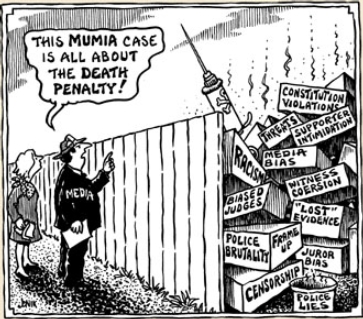
Hier geht es zur Homepage von "Journalist for Mumia"
Ihr findet dort immer wieder aktuelle englischsprachige Artikel zur aktuellen Situation.
Meeting Mumia and Getting to Know Him, Seeing Him Disappear in Hell for 25 Years, and the Hope for a New Trial
Interview with Linn Washington, Paris, place Denfert Rochereau, February 2, 2007
MS: Hi Linn, I have at least three questions here in that Café in beautiful Paris right at the place Denfert Rochereau. You were a speaker at the panel yesterday on Mumia Abu-Jamal at the 3rd World Congress Against the Death Penalty.
Yesterday, you told me you are working on a book that's putting together all the stuff you wrote on Mumia in the course of the last 25 years. But on the panel, you also said that you've known him for 34 years. That would be my first question: What can you tell me ; well obviously not everything in the space of three or four minutes, but all the same - what can you tell me about when exactly did you get to know him, Mumia, and what are some of the things you actually did together?
LW: I first met Mumia when I was a student at Temple University, and Mumia worked at the university's radio station, which is WRTI/FM. It was a very progressive, all-jazz station with a very progressive community format at the time. And as it turned out, we had several common interests like politics, black empowerment and utilizing the media to improve information to and information about black people.
MS: At the time, Mumia must have just come back from college in Vermont, right?
LW: Yes, probably so. This would have been 1972, '73; I was a DJ, I was a jazz DJ on WRTI, and I was also doing some news casts at the station.
MS: Are you still doing this from time to time?
LW: No, not DJ-ing, but I'm still with jazz, I still love it.
As for Mumia, he was doing a community talk show program. But it was primarily news-based - things were different then; people were more news-orientated in terms of their radio presentations. Now, most talk radio is just chit-chat, yelling and shouting at each other, but back then it was more substantive. So that's how I met him.
At first, he was very quiet, kind of withdrawn, and the distinction with regard to that is that everybody else at WRTI, all the other on-air personalities, were very flamboyant. They were self-promoting type of people. Mumia was a very stark contrast to that: quiet, very humble, and very progressive. So it wasn't like he was trying to build himself up as a personality like most of the other on-air personnel.
MS: What do you mean by progressive?
LW: What I mean by progressive is that he had a political orientation; he cared about the community, he was into Black Power in a real sense, not just the rhetorical one; because Black Power was the tenor of the times among most young blacks although some were more sincere than others in their commitment to Black Power. We started talking just being friends, it wasn't that all of a sudden or automatically that we were instant buddies, but we just started slowly to develop a friendship.
He continued with what he was doing at the WRTI and then he started going to other stations, I was seeing him from time to time, and it was pretty much a hi-and-bye sort of situation because at that point I would say we were pretty much professional acquaintances.
Around '76, '77, at this point I'm reporting for the Philadelphia Tribune, I'm a bona fide newspaper reporter and photojournalist, and Mumia is now a bona fide radio reporter. So we would begin seeing each other on news assignments and one of the vulgarities about news reporting is that there is a lot of down time. You go to cover an event, it's supposed to start at nine o'clock but it really doesn't start until ten, so, as a consequence of that, we ended up talking a lot, and that's when our personal friendship began to develop.
So that's how I met him. And watching him work, I got a tremendous appreciation for his professionalism and his attentiveness to the craft; because I started in the news business from many different sides, from photo journalism, from radio, from audio, and my college training was video, television directing specifically. I kind of had an affinity for what other people did, and I looked at what they did, so from that vantage, one of the things that really impressed me about Mumia was the fact that he was really into sound.
I often give the following example, which would probably have been in 1977 or 1978. I saw him at the scene of a police brutality incident. The police came and shot and killed some guy, who actually was breaking up a fight. This is showing the type of racism that was going on. This guy was a Black Muslim; he was a street vendor outside of a bar, there was a fight, he interceded; this vendor and his Muslim partner broke up the fight, and when the police came and responded to the fight, the fight was over, but they saw these Black Muslims, and they started hassling them. And of course they were not going to back down, they didn't do anything wrong, and this guy ended up getting murdered by the police, shot in the stomach while his hands were cuffed behind his back! Police claimed the guy, Winston Hood, tried to grab a cops gun but his hands were cuffed and witnesses said he was not resisting.
And of course, typical of Philadelphia, nobody was ever indicted or prosecuted. In fact, the guy who was with Hood was actually arrested and charged with attacking the police and ended up staying in jail for two weeks before he was released. But while in the aftermath of this I came to the scene, to do a follow-up story, Mumia was there, and I saw him with his microphone just pointing up in the air, even though he had already finished his interviewing work. I walked up to him and I said, Hey, man, what are you doing? I mean, there is nobody here you're interviewing; why do you have your microphone on? He said, Listen man, I'm just trying to get some sound. I need to have the sound of the scene. You know, you could write about it, you can take pictures of it, but I have to have sound! I just said to myself, man, this guy is really into it!
So that's how I knew him, and then '76 became '77, '77 became '78, '78 became '79, and at that point, we were really close, we were friends; we would see each other a lot and we had very extensive conversations about politics and life and women and, you know, certain other things we liked to do together. And one of the things, and I have to make this distinction now in my response to this question: a lot is said about Mumia being a Black Panther, and of course at his trial that was bootstrapped to make a motive for killing the officer.
MS: Yes, it was highlighted by prosecutor McGill.
LW: Mumia and I had extensive conversations over a five-year period and he never once, never once, mentioned his membership in the Black Panther Party. And we were talking about topics where that would have been germane, and his BPP membership didn't even enter into the conversations in a substantive sort of way. He wasn't boasting about his membership or even pushing the historic importance of the Party.
Now in the aftermath after his arrest, there were all these articles about he was a Black Panther and how he cultivated that philosophy and ideology and everything, and those news accounts weren't accurate to the Mumia I knew.
MS: Did you and did he cover the big MOVE trial?
LW: He covered the MOVE trial. And by that time, he was pretty much enamored with MOVE, very close to them, and he had really crossed the line from just being a traditional journalist, traditional in the sense of arms-length reporting.
MS: Is it true that he sold the organizations newspaper?
LW: Let me put it like this: I never saw him do it, but I wouldn't doubt it. MOVE had a column in the Philadelphia Tribune for a number of years, but then the column was canceled.
So that's when they started to produce their own publication. It was quite similar to the publications that you see now being handed out by the International Concerned Family and Friends of Mumia Abu-Jamal. So, yeah, I could imagine him passing that out, while covering the trial.
But an important part of his coverage of the trial is that he saw the injustices committed there. If you think his trial was a farce, that trial was a farce with a bucket full of absurdities added. So that had a really profound effect on him. But even more profound in terms of the starkness of the injustice was the trial for the police officers who were caught on news film beating Delbert Africa, after the August 8, 1978 shootout, and that was a trial that took place in 1981, where they brought a special jury from outside the city to ensure fairness to these officers. And after the defense presented its case, after the prosecution presented its case
MS: A jury from the super-suburbs, but finally, it was the judge who took the decision, wasn't it?
LW: Yes, the judge filed a 'Not Guilty,' and he issued what was called a directed verdict of acquittal, and that's a mechanism in the law where the defense attorney can say, listen, the prosecution has not made its case, it has not proven that my client is guilty. The judge then has the power to say yes or no. Here, the judge issued a directed verdict of acquittal that caught both prosecution and defense by surprise, since usually a directed verdict of acquittal follows a request from the defense ' what made this one highly unusual is that the defense didn't ask for it, and of course the prosecution didn't ask for it! Rarely does a judge inject themselves that way into a trial.
MS: It was just like the judge was somehow struck by lightning from heaven.
LW: In that connection it is certainly nice to know that that particular judge was a political ally of the now ex-mayor of the Philadelphia, Frank Rizzo. So when Rizzo was elected in the early seventies, a lot of people ran on his ticket. Because he was so popular, anybody who ran with him at the time was all but guaranteed his election. I think that's how Sabo got into his judgeship! So here we actually have somebody who like ' Sabo was not bright, OK. Mumia writes that he was crafty, but he wasn't intellectually brilliant. That was not his reputation in the legal community. Judges are supposed to be smart' well, they're supposed to be well versed in the law and I say: supposed to be...
MS: He was just a bully.
LW: He was a bully and he was a dummy. And that's one of the things that I think were really unusual about his opinion that was issued right after Mumia's 1995 appeals hearing. After an appeals hearing that stretched out for weeks, he issued a hundred-and-fifty-three-page opinion within four days. So what he did in fact was take what the D.A. offered: The prosecution says we think the opinion should go this way, and the defense says, we think the opinion should go this way
MS: Had he had it in a computer, he would just have copied and pasted it...
LW: Well, in effect that's what it was. It was copied and pasted from the prosecutions submission and Sabo's copying of the prosecutions version even included substantive factual errors, some of which the Pennsylvania Supreme Court had to correct in footnotes in their 1998 opinion.
So the judge in the Delbert Africa beating trial was an ally of Rizzo. From there, it was not surprising that he would well, it's not surprising that he would acquit them, because that was just the modus operandi at the time the M.O. was to do all that was necessary to keep brutal police out of jail for their crimes.
MS: Let's now hop on to the post-1981 period. What were some of your earlier articles on the whole case? Of course you were also at the scene a couple of hours after the incident.
LW: Well, it is accurate for me to say that I covered the Mumia case from the day of his arrest. But I really didn't start writing a lot about the case until the early nineties. Now, when this incident happened I was covering City Council for the Philadelphia Daily News. I was assigned to the Daily News City Hall bureau.
MS: Did you cover the trial?
LW: No, I didn't cover the trial, for two reasons. Number one, I was assigned to cover City Council, so that was my beat, I wasn't covering courts. Two, from an ethical perspective, because I knew him, it would not have been ethically appropriate to cover the trial. And, number three, I wasn't a favorite in the news room, so the big stories got assigned to the favorite reporters. And number four, not quite mitigating number three, was the fact that I was the head of the black employees organization at the paper, and so, from '82 to about '86, I was pushed further and further and further to the periphery of the news room, as retaliation for my role in urging management to hire more minorities and give better coverage to the minority communities. So I didn't have the opportunity to write.
MS: So you were kind of a union guy?
LW: Not really a union guy; I was a member of the union, and I participated in union activities, but we, the few black employees, and the one Puerto Rican that was there, we had our own group, and we ended up fighting not only management but the union, because the union was racist. So I got the double wham.
MS: You mean that was in the sense of a pressure group for certain minorities.
LW: Not only certain ones. Our group was called the Third World Caucus; we were going to call it the Black Caucus, but the one Hispanic guy said, listen, I'd go along with this, but I'm Puerto Rican, and I'm proud of it, so I can't go with 'Black' I wouldn't mind being black, but I'm Puerto Rican. This guy is Juan Gonzales.
MS: who is now with Democracy Now!, so you had wonderful company! What papers were you writing for at the time, in the eighties?
LW: In the eighties, I was writing for the Philadelphia Daily News; I worked for the Philadelphia Daily News from '79 to '89. I also did freelance writing for other publications around the country.
MS: Do you see a change in the outlook of the Daily News from the time back then to today?
LW: No, the paper has made moves, has made changes, but in terms of the substance of the coverage, it was more style than substance, it never was the 'paper of record,' meaning that there are some papers that have a higher rated perception. You know, the Inquirer is perceived as the 'paper of record.' That's the official paper for Philadelphia. And the Daily News is just that crazy paper that's out there, and it's still that crazy paper that's out there.
MS: Does that also mean that the Daily News from time to time is more open than the 'Inky'?
LW: Well, it is more open, and it has a more liberal bent, in a conservative way. If we could put it on a political spectrum, the Daily News is about 25 degrees left of center, whereas the Inquirer varies from 5 to 2 degrees left of center to 30 degrees to the right. The Daily News, though, despite it being a recurring target of charges of racism, and despite my personal problems for about a two-to-four-year period with the Daily News management they were always open and receptive to all of the enterprising and suggestions I came to them with. I was one of the most productive reporters in the paper. On average, I was in the paper five days out of their six-day publishing schedule, and 95 percent of the stories that I had in the paper were stories that I brought to them.
You know, because I wasn't a favored guy, I never got assigned to do a lot of stuff. I thus had to come up with my own things. But that's what I do! So not being given 'assignments' by editors was really no big deal. So the only coverage that I was actually involved in for the Daily News regarding the Mumia case was the articles in the first two days after his arrest, and after that, I dropped out. I monitored it and followed everything, and as things went on, I just became that consumed with the case. So I was reading all the legal pleadings, you know, from the defense and the prosecution, and was aware of this all.
After I came back from law school and I had a deeper understanding of the law, then I started writing more about the case, primarily from a legal perspective.
MS: That was in the early nineties then?
LW: I was in law school from '88 to '89, so from '89 on out, that's when I really started writing about the Mumia case, both under my byline, Linn Washington, and other pen names, because at one point, I was writing about the Mumia case, when I was working for the Chief Justice of the Pennsylvania Supreme Court! So of course I couldn't say, Linn Washington! So I had a lot of pen names, like Cindy Smith -
MS: Like Mumia had.
LW: Yes, he had his air names and once when I was visiting Mumia and we were talking, right when we were breaking up, he looked over at me and said: 'Hey, say hi to Cindy for me! And we both started chuckling! Well, he's smart, and he knows my style of writing, and he knows that I'm the only one who would know the type of minutiae about his case Mumia would apply the law to.
MS: When I write to him, I should say, hello William Wellington Cole.
LW: Well, do that, and tell him again about Cindy Smith.
MS: And my third question now would be, now you're investigating what happened in 1981 with the murder of other police officers. The treatment, as you told me yesterday, is quite differential from what happened with Mumia, both in terms of the media and in terms of the courts.
LW: In preparing to come to Paris and deliver remarks, and especially write a more academic examination, I started some more investigation, and I discovered that three police officers were shot and killed in 1981. The thing that I find very intriguing is the media treatment of it.
The second of the two police officers other than Faulkner that were shot and killed - one was on duty, one was off duty, the off duty shooting, was a horrific murder where the police officer was shot and killed by a drug dealer who was intent on stealing his car. The first police officer that was killed was a sniper attack. Both of those police officers were black. Both of the suspected assailants in these incidents were black. The news coverage on these incidents lasted one day. One day. There were two arrests in those killings but there wasn't extensive news coverage like when a white officer is slain.
MS: What was the background to the sniper attack?
LW: The police officer was patrolling a housing project. This officer and his partner had just spent time taking care of a domestic incident, a husband and wife argument, they're sitting in their patrol car, a bullet comes into the patrol car, blows the police officer's head off. Two days later, they arrest an eighteen-year-old, who lived in the housing project. According to the news accounts, he confessed, they put him on trial the following a year, but a jury acquits him!
So this notion that police and prosecutors and public officials in Philadelphia always propagate that evidence of guilt is overwhelming, that the crime is an open and shut case, you know, we have a confession so its open and shut, well there are problems with that!
So the sniper shooting led to an acquittal, and no one else was ever arrested. And I don't think there was any further investigation. The FOP, the police union, doesn't jump up and down about it or anything, they do have this man's picture on their website but there isn't and there wasn't a big public ruckus to find this officer's killer.
MS: I go to this web site from time to time, but I never heard about the case...
LW: By now, the have a listing of all the police officers that were shot in the line of duty, including police officers that were killed in car accidents while on duty.
MS: Yes, but these two cases must have been added quite recently, because I know the website on all the fallen officers and all that.
LW: But the one who was killed in the sniper attack is on the website. And they probably put it up just before you looked it up, so you didn't see it, they probably just put it up. The police officer who was murdered by the drug dealer is not on the website, because his murder was officially considered off duty. That particular person was arrested, tried, convicted but sentenced to life in prison!
Now, the legal distinction here is that this drug dealer planned to kill this police officer for at least a week, including contacting confederates, trying to elicit support of his confederates, his friends, to get him a gun, and then also to help him pull off the murder, and one of them actually was involved in helping him to dispose of the body! So if there was ever a clear case of premeditation, which should justify a conviction of murder in the 1st degree, but even more importantly, the death penalty, because of the heinousness of the crime, it would have been that.
In Mumia's case, even in the worst case scenario, where we would say, he did it, it was an act, a spontaneous act, not premeditated, and one that could be possibly mitigated by the fact that he saw his brother being beaten. Now, when people make that argument, the counter-argument from the police and the prosecutors is that he was only beating him with his flashlight, so how did that justify Mumia's shooting him?
The context is the core the context of the times and the levels of police brutality historically in Philadelphia.
We have Philadelphia where two years before the shooting of Faulkner, the federal government came in and sued all these top city officials, 21 top city officials including the mayor, for aiding and abetting police brutality. In the 1970s, Philadelphia police shot and killed more citizens than the police in New York City, and New York City was six times larger than Philadelphia in terms of population at the time.
Ironically, two weeks ago, what was the front page article on the Sunday Philadelphia Inquirer: Philadelphia police shoot and kill more people than police in New York City.
MS: So some things never seem to change.
LW: Some things never change, or patterns just keep recurring.
MS: So keep me posted about the book since I might try to find some German publisher.
LW: Once I'm back home, I'm going to start working on it; I'll send you a proposal!
Interviewer: Michael Schiffmann
A Life Still in the Balance: Amnesty International, the Fight Against the Death Penalty, and the Case of Mumia Abu-Jamal
Interview with Piers Bannister, Paris, Opera Bastille, February 3, 2007
MS: This is for a brochure we are going to make about the World Congress, which should appear soon.
I'm talking to Piers Bannister from Amnesty International, and maybe, Piers, you just introduce yourself in terms of what you've been doing for Amnesty, and what you are doing now.
PB: My role in Amnesty is and has been to provide a global overview of the death penalty, and thus I have a little knowledge about a lot of countries. But I also have knowledge about global trends in executions and knowledge of various legal systems, as well as knowledge about the United Nations and various other human rights apparatuses, and Amnesty's campaign against the death penalty.
MS: Well, I understand that the day before yesterday, you also gave a summary of what's transpiring at the World Congress Against the Death Penalty. Could you give a short overview over what was the focus of these three days which are now ending with a demonstration in Paris against the death penalty?
PB: I think what we have achieved at the World Congress is to remind ourselves of several things: that the death penalty is a failure of justice; that it is administered in a discriminatory and unsatisfactory way; by that, I mean by grossly unfair trials, of which, sadly, there are many examples in the United States. We have also heard of others in Uganda, in Singapore etcetera, where the death penalty is also administered in violation of international standards regarding fair trials. We've reminded ourselves of the successes and the fact that many countries have abolished the death penalty and that many are on the verge of abolition.
And we've swapped information and unified our struggle, which I think is very important. Death penalty work can often be lonely in many countries; you can sometimes be a sole voice. Reminding ourselves that we are part and parcel of a global movement to see and end of capital punishment is an important message to send to the outside world and ourselves.
MS: Yes, and there is also something coming up at the United Nations, and I think in your speech you stressed the importance of that.
PB: We, the Italian government, and other governments are keen to see the United Nations General Assembly pass a resolution that says, we are calling for a moratorium on executions worldwide. If that is achieved, I thing it will be a major intermediate goal in achieving the end of capital punishment. It isn't the sole answer, but it will be a milestone, it will be a significant stepping stone in achieving our aims.
MS: And there is also a flip side, I understand: A defeat would be also a big defeat.
PB: A defeat would also set us back. There are many nations, Singapore, Indonesia, Egypt, who say that there is no world consensus on the death penalty: it's not a violation of international human rights standards, and it is acceptable for sovereign states to carry it out. If we loose at the United Nations, we embolden those that make those arguments, we give them confidence. So a loss is not a free loss; it will hurt our movement. We have to make sure we win it, we have to be strategic to make sure we do it at the right time.
MS: When will the decision at the United Nations be taken?
PB: Well, that's up to the member states. Here, it is important to remember that the abolitionist movement isn't a member of the United Nations. That body is controlled by the world's governments. And so we have only the influence of campaigning. It will be up to the Italians, the European Union, the African countries that are behind this initiative, to decide when it is brought forward.
MS: Yes, and of course the population in these states, respectively. Let's now talk about something you've been involved in as an author. You are the author of the February 2000 Amnesty report on Mumia Abu-Jamal, A Life in the Balance. Can you talk a bit about how it came that you wrote that report, and what did you do in the process of writing it?
PB: At that point I was responsible for Amnesty International's research on the death penalty in the United States, and I decided that Mumia Abu-Jamal's case was one of the key cases in the U.S. that was worthy of examination as an illustration of all that is wrong with the system.
I read the entire trial transcript, I read many of the briefs put in by the defense and the prosecution, and it's very important to listen to what the prosecution had to say. And then I did an analysis using international law about whether that trial was fair, and I found that it was fundamentally unfair and failed to meet international standards governing and pertaining to the administration of capital punishment.
MS: Yes. Why in particular do you think that trial was unfair?
PB: Well, the report is more than 30 pages long, and I can give you just some highlights. I think that one of the most shocking thinks, one of the things that spoke to me very soon in the trial about the bias of the judge, was the removal of Mumia Abu-Jamal from his right to legally represent himself. The judge said things such as that he was intimidating the jurors, that he was taking too long to question them. In the trial transcript, there is absolutely no evidence to support that. His language is polite, it is appropriate for a courtroom, he asks pertinent questions, there is no indication that it is taking too long, and no point where the judge is asking him to hurry up as far as I can remember.
So that was the first thing that showed me bias. I was shocked by his defense lawyer's, who was appointed to him, lack of ability to cross-examine adequately witnesses. He would get up, he would ask a few questions that I didn't really feel advanced the case of the defense, and then would sit down, and I was left wondering as I read the trial transcript what strategy did this lawyer have to save the client and prove the innocence of his client? There seemed to be nothing in place.
MS: There was also, I understand, a rift between the lawyer and his client, a rift that was basically generated by the court and the prosecution.
PB: I can't really speak to that because my memory has faded a bit. I did this eight years ago now, so detailed questions like this are hard for me to answer without looking at the report. For that you would have to turn to that report itself.
MS: So let me just wind up by asking you: Have you been following up the issue since February 2000, and can you comment on the present state of the case?
PB: Yes, it's one of the cases I invested my time in, and there are several key cases around the world, the case of the Grenada 17 and Abu-Jamal's case and several others that I continue to monitor, as is the case of the state of the death penalty in those countries. My understanding is that he now has the chance of getting an adequate hearing to examine the troubling issues in that case. Amnesty's position has always been crystal-clear: We believe that the original trial is so fundamentally flawed so as to be an inadequate fact-finding mechanism.
So we take no position on his guilt or innocence, but we can say that that original trial is not sufficient to establish his guilt. Therefore, the answer to that is a new trial. So we will continue calling for a new trial, and we hope that the judicial system of the United States grants him a new trial at its earliest possible convenience.
MS: There is a hearing for Mumia Abu-Jamal coming up now, and maybe the hearing will result in Abu-Jamal being given a new trial. Will Amnesty be monitoring the hearing, and will it be monitoring the trial?
PB: For both the hearing and trial, of course it will!
MS: Thanks a lot, Piers.
PB: You're welcome.
What Happened on December 9, 1981: A Timeline
A Preliminary (May 5, 2007) Analysis by Michael Schiffmann